题目内容

People always feel headache about academic writing.Jennifer Ahern-Dodson provides some suggestions with some students and teachers.She asks about their earlier writing experiences.Were they negative or positive?She advises that you are not alone if you have had problems with your writing.She says everyone struggles with writing.

“Writing is hard.All writers struggle at some point.And even if writing has come easily for you,at some point in your work as a student,that eventually you’re going to hit a roadblock.So it’s really important to take a moment to think about their past writing experiences.And when the writing was going well,what was happening?When the writing wasn’t going well,what was happening?”

She says most people’s negative writing experiences happened because a very specific formula is required for a paper including an exact length.”And so they primarily focus on,and worry about,what the final product has to look like,like how many pages for a research essay?Or if it is in the second or third language,you know,punctuation and grammar,like whether it gets communicated in the right language.

Another problem can arise when the need to do well on a paper is extremely important.“...like a timed essay exam,or a college application essay,or a research paper that is at the end of the semester,and it’s tied to the entire grade for the class.So worrying about what will happen if they don’t do well–get bad grades,don’t get into college–creates,of course,significant anxiety.And that can make it harder to get the writing done.”

Then she and the people she’s helping move to more positive projects.She says usually when writing comes easily,the writers feel they have something important to say.The teacher advises thinking about who your audience is,and what it is that you really want to say to them.

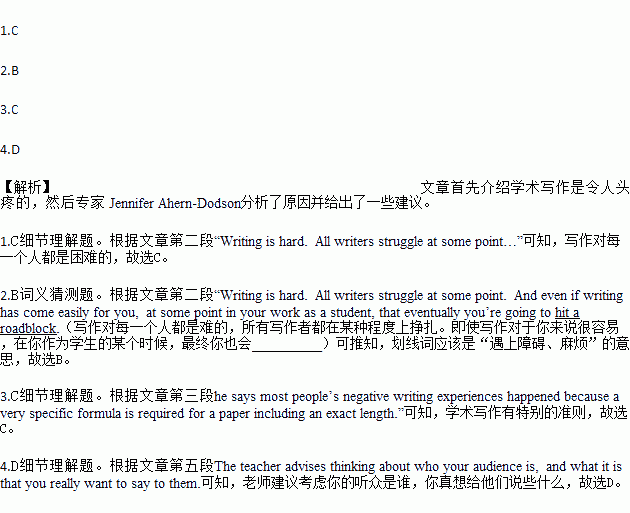
1.What does Jennifer Ahern-Dodson think of academic writing?

A. It is made up of past experiences. B. It has positive effects.

C. It is hard for everyone. D. It makes people think.

2.Which can best explain the underlined words“hit a roadblock”in Paragraph 2?

A. Have an accident. B. Meet into trouble.

C. Break some record. D. Graduate from school.

3.What can be the problem with academic writing?

A. Research subjects. B. Required styles.

C. A certain formula. D. Lack of patience.

4.According to Jennifer,how can we improve writing?

A. By stopping worrying. B. By thinking positively.

C. By focusing on the subject. D. By thinking about audience.
练习册系列答案
相关题目

Time spent in a bookshop can be most enjoyable, whether you are a book-lover or merely go there to buy a book as a present. You may even have entered the shop just to find shelter from a sudden shower.

Whatever the reason, you can soon become totally unaware of your surroundings. The desire to pick up a book with an attractive dust-jacket is irresistible but you might end up with a rather dull book. A book-lover rarely adopts this method of selection. All too often you soon become absorbed in some book or other, and usually it is only much later that you realize you have spent far too much time there and must dash off to keep some forgotten appointment — without buying a book, of course.

This opportunity to escape the realities of everyday life is, I think, the main attraction of a bookshop. There are not many places where it is possible to do this. A music shop is very much like a bookshop. You can wander round such places to your heart’s content. If it is a good shop, no assistant will approach you with the unavoidable greeting: “Can I help you, sir?” You needn’t buy anything you don’t want. In a bookshop an assistant should remain in the background until you have finished browsing. Then, and only then, are his services necessary. Of course, you may want to find out where a particular section is, but when he has led you there, the assistant should retire considerately and look as if he is not interested in selling a single book.

You have to be careful not to be attracted by the variety of books in a bookshop. It is very easy to enter the shop looking for a book on, say, ancient coins and to come out carrying a copy of the latest best-selling novel and perhaps a book about brass-rubbing — something which had only uncertainly interested you up till then. This volume on the subject, however, happened to be so well illustrated and the part of the text you read proved so interesting that you just had to buy it. This sort of thing can be very dangerous. Apart from running up a huge account, you can waste a great deal of time wandering from section to section.

1.What is most likely to happen to a book-lover in a bookshop?

A. Lost in some book, he forgets something else important.

B. Annoyed by the shop assistant, he dashes off for an appointment.

C. Attracted by its cover, he buys some book turning out to be a dull one.

D. Unsatisfied with its surroundings, he leaves the shop without buying a book.

2.In the author’s opinion, a shop assistant in a bookshop is supposed to ________.

A. greet customers in a more suitable manner

B. retire from the job if he has no passion for it

C. leave customers alone before services are needed

D. offer nice services from the very moment customers step into the shop

3.In a bookshop with a diversity of books, you tend to ________.

A. ignore the latest best-selling novel

B. be trapped in a dangerous situation

C. buy some book you are not at all interested in

D. buy other books instead of those you initially want

When people find out that I am a journalist, they often ask me: What do you think about the future of newspapers?

I tell them that I think the future of communications is moving online. People expect me to be fearful for the future of print. After all, in some people’s minds I wouldn’t be able to build a career in journalism if it all moves online. However, strangely enough, I’m actually comforted by the fact that online journalism is becoming usual. I am a blogger who has always been able to find a home for my writing online.

Since I began writing blogs, I have become aware of how many people you can reach with online writing. Compare this to the newspapers circulation base, and you will have a strong reason for online journalism.

In her successful blog post titled The Job I have spent the last year learning is not the one I will have, author Jenny Surane states, “Print is an expensive product to love. And general managers, publishers and editors must now figure out a profitable way to get their news into readers’ heads,” She goes on to state that people don’t feel like picking up a newspaper now and would rather scroll(滚屏) through their Twitter feed, and get new from many different sources.

If print is dying, then a new form of communicating information is being born. The need for information has not died. If anything, it has increased. What has died, rather, is the way in which information is presented.

Now more than ever, in this age of information, there is a desire for stories on the same topic from different points of view. The printing industry can keep pace with the need of providing a variety of sources, if it chooses to.

Now more than ever, in this age of information, there is a desire for stories on the same topic from different points of view. The printing industry can keep pace with the need of providing a variety of sources, if it chooses to.

Is the future of print grim? Maybe. But is the future of journalism of communicating information to people, grim as well? Definitely not.

1.According to Paragraph 2, the author feels ________.

A. confident about the future of his career

B. worried about the future of print

C. tired of being a newspaper journalist

D. embarrassed about online writing

2.What information is conveyed in Jenny’s blog post?

A. Twitter is not very popular.

B. It is hard to manage online journalism.

C. Print still has its own advantages.

D. People have more options to get information.

3.What does the underlined word “grim” in the last paragraph probably mean?

A. Promising B. Depressing

C. Unforgiving D. Encouraging

4.What is the author’s purpose in writing the text?

A. To explore the future of journalism.

B. To analyze the cause of print decline.

C. To explain the bright future of a journalist.

D. To introduce a successful blog post about print.

Maybe you often have arguments with your parents about clothes, homework, friends and many other personal things.1.Most teenagers must be sorry or even frightened when their parents fight. They might think their parents don't love each other any more and that it would result in divorce.

2.They might disagree about important things like jobs or major family decisions. They might even disagree about little things that don’t seem important at all—Like what’s for dinner or what time someone gets home. Maybe sometimes parents can feel so strongly about their differences that it may lead to arguments. However, these arguments are often over quickly.3.

As a family member, you should find out what it really means when your parents fight. When your parents get upset with each other, they might cry or say things they don’t really mean. Most people lose their cool now and then, so if your parents arc fighting, don’t worry too much about it.4.

If your parents' fight really bothers you, you might find it hard to sleep or go to school.5.They may not even realize how upset you are until you tell them how their arguments affect you. You can also tell other relatives, a teacher or a friend.

Just remember that no family is perfect and arguments are common in every family.

A. Try to find a good way to solve it.

B. Parents might fight over small things

C. You should never argue with your parents.

D. But what’s going on when your parents fight with each other?

E. In fact, it is normal for parents to disagree and argue from time to time.

F. If this happens, try talking to one or both of your parents about their behavior.

G. Parent may apologize and make up and the family gets back into its usual way.

Heaviest snow in half a century hit the south of the country. It snowed continuously for half a month, _______the railways, highways, and runways in the airfields. Ice wrapped and paralyzed(使瘫痪)the power and communication system. Many people were_______in railway stations, bus stations and airports, and_______in cars, buses and trains. Governments and people did everything they could to fight the snow_______, resulting in the good news that no one was killed from_______and hunger. Gradually, trapped people all went back home_______. While fighting the snow, people forgot their_______until a moving story of a swallow couple was widely_______on the Internet.

Being hungry and cold, the swallow couple tried to fly_______people's home to warm themselves, but every house was closed________. They jumped and flapped their wings to________the attention of the people inside the house, but failed. The wife’s body was________, she could not move any longer. The husband came near and wrapped his wife with his wings. He lost his________soon because of his opened wings. The couple died in the end.

The next morning, the housemaster went to the balcony to________his flowers because of concern and saw a________swallow outside the window pane. Touching it, he found that they were two________together. Moved to tears, he took them in, giving them some________, but in vain. He found a small cardboard box, laid them in and________them in the back garden.

In my hometown, in the countryside, a swallow family lives in the________of my house. I wonder if they will come back this spring________they did.

1.A. protecting B. maintaining C. blocking D. keeping

2.A. restricted B. stuck C. surrounded D. persuaded

3.A. even B. still C. yet D. nevertheless

4.A. disturbance B. occurrence C. incident D. disaster

5.A. cold B. disease C. poverty D. thirsty

6.A. merrily B. safely C. excitedly D. exhaustedly

7.A. family B. distant relatives C. parents D. animal friends

8.A. broadcast B. written C. spread D. identified

9.A. into B. through C. beyond D. across

10.A. tightly B. early C. secretly D. quickly

11.A. pay B. attract C. resist D. keep

12.A. injured B. lifted C. frozen D. broken

13.A. heat B. strength C. direction D. eyesight

14.A. water B. plant C. dig D. check

15.A. dead B. drunk C. lively D. lovely

16.A. touching B. embracing C. living D. lying

17.A. warmth B. food C. kindness D. fruit

18.A. left B. sheltered C. buried D. threw

19.A. roof B. basement C. window D. wall

20.A. when B. as C. unless D. if

违法和不良信息举报电话:027-86699610 举报邮箱:58377363@163.com

精英家教网