题目内容
完形填空
I've always had strong opinions of how love should be expressed, but others had their own ways of showing care.
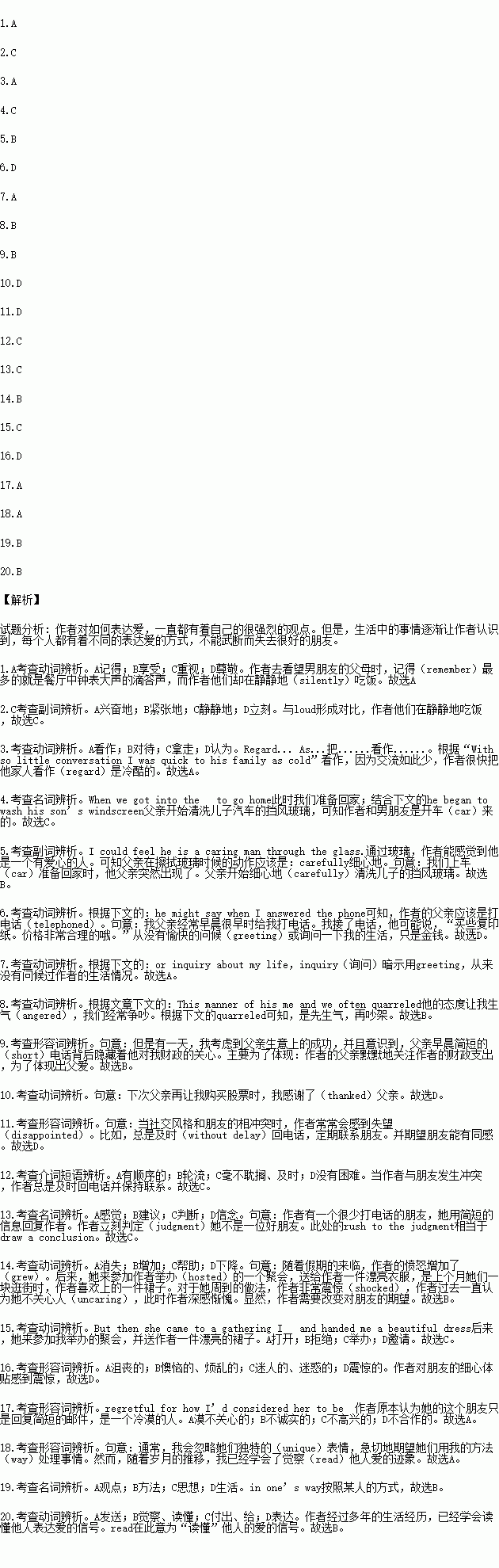
What I _________ most about visiting my boyfriend's parents is the loud tick of the clock in the dining room as we _________ ate our meal. With so little conversation I was quick to _________ his family as cold. When we got into the _________ to go home, his father suddenly appeared.
_________, he began to wash his son's windscreen. I could feel he was a caring man through the glass.
I learned another lesson about love a few years later. My father often _________me early in the morning. “Buy Xerox. It's a good sharp price,” he might say when I answered the phone. No pleasant _________ or inquiry about my life, just financial instructions. This manner of his _________ me and we often quarreled. But one day, I thought about my father's success in business and realized that his concern for my financial security lay behind his _________ morning calls. The next time he called and told me to buy a stock, I _________ him.
When my social style has conflicted with that of my friends, I've often felt _________ . For example, I always return phone calls _________ and regularly contact with my friends. I expect the same from them. I had one friend who rarely called, answering my messages with short e-mails. I rushed to the _________ : She wasn't a good friend! My anger _________ as the holidays approached. But then she came to a gathering I _________ and handed me a beautiful dress I had fallen in love with when we did some window-shopping the previous month. I was _________at her thoughtfulness, and regretful for how I'd considered her to be _________ . Clearly I needed to change my expectations of friends.
Far too often, I ignored their _________ expressions, eagerly expecting them to do things in my _________ . Over the years, however, I've learned to_________ other persons' love signs.
1.A. remember B. enjoy C. value D. admire
2.A. excitedly B. nervously C. silently D. instantly
3.A. regard B. treat C. take D. think
4.A. bus B. train C. car D. plane
5.A. Punctually B. Carefully C. Proudly D. Coldly
6.A. visited B. interrupted C. warned D. telephoned
7.A. greeting B. meeting C. apology D. explanation
8.A. interested B. angered C. encouraged D. surprised
9.A. long B. short C. warm D. polite
10.A. praised B. remembered C. blamed D. thanked
11.A. content B. guilty C. curious D. disappointed
12.A. in order B. in turn C. without delay D. without difficulty
13.A. feeling B. suggestion C. judgment D. belief
14.A. disappeared B. grew C. helped D. declined
15.A. opened B. refused C. hosted D. invited
16.A. depressed B. upset C. fascinated D. shocked
17.A. uncaring B. dishonest C. unhappy D. uncooperative
18.A. unique B. common C. pleasant D. familiar
19.A. opinion B. way C. mind D. life
20.A. send B. read C. give D. express





请认真阅读下列短文, 并根据所读内容在文章后表格中的空格里填入一个最恰当的单词。注意: 每个空格只填1个单词。请将答案写在答题纸上相应题号的横线上。
How Technology Can Help Language Learning
Intelligence, according to Howard Gardner, is of eight types—verbal-linguistic, logical-mathematical, musical-rhythmic, visual-spatial, bodily-kinesthetic, interpersonal, intrapersonal, and naturalistic. This is the first in a series of posts that explore and understand how each of the above forms of intelligence is affected by technology-mediated education.
Verbal-linguistic Intelligence involves sensitivity to spoken and written language, the ability to learn languages, and the capacity to use language to accomplish goals. Such intelligence is developed by three specific activities: reading, writing and interpersonal communication—both written and oral. The traditional tools that have been used to efficiently develop verbal/linguistic intelligence—textbook, pencil, and paper—are giving way to technology in many schools. E-books, Internet lesson plans, online assignments and word processing software, or a subset of the above, are now common in schools. Technology allows addition of multisensory (多种感觉的) elements that provide meaningful contexts to help comprehension, thus expanding the learning ground of language and linguistics.
Research into the effect of technology on the development of the language and literacy skills vis-à-vis reading activities of children has offered evidence for favorable effects of digital-form books. A study shows that digital reading materials have become common in developing countries in early childhood classrooms to support engagement in storybooks while enhancing the emergent literacy (早期读写能力) among children. E-books are also being increasingly used to teach reading among beginners and children with reading difficulties.
Technology can be used to improve reading ability in many ways. It can enhance (加强) and sustain the interest levels for children by allowing immediate feedback on performance and providing added practice when necessary. Recent research shows that students are able to improve their sight word vocabulary, fluency, and comprehension through computer-based reading.
Technology can also help in improvement of writing skills. Word processing software promotes not only composition but also editing and revising in ways that streamline the task of writing. Desktop publishing and web-based publishing allow the work to be taken beyond the classroom into a virtual world that allows more constructive interactions.
Technology enhanced oral communication is indeed useful in that it allows students from remote locations, or from all over the world to communicate orally through video and audio conferencing tools. For example, students of languages in Australian universities overcome the problem of insufficient contact with native language speakers by using online audio and video tools that allow the development of aural, vocal and visual-cognition skills that are important in verbal and linguistic education. Oral group discussions in the form of video conferencing can help non-native speakers of a language with natural language negotiation and cultural intonations in ways that have not been possible due to geographic isolation.
Computer definitely aided language learning and computer mediated communication enhance teaching and learning experiences in the areas of linguistics and language intelligence. Although there have not been comprehensive studies on the use of technologies to aid K-12 English-language learners, there have been many individual computer programs and other technologies that accelerate the acquisition of phonics, vocabulary, fluency, and reading-comprehension skills and other language building blocks.
Title: How Technology Can Help Language Learning
Paragraph outline | Detailed information |
Brief introduction to Verbal-linguistic Intelligence | ●Howard Gardner thinks that intelligence is of eight types, 1.________ from verbal-linguistic to naturalistic intelligence. ●Verbal-linguistic Intelligence, 2.________ of three aspects, is developed by three specific activities. ●Technology is 3._______ traditional tools used to develop verbal/linguistic intelligence efficiently. ●The learning ground of language and linguistics has been 4._______ by adding multisensory elements to language learning. |
Effects on language and literacy skills | Digital reading materials have been used to help children in developing countries get 5.________ in storybooks, enhancing the emergent literacy among them. |
Effects on reading ability | Technology can enhance and sustain children’s interest levels by providing immediate feedback and extra practice. |
Effects on writing skills | Technology allows our work to be taken in a virtual world with more constructive6.________. |
Effects on oral communication | Technology allows students to communicate orally through video and audio conferencing tools7.________ geographic isolation. |
Conclusion | ●There is no8.________ that technology enhances teaching and learning experiences concerning linguistics and language intelligence. ●Although there is a 9._______ of comprehensive studies on the use of technologies to aid K-12 English-language learners, there have been other technologies that10.________ the acquisition of language building blocks. |