题目内容
Iceland is a popular European tourist destination. Before you go there, it is good to learn some of the basic Iceland customs first.
Just like other countries in Europe, it is one of the customs in Iceland to shake hands and say “Hello”. Kissing each other’s cheeks is acceptable along with wishing each other a happy day.
Another custom is to take off your shoes in the hallway(走廊) when you enter someone’s home. Also, don’t be surprised if someone invites you to their house, since Icelanders love to have guests. Just make sure you take flowers or a similar token of thanks to give them.
If you have been invited to eat, keep in mind that you don’t need to express thanks before meals like the French or the Japanese. Rather, eat heartily and then thank your host afterwards by shaking his hand.
Keep in mind that believing in mysterious beings is part of the tradition in Iceland. Indeed, most of the unique and sometimes strange rock formations in Iceland are due to elves(小精灵), according to the people of Iceland.
Are you planning to spend Christmas in Iceland? If so, make sure you practice saying “Gleileg jol got tog fars!” first, which is the local Christmas greeting. It is part of the tradition in Iceland to have long Christmas holidays—26 days—longer than in any other European country. There are 13 Santa Clauses in Iceland, too!
There may not be a law requiring you to follow the customs, but there is no harm in doing so. Following them, you might be rewarded with a rich cultural experience and a more meaningful trip.
1. When you are invited to someone’s home in Iceland, you'd better do all of the following EXCEPT ______.
A. eating heartily and enjoying your time there
B. expressing your thanks to the host before you eat
C. taking some flowers or something else to the host
D. taking off shoes in the hallway before you enter the home
2.Which of the following is one of the differences in customs between Iceland and France?
A. Shaking hands when greeting.
B. A 26-day-long Christmas holiday.
C. Saying hello when meeting each other.
D. Kissing each other’s cheeks when greeting.
3.The text is mainly about ______.
A. what some of the customs in Iceland are like
B. why some of the customs in Iceland are special
C. how some of the customs in Iceland were formed
D. what some of the customs are like in Europe
4. In the text, the author aims to tell us that ______.
A. happiness is a form of courage
B. when in Rome, do as the Romans do
C. practice is the only path to knowledge
D. everyone has good and bad times in life
1.B
2.B
3.A
4.B
【解析】
试题分析:在本文中作者介绍了旅游胜地爱尔兰当地的一些习俗,比如去做客时要带上一束鲜花或者一件小纪念品以表示礼貌;在进房间之前要把鞋子脱在走廊内;不要在饭前对主人表示感激等等。作者认为如果了解了一些当地的风土人情,在爱尔兰的旅游才会更加有意义。
1.B细节理解题。根据文章第三段keep in mind that you don’t need to express thanks before meals like the French or the Japanese.可知在爱尔兰做客时不要在饭前对主人表示感激,所以答案选B。
2.B细节理解题。根据文章倒数第二段It is part of the tradition in Iceland to have long Christmas holidays—26 days—longer than in any other European country.可知爱尔兰的圣诞节比欧洲任何一个国家的圣诞节都要长,所以B选项正确。
3.A主旨大意题。作者在首段提出Before you go there, it is good to learn some of the basic Iceland customs first.然后在下文详细介绍了一些爱尔兰的风俗习惯,所以文章中心是介绍爱尔兰的风俗,故选A。4.B推理判断题。A幸福(快乐)是勇气的一种形式。B入乡随俗。C实践是通向知识的通道。D每个人的生活都会有顺境和逆境时。本文开头提出中心it is good to learn some of the basic Iceland customs first.,然后在文章末段用Following them, you might be rewarded with a rich cultural experience and a more meaningful trip.进一步呼应开头,由此可知作者想告诉我们的是入乡随俗才会使旅行充满更多乐趣,故B选项正确。
考点:考查社会生活类短文阅读。

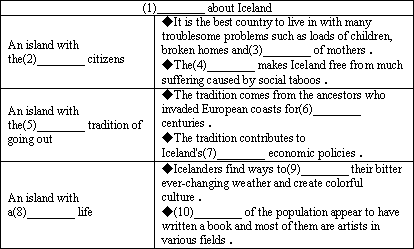
To American visitors, Iceland is a very interesting country, partly because it is different in so many ways from what he or she is used to seeing at home. There are quite a few things that are not done, or that do not exist on the island - quite a few "No's".
There is no pollution, for instance. No dogs are permitted in Reykjavik, the capital. There is no television on Thursdays or during the entire month of July, and only three hours of black-and-white TV the rest of the time. There is no hard liquor on Wednesdays and no beer at any time. There are no handguns; only one jail of thirty-five cells(牢房) in the entire land – an admirable figure, even for a small country of 313,376 people.
There is no army, air force or navy. There is no tipping for anything. There are no large stores open on Saturdays or Sundays. Since Iceland is situated just under the Arctic Circle, there is no darkness in summer and do daylight in winter. But thanks to Gulf Stream, the climate is rather mild, with temperatures ranging from 34 degrees Fahrenheit to 52 degrees in July.
The rules on television, liquor, and guns are the result of governmental decision. But the absence of pollution is due in great part to the fact that Iceland gets its power from the enormous geyser(间歇泉)and the thousands of hot springs that come out of the ground. They provide all the energy needed by the country. In fact, Iceland uses only 3 percent of all its available power.
Iceland has been described as a democratic (民主的) independent country where more fish are caught and more books published per person than anywhere else in the world. The Icelanders have always felt a particular love for literature. They composed their first works in the ninth and tenth centuries AD. These works were poems and tales about the kings, heroes, and heroines of Iceland and Norway. At first the stories were memorized and passed from generation to generation. The Icelanders have never stopped writing ever since. “Rather shoeless than bookless," they proudly say.
【小题1】American visitors enjoy visiting Iceland probably because .
| A.no dogs are permitted in the capital |
| B.the police do not carry handguns |
| C.it is very different from America |
| D.the climate is rather mild. |
| A.there are no soldiers in Iceland |
| B.the Icelanders don't drink beer |
| C.there is no service fee of any kind |
| D.there are no crimes in Iceland |
| A.Iceland uses only 3 percent of all its available power |
| B.the Icelanders use hot water from the ground below as their energy |
| C.it is located just under the Arctic Circle |
| D.it is a democratic independent country |
| A.they regard books more important than shoes. |
| B.they would rather have shoes on than write books |
| C.they prefer traveling to reading |
| D.they prefer not to have shoes or books |