题目内容

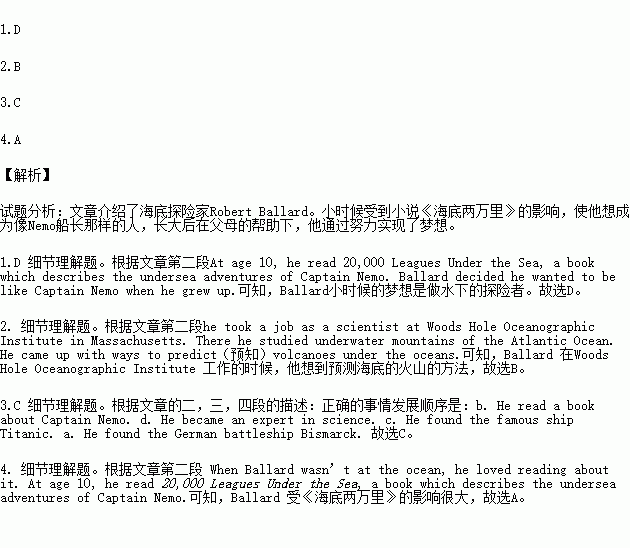
Robert Ballard was born in 1942. From an early age, he loved the sea. Ballard grew up in Southern California. He spent his free time at the beach near his home. He enjoyed fishing and swimming. He even learned to dive. When Ballard wasn’t at the ocean, he loved reading about it. At age 10, he read 20,000 Leagues Under the Sea, a book which describes the undersea adventures of Captain Nemo. Ballard decided he wanted to be like Captain Nemo when he grew up. His parents helped him follow his dream.

Ballard was a hard-working student. He spent many years learning all he could about the ocean. By the age of 28, he was an expert. In 1970, he took a job as a scientist at Woods Hole Oceanographic Institute in Massachusetts. There he studied underwater mountains of the Atlantic Ocean. He came up with ways to predict(预知) volcanoes under the oceans. Working with other scientists, Ballard also found previously (以前) unknown sea animals. These animals lived far below the ocean’s surface, where scientists had believed no animals could live.

By the 1980s, Ballard’s interests changed. He developed unmanned(无人的)vehicles to explore the ocean bottom. His first find, the well-known ship Titanic, made Ballard famous. He was not happy with just one big find, however. He looked for and found other well-known ships. One was the German battleship Bismarck. Another was the U.S.S. Yorktown, an aircraft carrier (航空母舰) that sank during World War II.

Today Robert Ballard is still an underwater explorer. He also heads an organization that encourages students to learn about science. Ballard hopes that some of the students will follow in his footsteps. After all, the world’s huge oceans are mostly unknown. Who knows what remains to be discovered under the sea?

1.What was Ballard’s dream when he was young?

A.To be a science teacher.

B.To be a famous writer.

C.To be an animal expert.

D.To be an underwater explorer.

2.When Ballard worked at Woods Hole Oceanographic Institute, he _____.

A.explored the undersea world by ship

B.thought of ideas to predict underwater volcanoes

C.found some unknown sea animals alone

D.set up an organization to teach students science

3.Which is the correct order of the events mentioned in the text about Ballard?

a. He found the German battleship Bismarck.

b. He read a book about Captain Nemo.

c. He found the famous ship Titanic.

d. He became an expert in science.

A.b-c-d-a B.d-b-c-a

C.b-d-c-a D.d-c-a-b

4.What can we learn from the text?

A. Ballard was greatly influenced by 20,000 Leagues Under the Sea.

B.Ballard didn’t like fishing and swimming in his childhood.

C.Ballard’s parents felt disappointed at his undersea adventures.

D.Human beings have explored more than half of the sea.
练习册系列答案
相关题目

阅读下面短文,从短文后各题所给的四个选项(A、B、C和D)中,选出可以填人空白处的最佳选项,并在答题卡上将该项涂黑。阅读下面短文,掌握其大意,然后从1--20各题所给的四个选项(A、B、C和D)中选出最佳的选项,并在答题纸上将该选项标号涂黑。

Some people are just born to be failures. That’s the way some adults look at _________ kids. Maybe you've heard the saying, “A bird with a _________ wing will never fly as high.” I'm sure that T. J. Ware was made to _________ this way almost every day. At high school, T. J. was the best-known troublemaker in his town. He was a silent boy, didn’t answer questions and often _________ .

I met T. J. for the first time at an activity aimed at getting students more involved in community charity. When I _________ , the community leaders _________ me that T.J. had the longest arrest(拘留) record in the history of town. Actually, I wasn’t the first to hear about T.J.’s darker side as the first words of _________ .

At the start of the activity, T. J. was just _________ outside the circle of students, against the back wall, with a(n) _________ look on his face. He didn’t readily join the discussion groups, and didn’t seem to have much to say. But gradually, the interactive games _________ him in. T. J. shared his great thoughts on _________ . The other students_________ his ideas and were impressed with his passion for helping those in need. _________ , they elected T. J. co-chairman of the group.

After the activity, T. J. started showing up at school and being active in class, which none of his teachers expected. More _________ , two weeks later, T. J. led a group of 70 students in a drive to collect _________. They collected a school _________ : 2,854 cans of food in just two hours, (the shortest time in the history of town) enough to take care of _________ families in the area for 75 days.

T. J. reminds us that a bird with a broken wing only needs _________. Once it has _________, it can fly higher than the rest. Now T. J. is _________ quite nicely as a chairman of a nationwide charity organization.

1.A. failed B. troublesome C. annoyed D. worried

2.A. single B. faulty C. burden D. broken

3.A. think B. walk C. feel D. struggle

4.A. fought B. drove C. challenged D. laughed

5.A. looked up B. stood up C. finished up D. turned up

6.A. warned B. suggested C. reminded D. reached

7.A. explanation B. communication C. introduction D. instruction

8.A. standing B. laughing C. hiding D. wandering

9.A. worried B. interested C. indifferent D. puzzled

10.A. allowed B. showed C. drew D. put

11.A. games B. concerns C. school D. charity

12.A. ignored B. welcomed C. doubted D. misunderstood

13.A. However B. Besides C. Anyway D. Therefore

14.A. importantly B. surprisingly C. luckily D. popularly

15.A. money B. rubbish C. cans D. food

16.A. restaurant B. record C. yard D. term

17.A. needy B. lonely C. friendly D. likely

18.A. persuading B. mending C. observing D. teaching

19.A. healed B. noticed C. appeared D. changed

20.A. behaving B. growing C. flying D. achieving

阅读理解。

Based on new analysis, we are rapidly approaching major climate change and the effects on society and the environment could be quite severe.Geographers predict that within the next eighty years, current world climate zones could shift and some could completely disappear.Polar regions will get colder while tropical regions will get even hotter,forcing animals to migrate(迁徙) north.

Climate changes like these could lead to the spread of diseases.Tropical storms and hurricanes will not only increase but may also become more intense.If the changes come too quickly, animal and plant species may not be able to adapt fast enough and could disappear.

According to Science Daily, a new study predicts that by the year 2100,many of today's familiar climates will be replaced by climates unknown in today's world.It is urgent that we reduce the risks of these far?reaching consequences for the whole world.The planet itself has been showing signs of change.In 2004, a serious tsunami created by a major earthquake killed thousands in Sumatra and in 2008, thousands died in China because of another severe earthquake.Egypt was hit in 2009 with a major earthquake and Haiti was devastated in 2010 by yet another massive earthquake.

Within just the last few months, new reports from around the world have been coming in and most agree that our climate situation is much worse than previously thought.At this point, it doesn't matter what is causing it, but rather, what can be done about it.What's more, our world is getting more and more unstable every year.There is war and threat of war everywhere.Natural disasters are becoming more frequent and serious.

However, other planets are experiencing global warming as well as our own and some scientists believe there may be some connection between this.No one knows anything for sure at this point because there is simply not enough data.

1.What is the major function of Paragraph 1?

A.To arouse the reader's concern.

B.To introduce the theme of the whole passage.

C.To summarize the whole passage.

D.To state how climate changes.

2.What is the author's purpose in using the examples of earthquakes?

A.To show major changes are taking place on the planet.

B.To remind people to prevent future earthquakes.

C.To show the damage earthquakes caused.

D.To tell us more earthquakes will happen in the future.

3.Which of the following is NOT true of climate changes' effects?

A.Animal and plant species may not be able to adapt fast enough and could disappear.

B.It could lead to the spread of diseases.

C.Current world climate zones could shift and completely disappear.

D.Natural disasters are becoming more frequent and serious.

4.What can be inferred from the passage?

A.Animals and plants won't die out as long as climate changes slowly.

B.There's enough data for us to predict the future of climate change.

C.The world is getting more unstable because of animal migration.

D.The earth is not the only planet that is experiencing climate change.

违法和不良信息举报电话:027-86699610 举报邮箱:58377363@163.com

精英家教网