题目内容
Do you love to cook? Are you feeling inspired by the movie Ratatouille or all the food-based reality TV shows on air today? If so, working as a chef may just be for you. However, before you rush out and sign up for cooking school, be aware that working as a chef isn't all very attractive. There's a long ladder to climb before you reach the rank of head chef at a top restaurant.
The first question that many future chefs have is whether or not they need to attend cooking school in order to become successful. The short answer is no – it is possible to develop your cooking skills on your own, or to work your way up the ladder from a position as a prep cook or line cook. However, if you are able to invest in a cooking school education, it's definitely a good idea. Cooking school will not only introduce you to other elements of a chef's career – like sanitation (卫生) and kitchen management – but will also help you develop connections that can help get your career off the ground.
Your first job as a chef will likely be at the bottom of the ladder. If you attended cooking school, you may find that you're able to start out as a prep cook in a nice restaurant, while chefs without this degree may find employment as short order or line cooks in smaller restaurants and diners. Expect to work hard in these positions – you'll put in long hours on your feet, carrying heavy pots and pans around a steaming kitchen. And don't expect to be paid much – chefs in these positions typically earn about $26,000-$32,000/year. However, it is in these positions that you'll have the chance to learn from more experienced chefs and to prove yourself ready for higher-level positions.
Competition for chef positions can be fierce, but if you've proven yourself to be talented and creative, you may be invited to fill a second chef or assistant chef position. You may also be able to use your experience to move from a smaller, unrenowned restaurant to a rated restaurant in the culinary capitols of the world. But don't expect that the work load will be reduced. If anything, these positions are more demanding that the entry-level positions, since you'll be responsible for more of the kitchen operations and for ensuring customer satisfaction. In addition, one common complaint of chefs working these positions is the hours – working popular meal shifts may leave little time for socializing outside of the restaurant.
With time and experience, you may eventually be able to earn the title of head chef at a well known restaurant or finally fulfill your dream of owning your own restaurant. It should go without saying that these opportunities are even more competitive and demanding than work at any other level of the chef hierarchy (层). You'll be expected to provide the creative vision for the restaurant, coming up with new and innovative dishes to please your patrons. In addition, you'll also be responsible for the overall management of your entire staff and all the kitchen operations. Because of all the stress involved in this career path, it isn't uncommon to see talented chefs leave the restaurant industry behind for calmer options, like catering or restaurant buffet management. However, most people in the industry will tell you that despite the utter chaos of their profession, there's nothing else they'd rather be doing.
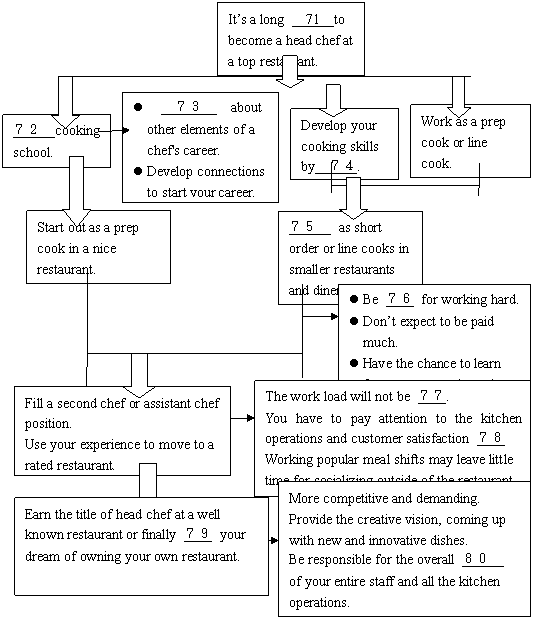
71. way 72. Attend 73. Learn 74. yourself 75. Employed
76. ready/prepared 77. reduced 78. more.79. more.80. management

 天天向上一本好卷系列答案
 小学生10分钟应用题系列答案
What is time? Is it a thing to be saved or spent or wasted, like money? Or is it something we have no control over, like the weather? Is time the same all over the world?
That's an easy question, you say. Wherever you go, a minute is 60 seconds, an hour is 60 minutes, a day is 24 hours, and so forth. But in America, time is more than that. Americans see time as a valuable resource. Maybe that's why they are fond of the expression, "Time is money."
Because Americans believe time is a limited resource, they try to conserve and manage it. People in the U.S. often attend seminars or read books on time management. It seems they all want to organize their time better. Professionals carry around pocket planners -- some in electronic form -- to keep track of appointments and deadlines. People do all they can to squeeze more time out of their time. The early American hero Benjamin Franklin expressed this view best: "Do you love life? Then do not waste time, for that is the stuff life is made of."
To Americans, punctuality is a way of showing respect for other people's time. Being more than 10 minutes late to an appointment usually calls for an apology and an explanation. People who are running late often call ahead to let others know of the delay. Of course, the less formal the situation is, the less important it is to be exactly on time. At informal get-togethers, for example, people often arrive as much as 30 minutes past the appointed time.
To outsiders, Americans seem tied to the clock. People in other cultures value relationships more than schedules. In these societies, people don't try to control time, but to experience it. Even Americans would admit that no one can master time. Time -- like money -- slips all too easily through our fingers. And time -- like the weather-- is very hard to predict. Nevertheless, time is one of life's most precious gifts. And unwrapping it is half the fun.
【小题1】What’s the main topic of this passage?
| A.What is time? |
| B.How to control time? |
| C.Make good use of time. |
| D.Time among Americans. |
| A.protect | B.develop | C.produce | D.assist |
| A.Americans often carry a clock with them. |
| B.Americans can not predict the time. |
| C.Americans can take control over time. |
| D.Americans often make full use of time. |
| A.Americans have more time than others. |
| B.by using pocket planners, people can have more time. |
| C.for informal meeting, Americans often arrive 30 minutes earlier. |
| D.Americans often attend seminars, because they want to use time better. |

--- Do you love teaching, Miss He?
--- I fell in love with teaching in 2000. I ________ for twelve years by this summer.
|
A.will teach |
B.would have taught |
C.has been teaching |
D.will have been teaching |