When we do not understand each other’s language, we can talk with the help of signs.
A Frenchman was once travelling in England.He could not speak English at all.One day he went into a restaurant and sat down at a table.When the waiter came, he opened his mouth, put his fingers in it and took them out again.He wanted to say,“Bring me something to eat.”
The waiter soon brought him a cup of tea.He moved his head from side to side.The waiter understood him and took the tea away.In a moment he came with a cup of coffee, but the man again refused it.He shook his head whenever the waiter brought him something to drink, for drinks are not food.
When the man was going away, another man came in.This man saw the waiter, and he put his hand on his stomach(胃).That was enough.In a few minutes there was a large plate of meat and vegetables on the table in front of him.
So, you see sometimes we can understand the language of signs as well as the language of words.
(1)
According to the passage, when people don’t understand each other’s language, they can talk with the help of ________.
[ ]
A.
a waiter
B.
a teacher
C.
an Englishman
D.
their hands, heads and other parts of their bodies
(2)
A Frenchman signed to the waiter ________.
[ ]
A.
to give him some medicine
B.
to bring him a cup of coffee
C.
to ask him for food
D.
to tell him what he said.
(3)
The waiter brought the Frenchman ________.
[ ]
A.
a cup of tea, a cup of coffee and a lot of other drinks
B.
a large plate of meat and vegetables
C.
a lot of drinks and a large plate of meat
D.
a lot of food and drinks
(4)
Another man saw the waiter and put his hands on his stomach.He means ________.
[ ]
A.
he had a fever
B.
he was hungry
C.
he was very thirsty
D.
he had enough
(5)
From the story, we know ________.
[ ]
A.
people can only understand the language of words
B.
people nearly know the language of signs as well as the language of words
C.
people can make a waiter understand what they want
D.
people can only understand their language
David Brenner came from a poor family.When he finished his school, he was given a wonderful present.“Some of my friends got new clothes and a few rich boys even got new cars.” he remembered, “My father reached into his trousers pocket and took something out, I held out my hand, and he let my present drop into it——a nickel!”
“Dad said to me.Buy a newspaper with that.Read every word of it.Then turn to the classified section and get yourself a job.Get into the world.It’s all yours now!”
“I always thought that was a great joke my father had played on me until a few years later when I was in the Army, sitting in a foxhole, and thinking about my family and my life.It was then that I came to know that my friends had got only new cars, or only new clothes.My father has given me the whole world.What a great present!”
(1)
What did David get as a present when he left school?
[ ]
A.
New clothes
B.
A new car.
C.
Something nice.
D.
A nickel.
(2)
David’s father asked him to read the newspaper to ________.
[ ]
A.
find interesting stories
B.
find himself a job
C.
know what happened in the world
D.
learn more things in it
(3)
Some years went by and David became a ________.
[ ]
A.
doctor
B.
teacher
C.
soldier
D.
driver
(4)
In the end David understood the present his father gave him was ________.
[ ]
A.
great
B.
unimportant
C.
beautiful
D.
useless
Jane’s mother was about seventy, and Jane and her husband wanted to give the old lady a nice present(gift)for her birthday.She liked taking tea, so Jane bought a small electric machine(电器).It could make tea and then wake you up in the morning.She brought it to her mother on her birthday, and showed her how to use it.
“Before you go to bed, put tea and water in it,” she explained to her mother, “and don’t forget to turn the electricity(电)on.When you wake up in the morning, your tea will be ready.”
After a few days, the old lady telephoned her daughter and said, “Jane, there is one thing I don’t understand.Why do I have to go to be bed to make tea?Can’t I have tea in the afternoon or in the evening?”
(1)
On her birthday Jane’s mother got a machine to ________.
[ ]
A.
make tea for her
B.
buy tea for her
C.
wake her up in the morning
D.
both A and C
(2)
________ how to use the machine.
[ ]
A.
Jane told her husband
B.
Jane told her mother
C.
Jane’s husband told her mother
D.
Jane’s mother knew
(3)
Jane’s mother told her she ________ the machine.
[ ]
A.
was not pleased with
B.
was not sure how to use
C.
loved
D.
didn’t know when to use
(4)
The machine can be used ________.
[ ]
A.
before going to bed
B.
only in the morning
C.
both in the afternoon and in the evening
D.
at any time
(5)
We need ________ to use an electric machine.
[ ]
A.
time
B.
a telephone
C.
electricity
D.
tea
阅读理解
Bill Gates was born on October 28, 1955.He grew up in Seattle, Washington.He was a very clever boy.His favorite subjects at school were science and math.When he was 13 years old, Bill started to play with computers.At that time, computers were very large.Once he was very interested in a very old computer.He and some of his friends spent lots of time doing things with it.In the end, they worked out a software program(软件程序)with the old computer.Bill sold it for $4,200 when he was only 17.
In 1973, Bill went to Harvard University.In his third year, he left Harvard to work for a company called Microsoft.Bill began his company in 1975 with his friend Paul Allen.They thought the computer would come into every office and every home soon.So they began developing(发展)the software for personal computers.They improved the software to make it easier for people to use computers.
(1)
Bill Gates grew up in ________.
[ ]
A.
Canada
B.
Australia
C.
America
D.
Germany
(2)
What subjects did Bill like best at school?________
[ ]
A.
Science and math.
B.
Language and art.
C.
Math and language.
D.
Music and P.E.
(3)
Bill’s company worked hard at ________.
[ ]
A.
making large computer
B.
playing computer games
C.
mending old computers
D.
developing software
(4)
Bill started to play with computers ________.
[ ]
A.
in 1955
B.
in 1968
C.
in 1973
D.
in 1975
(5)
The work “personal” means ________.
[ ]
A.
个人的
B.
公众的
C.
大型的
D.
昂贵的
In 1895, a man named Raymond Kroc found a partnership with two brothers named McDonald.They opened a popular restaurant in California.It sold food easy to prepare and serve quickly.Hamburgers, French fries, and cold drinks were the main food there.Kroc opened similar eating-places under the same name “McDonald”, and they won an immediate success in America and the world.
Why was his big idea so successful?Maybe the most important reason was that his timing was right.In the 1950s, most married women stayed home to keep house and take care of their children.In the 1960s, many women returned to the workplace.This meant that they had less time and energy to do housework and preparation for meals so they relied more on “TV dinners” and fast-food restaurants.Single parents also have little time to spend in the kitchen.People living alone also depended on this kind of food, since cooking for one is often more trouble than it is worth.
Fast food is not part of the diet of all Americans.Another trend of the 1960s, sometimes called the back-to-nature movement influenced many people to avoid food that was packaged or processed.This preference for nature food continues to this day.
From the success of Raymond Kroc’s fast-food business, we can say the social economic trends influence where and what we eat.
(1)
“Cooking for one is often more trouble than it is worth.” means ________.
[ ]
A.
cooking for several people is worth more money
B.
it is not necessary to take too much time to cook for one person
C.
there are more problems when one person cooks
D.
there are a lot of housework and preparations to do when one person cooks
(2)
An idea implied in the passage is that ________.
[ ]
A.
many married women began to work in the 1960s
B.
the social economic trends can’t influence where and what we eat
C.
fast food is not part of the diet of all Americans.
D.
divorce(离婚)causes people to change their eating habits
(3)
Americans had the back-to-nature movements ________
[ ]
A.
in 1955
B.
in 1950
C.
in 1960s
D.
both in 1950s and 1960s
(4)
Why was McDonald’s idea so successful?It was mainly because ________.
[ ]
A.
people living alone depend on fast-food
B.
single parents have little time to spend in the kitchen
C.
many women returned to the workplace in 1960s
D.
his timing was right
(5)
The main idea of the passage is that ________.
[ ]
A.
Raymond Kroc is the most successful fast-food business owner in the world
B.
social and economic changes affect eating habits
C.
fast-food is easy to prepare and serve quickly
D.
Americans eat either fast food or natural food
阅读理解:
Different countries and different people have different manners.We must find out their customs(习俗),so that they will not think us impolite(不礼貌).Here are some examples of thing that a person with good manners does or does not do.
If you wait a Chinese family you should knock at the door first.When the door opens you will not move before the host(主人)says “Come in, please.” After you enter the room you won’t sit down until the host asks you to take a seat.When a cup of tea is put up on a tea table before you or send to your hand, you will say “Thank you” and receive it with your two hands, or they will think you are not polite.Before entering the House in Japan it is good manners to take off your shoes.In European countries, if your shoes become very dirty, this is not done.In Malay(马来)house, a guest never finishes the food on the table.He leaves a little to show he had has enough.In England, guest always finishes a drink or the food to show that he has enjoyed it.This will make the host very pleased.
(1)
In China, before the host says “Come in, please,”________.
[ ]
A.
you won’t knock at the door
B.
you won’t run away
C.
you won’t enter the room
D.
you won’t sit down
(2)
In Japan it is good manners to ________ before you enter the host’s house.
[ ]
A.
take off your shoes
B.
take off your coat
C.
say “Thank you”
D.
wait outside
(3)
In Malay house a guest leaves a little food to show that ________.
[ ]
A.
he has enjoyed it
B.
he does not like the food
C.
he needs some drink
D.
he can’t have any more
(4)
In England the host will be pleased if his guest ________.
[ ]
A.
take off his dirty shoes
B.
leaves a little food on the table
C.
finishes the drink or food
D.
receive a cup of tea with his two hands
If you want to work more on writing, we suggest(建议)that you read throngh the passage below.That will help you learn how to improve your writing.
Choosing a Writing Topic(题目,话题)
Your teacher and your group members may help you choose a topic sometimes.We suggest that you try if possible to choose or make up a topic that is interesting to you because it will be easier for you to write about something you are interested in.
Getting Started
Once you have chosen a topic, you have to get started writing.Getting started is the hardest part of writing for most people.However, there are ways of making this job easier, and we would like to introduce you some of these techniques(技巧)at this time.
Brainstorming helps you get ideas for your writing.Here is how to do it.First, take a pen and piece of paper and write down your topic on it.Read your topic over a few times to yourself.Then let your mind go freely.And then write down any ideas that come to your mind.Now let’s suppose your topic is blue jeans.Please do as suggested.
blue jeans youth/young people clothing
freedom comfortable enjoyable
Listing is useful for exploring something where you are trying to look at two sides of a subject, the advantages(good points)and disadvantages(bad points)of something, reasons for doing and not doing something.
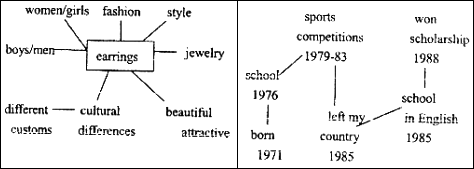
Another useful technique is mapping.You start by writing your topic in the center of your page in a box.And then as you brainstorm for ideas, you write your ideas around the topic.As you write one idea down, you may think of another idea related to(与……有关的)it, so you could write this second idea close to the first one.Mapping can be useful for helping you see relationship between ideas and also showing important events in relation to each other.Here are two examples of mapping.
Another way to get started and to explore your ideas on a topic is to do some free-writing at the beginning.You can do free-writing after or in place of brainstorming.You write for 10~15 minutes about your topic.You should write anything that comes into your mind.Keep on writing even if nothing comes into your mind.When you free-write, don’t think about grammar, spelling, or punctuation(标点).Just write!And don’t stop writing until your time is up.After you finish, read over what you have written.Draw a line under anything that seems interesting to you.You can free-write again beginning with the part you underlined.You can free-write several times.Each time you bring your ideas more and more closely to your topic.
(1)
There’re ________ writing techniques mentioned in the passage.
[ ]
A.
2
B.
3
C.
4
D.
5
(2)
When we write, which order should we follow?
a.map b.free-writing c.brainstorm d.choose a topic e.list f.get started
[ ]
A.
bce
B.
dce
C.
cea
D.
fcb
(3)
Which is NOT TRUE according to the passage?
[ ]
A.
We can find ideas not related to the topic on a map.
B.
We can try different ways when we are mapping.
C.
We learn listing is a very useful technique.
D.
We either brainstorm or free-writing when getting started.
(4)
What does the writer write the article for?
[ ]
A.
The writer wants to help us write our composition.
B.
The writer wants to show he is more knowledgeable than others.
C.
The writer wants to tell us the methods of writing.
D.
The writer wants to write a good article.
(5)
What does the underlined word “explore” mean in the passage?