The apple is more than just a fruit. People use it for city names and business logos, too.
“The Big Apple”stands for New York City.
The phrase was first used in a 1909 book called
“The Wayfarer in New York”It was used to show how rich New York is.Later, jazz musicians in the 1930s and 1940s made the phrase more popular. At that time, musicians earned money by playing in cities and towns across America.
They said each city in America was an apple on a tree. But New York city, where most fans of their music lived, was
“the big apple”. It was there they got the most pay.In the 1970s, the city wanted to make itself more popular with tourists. It started to use an apple as its symbol.
(象征)Apples are also hot in the computer world. Apple Computer, a big company in America, uses a picture of an apple with a bite taken out of it as its logo. Some say that the bite
(一口)means“learning knowledge”. Also,“bite”sounds similar to“byte(字节),”a unit(单位)in computer science.阅读短文,选择最佳答案.
(1) Which of the following is NOT true?.
[ ]
A
.The apple can be used for city names.B
.“The Wayfarer in New York”came out in 1909.C
.New York people like eating big apples.(2) What became more popular in the 1930s and 1940s.
[ ]
A
.The use of“Big Apple”as another name for New York.B
.The Wayfarer in New York.C
.Jazz musicians.(3) Musicians played in cities and towns across America for ________.
[ ]
|
A .books |
B .money |
C .computers |
(4) When did New York start to use an apple as its symbol?
[ ]
|
A .In the 1930s |
B .In the 1940s |
C .In the 1970s |
(5) The word
“hot”in the last paragraph(段落)means ________.[ ]
|
A .炎热的 |
B .畅销的 |
C .流行的 |
根据图示信息选择最佳答案.
The Grade 2 students at the Clean City School collect empty bottles. In June, they are going to take them to a recycling center. They are going to sell the bottles and buy some books for the school library.
Kate has started a graph
(图表)to show the number of the bottles they have collected. This is the graph.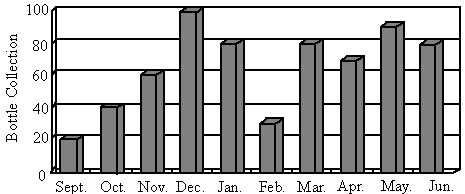
(1) In October the students collected ________ empty bottles.
[ ]
|
A .20 |
B .40 |
C .60 |
(2) The students collected ________ more bottles in December than in January.
[ ]
|
A .10 |
B .20 |
C .30 |
(3) From the graph above, we know that the students picked up the same number of bottles in ________ and ________.
[ ]
|
A .January;March |
B .September;April |
C .May;June |
(4) In which month did they collect the most bottles?
[ ]
|
A .May |
B .June |
C .December |
(5) Why do the students collect empty bottles? Because they ________.
[ ]
A
.want to do something for their schoolB
.like empty bottles very muchC
.want to sell them to buy balls根据表格所提供的信息选择最佳答案.

(1) You can enjoy the best burgers and fries in town at ________.
[ ]
|
A .SOUND HUT |
B .BURGER GIANT |
C .JO-JO'S DISCO |
(2) If you want to see Star Wars, you have to arrive there at ________.
[ ]
|
A .8∶30 |
B .10∶00 |
C .9∶00 |
(3) You can't go to SOUND HUT, because it's ________.
[ ]
|
A .rainy |
B .cloudy |
C .closed |
(4) How much will you spend, if you want to see both Catch a Train and Star Wars?
[ ]
|
A . 4.30 4.30 |
B .9 |
C .11.80 |
(5) How long will it take you to finish a return boat trip?
[ ]
|
A .4 hours |
B .45 minutes |
C .2 hours |
Learning the language of a country isn't enough. If you want to know the manners of your foreign friends, you will probably be surprised just how different they can be from your own.
A visitor to India should remember that people there are impolite
(不礼貌)to use the left hand for passing food at table. The left hand is used for washing yourself. Also in India, you might see a man shaking his head at another to show that he is disagreeing(不同意). But in many parts of India, a rotating(转动)movement of the head is to show agreement. In Bulgaria you shake your head to show“yes”, a nod to show“no”.In Europe it is quite usual to cross your legs while sitting and talking to someone, even at an important meeting. But doing this could cause offence
(反感)to a Thailander. Also touching the head of grown-up is just not done in Thailand.Knowing about manners is useful when you are traveling, but you need to know the language used to express for ritual
(礼节).(1) If you are staying in India, you'd better ________.
[ ]
A
.not use your left hand to pass food at a tableB
.use your left hand to pass food at a tableC
.not use your left hand impolitely(2) To shake your head means
“Yes”________.[ ]
|
A .in India |
B .in China |
C .in Bulgaria |
(3) You can easily make a Thailander angry by ________.
[ ]
A
.touching his headB
.crossing your legs while you are talking to himC
.shaking your head(4) The writer thinks that to know about a country well one must ________.
[ ]
A
.only know its languageB
.only know its mannersC
.know its manners and its language(5) You can infer
(推断)from the passage that ________.[ ]
A
.the manners in Thailand are the same as in ChinaB
.you should be careful not to cross your legs at an important meeting in EuropeC
.you should not touch a grown-up's head in India
阅读上面的信息,选择最佳答案.
(1) The Newton Theatre is in ________.
[ ]
|
A .Danby |
B .Lawrence |
C .Oxford |
(2) The Shanghai Festival Ballet
(芭蕾舞)will perform(表演)for_____ evenings.[ ]
|
A .three |
B .four |
C .five |
(3) You can see ________ on Tuesday, January 30th.
[ ]
|
A .Newton Theatre |
B .My Fat Friend |
C .Swan lake |
(4) Performances start at ________ on weekdays.
[ ]
|
A .8∶00 |
B .7∶30 |
C .5∶00 |
(5) You can get ________ at Newton Theater during the interval
(幕间休息).[ ]
|
A .bread and orange |
B .water and cake |
C .coffee and tea |
The Browns are the Smiths' neighbors. Mr. Brown's name is John. But when his neighbors talk about him, they call him Mr.
“Going-to-do”. Do you know why? Mr. Brown always says he is going to do something, but be never does it.Every Saturday Mr. Brown goes to the Smiths' back door and talks to Mr. Smith.
“I'm going to clean my house today,”he says, or “I'm going to wash my car tomorrow,”or“These trees in front of my house are too big. I'm going to cut them down next week.”But Mr. Smith knows his neighbor isn't going to do those things.
Mr. Smith often says to his only child Dick,
“Are you going to do something? Then do it. Don't become another Mr. Going-to-do.”阅读上面的信息,选择最佳答案.
(1) Mr. Brown and Mr. Smith are ________.
[ ]
|
A .brothers |
B .twins |
C .neighbors |
(2) Who is
“Mr. Going-to-do”?[ ]
|
A .Mrs. Brown |
B .Mr. Smit |
C .John |
(3) Why do people call John
“Mr. Going-to-do”?A
.Because he is always going to do something.B
.Because he often says the sentence but never does it.C
.Because he is always busy.(4) How often does Mr. Brown do the housework?
[ ]
|
A .Always |
B .Never |
C .Usually |
(5) Which of the following is RIGHT?
A
.Mr. Brown works harder than Mr. Smith.B
.It's easier for Mr. Brown to say than to do something.C
.Mr. Smith wants his son to learn from John.根据表格所提供的信息选择最佳答案.

(1) On which day will Han Mei have the fewest lessons?
[ ]
|
A .Monday |
B .Friday |
C .Tuesday |
(2) How many physics lessons will she have every week next term?
[ ]
|
A .One |
B .Two |
C .Three |
(3) when will she have her Chinese lesson on Monday?
[ ]
|
A .9∶50 |
B .8∶50 |
C .10∶45 |
(4) What is her last lesson on Thursday?
[ ]
|
A .Self-study |
B .Art |
C .Chemistry |
(5) what time will she have lunch every day?
[ ]
|
A .12∶10 |
B .12∶30 |
C .11∶30 |
Dick is six years old and begins to go to school this autumn. He studies hard and listens to his teachers carefully. He is polite
(有礼貌的)and has a few friends. So they like him.It's Saturday today. Dick, his sister Kate and his mother stay at home. His mother is doing some housework and he's watching TV and the girl is doing her homework. At ten, his father comes back with a bag of apples. The boy likes them very much and wants to eat some. His mother gives him four and says,
“Go to wash them in the kitchen.”Dick washes the apples and then gives them to his mother. The woman says,
“Which apple do you want, Dick?”“The biggest one, Mum.”
“What?”says his mother,“You should be polite and pick the little one.”
“Should I tell a lie just to be polite, Mum?”
(1) Dick is in ________ now.
[ ]
|
A .Class One |
B .Grade One |
C .Grade Two |
(2) ________, so his friends like him.
[ ]
A
.Dick begins to go to schoolB
.Dick studies hardC
.Dick is a good boy(3) Dick wants to eat some apples because ________.
[ ]
|
A .he is hungry |
B .he's young |
C .he likes them |
(4) Dick's mother tells him to wash the apples because ________.
[ ]
A
.he's freeB
.he wants the biggest oneC
.he likes to do the housework(5) Which of the following is right?
[ ]
A
.Dick doesn't want to be polite.B
.Dick wants to pick a little apple.C
.Dick wants to be honest(诚实的).阅读理解
In most parts of the world, many students help their schools make less pollution
(污染). They join“environment clubs(环境俱乐部)”. In an environment club, people work together to make our environment clean.Here are some things students often do.
·No-garbage(垃圾)lunches. How much do you thrown away after lunch? Environment clubs ask students to bring their lunches in bags that can be used again. Every week they will choose the classes that make the least garbage and report them to the whole school!
·No-car day. On a no-car day nobody comes to school in a car-not the students and not the teachers! Cars give pollution to our air, so remember:
Walk, jump, bike or run.
Use your legs! It's lots of fun!
·Turn off the water! Did you know that some toilets can waste(浪费)twenty to forty m3 of water an hour? In a year, that would fill a small river! In environment clubs, students mend those broken toilets.
We love our environment. Let's work together to make it clean.
(1) Environment clubs ask students ________ .
[ ]
|
A .to run to school every day |
B .to take exercise every day |
|
C .not to throw away lunch bags |
(2) From the passage we know the students usually have lunch ________ .
[ ]
|
A .at school |
B .in shops |
C .in clubs |
(3) On a no-car day, ________ will take a car to school.
[ ]
|
A .both students and teachers |
B .only students |
|
C .neither students nor teachers |
(4) After students mend toilets, they save ________.
[ ]
|
A .a small river |
B .a club |
C .A lot of water |
(5) The writer wrote the passage to ask students to ________ .
[ ]
|
A .clean schools |
B .make less pollution |
C .join clubs |
阅读理解
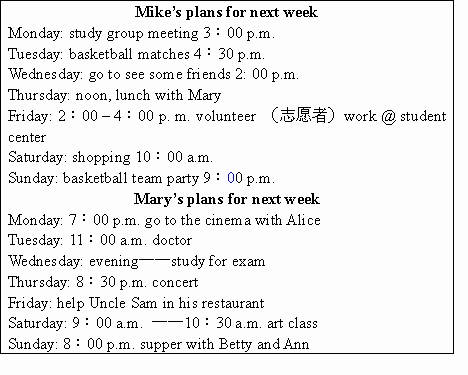
(1) Mike's study, group meeting will be on _______
[ ]
|
A .Sunday morning |
B .Monday afternoon |
C .Friday afternoon. |
(2) From Mike's plan we learn that Mike likes playing ________.
[ ]
|
A .table tennis |
B .music |
C .basketball |
(3) What Mil Mary do on Wednesday evening?
[ ]
|
A .Study for exam. |
B .See her friends. |
C .Play basketball |
(4) Who will Mike have lunch with on Thursday?
[ ]
|
A .His mother |
B .His aunt |
C .Mary |
(5) Mary will ________ at 8: 30 p.m. on Thursday.
[ ]
|
A .go to the concert |
B .Be free |
C .see the doctor |