When I was nine years old, I used to go to the post office with my mother, sending greeting cards to my aunt in Singapore. To me, these trips were really ______ memories. And receiving mail through a mailbox outside our gate was just as exciting. My small hands could ______ get the mail without using a key! Every time I always couldn’t wait to see how much I could ______. Oh, a letter! From Singapore! I would run back home and show it to my ______. When there was a letter for me, I wouldn’t run—I would open it right there.

After my family moved back to Singapore, I ______ going to the post office. Years later, my company sent me to Shanghai, and the post office found me again. Two years ago I celebrated my ______ with five friends on top of the mountain in Longsheng, China. At sunrise we ______ up to see a beautiful view from the mountain top. Later in the afternoon, as we were going ______ the mountain and returning from the sunrise viewing place, we saw a _____ shop nearby. It only sold noodles, coffee and had a China _____ sign.

We asked the owner if she could really send mail. She happily said yes. It seemed hard to believe, ______ we were on the highest top of the mountain. I picked one postcard out and asked my friends to write to ______ a birthday note. We bought a stamp, wrote some notes and gave the shop owner the postcard.

Three weeks later, I arrived home and _____ my mailbox: Hello, postcard! I had a big smile.

That birthday postcard attracted me again to the post office. I had ____ the post office all these years. Today I ______ send postcards to friends. And every time I am at the post office buying stamps, I always wonder how one postcard will make its way across the world and brighten up someone’s day.

1.A. bad B. poor C. good D. short

2.A. easily B. simply C. hardly D. specially

3.A. weigh B. get C. select D. accept

4.A. friend B. aunt C. mother D. owner

5.A. enjoyed B. stopped C. hated D. considered

6.A. wedding B. return C. success D. birthday

7.A. broke B. woke C. grew D. stood

8.A. around B. over C. up D. down

9.A. cold B. dirty C. small D. modern

10.A. Traffic B. Life C. Police D. Post

11.A. because B. though C. while D. when

12.A. him B. me C. her D. them

13.A. bought B. repaired C. painted D. opened

14.A. missed B. influenced C. studied D. attracted

15.A. just B. seldom C. still D. never

1.C 2.A 3.B 4.C 5.B 6.D 7.B 8.D 9.C 10.D 11.A 12.B 13.D 14.A 15.C 【解析】 1. 2. 3. 4. 5. 6. 7. 8. 9. 10. 11. 12. 13. ...

How could we tell time if there were no watches or clocks anywhere in the world? The sun was probably the world’s first “clock”, except in the far north, where the Eskimos(爱斯基摩人) live. There, it’s dark most of the winter, and light most of the summer. But in most of the world, people have used the sun for a clock. Even today, if you don’t have a clock, you still know that when the sun shines, it’s day, and when it’s dark, it’s night. The sun can also tell you if it’s morning, noon, or afternoon.

People who live near the sea can tell time from the tides. In the daytime, for about six hours, the water rises higher and higher on the beach. And then it goes down and down for about six hours. The same thing happens again at night. There are two high tides and two low tides every 24 hours.

Seamen on a ship learn how to tell time by looking at the moon and the stars. The whole sky is their clock.

In some places in the world the wind comes up at about the same time every day or changes direction or stops blowing. In these places the wind can be the clock.

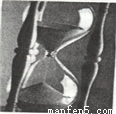
A sand clock is an even better clock. If you had fine dry sand in a glass

shaped like the one in the picture, you would have what is called an hourglass.

The sand in the hourglass goes from the top part to the bottom part in exactly

one hour. When the hourglass is turned over, the sand will take another hour

to go back again.

1.According to(根据) the passage, there are ____________ ways to tell time besides(除了)the clock and watch.

A. 3 B. 4 C. 5 D. 7

2.The Eskimos in the far north can’t use the sun for a clock because _______________.

A. they know very little about the sun

B. the sun there never goes down in winter

C. it’s too cold for them to go out to watch the sun

D. it has long dark winters and long light summers

3.The underlined(下划线) word “tides” in the passage means _______________.

A. 洋流 B. 潮汐 C. 海啸 D. 波浪

4.In which page of a newspaper can you most probably read this passage?

A. News B. Science C. Business D. Advertisement

5.What’s the best title for the passage?

A. Different Ways to Tell Time B. Useful Machines to Tell Time

C. The History of the Clock D. The Development of the Clock

1. C 2. D 3. B 4. B 5. A 【解析】 试题这篇短文主要介绍了没有手表和钟表,其他的方式也可以给人们指示时间。如太阳的转动,大海的潮汐,风的变化,以及沙漏等。 1. 2. 3. 4. 5.
 0  127939  127947  127953  127957  127963  127965  127969  127975  127977  127983  127989  127993  127995  127999  128005  128007  128013  128017  128019  128023  128025  128029  128031  128033  128034  128035  128037  128038  128039  128041  128043  128047  128049  128053  128055  128059  128065  128067  128073  128077  128079  128083  128089  128095  128097  128103  128107  128109  128115  128119  128125  128133  159627 

违法和不良信息举报电话:027-86699610 举报邮箱:58377363@163.com

精英家教网