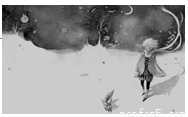
“Who are you?” asked the little prince (王子).

“I am a fox (狐狸),” said the fox.

“Come and play with me,” said the little prince. “I am so unhappy.”

“I cannot play with you,” the fox said. “I am not tamed.”

“I am looking for men,” said the little prince. “What does that mean—‘tame’?”

“To me, you are still nothing more than a little boy who is just like a hundred thousand other little boys. And I have no need of you. And you, on your part, have no need of me. To you, I am nothing more than a fox like a hundred thousand other foxes. But if you tame me, then we shall need each other. To me, you will be unique (独一无二的) in all the world. To you, I shall be unique in all the world...” said the fox.

“I am beginning to understand,” said the little prince. “There is a flower... I think that she has tamed me...”

“My life is very monotonous (单调的),” the fox said. “I hunt chickens; men hunt me. All the chickens are just alike, and all the men are just alike. And, in consequence, I am a little bored. But if you tame me, it will be as if the sun came to shine on my life. I shall know the sound of a step that will be different from all the others. Other steps send me hurrying back underneath the ground. Yours will call me, like music, out of my burrow (洞穴). And then look: you see the grain (谷物)-fields down there? I do not eat bread. Wheat is of no use to me. The wheat fields have nothing to say to me. And that is sad. But you have hair that is the colour of gold. Think it will be so wonderful when you have tamed me! The grain, which is also golden, will bring me back the thought of you. And I shall love to listen to the wind in the wheat...”

The fox gazed at the little prince, for a long time.

“Please—tame me!” he said.

“One only understands the things that one tames,” said the fox. “Men have no more time to understand anything. They buy things all ready made at the shops. But there is no shop anywhere where one can buy friendship, and so men have no friends any more. If you want a friend, tame me...”

“What must I do, to tame you?” asked the little prince.

“You must be very patient,” replied the fox. “First you will sit down at a little distance from me—like that—in the grass. I shall look at you out of the corner of my eye, and you will say nothing. Words are the source of misunderstandings. But you will sit a little closer to me, every day...”

The next day the little prince came back.

“It would have been better to come back at the same hour,” said the fox. “If, for example, you come at four o’clock in the afternoon, then at three o’clock I shall begin to be happy. I shall feel happier and happier as the hour advances. At four o’clock, I shall already be worrying and jumping about. I shall show you how happy I am! But if you come at just any time, I shall never know at what hour my heart is to be ready to greet you...”

1.At the moment he first saw the fox, the little prince was.

A. bored B. Afraid C. worried D. unhappy

2.According to the passage, the underlined word “tame” probably means.

A. to train somebody to obey you

B. to ask somebody to attack you

C. to keep somebody waiting for you

D. to prevent somebody needing you

3.What will probably bring the fox back the thought of the little prince?

A. Bread. B. Chickens. C. Grain. D. Wind.

4.The last four paragraphs are mainly about.

A. the ways the little prince tames the fox

B. the causes the little prince tames the fox

C. the purposes the little prince tames the fox

D. the best time the little prince tames the fox

5.What can we infer (推测) from the passage?

A. The fox wanted a friend.

B. The little prince was looking for the fox.

C. Men can buy friendship in the wheat fields.

D. It is good to meet the fox at different times of a day.

阅读下面短文,根据所读内容,在文章小题的空格里填入一个最恰当的单词,并将答案填写在答题卡的相应位置上。

注意:每个空格只填一个单词。

Many animal lovers would like to do more to help animals, but aren’t sure where to start or feel like they just don’t have the time. The good news is that there are many simple things you can do to help protect animals.

Think more before you decide

The decisions you make may go a long way toward stopping the killing of animals. Consider eating a vegetarian (素食者) diet. If you aren’t ready to make this change, there are still things you can do. Do not buy animal products from companies that have illegal (违法的) practices.

Help speak the word out

Speaking the word out about the problems faced by animals can be as easy as putting up a notice on your car. Also, talk to your friends and family members about important problems of animals. Give some simple advice to a friend with a new pet about the serious pet over-population problem we’re facing. Turn to some books on the subject if you are not so clear about the advice you give to your friend.

Write a letter

We’ve all heard the saying, “The pen is more powerful than the sword (宝剑)”. Put this idea to the protection of animals. If a company has practices or rules that are harmful to animals, write them a letter to let them know you are angry about them, and that you won’t buy their products until they make some changes. Write letters to state and local legislators (立法者) to let them know how important it is that they support legislation that protects animals. Make them know that their actions will have a great effect on your vote.

Be more loving

If you’re considering adding a dog or a cat to your family, think about getting one from a homeless-animal house rather than buying a pet. There are many wonderful animals just waiting for a home. By taking back an animal from there, you will be helping in the fight against pet over-population, as well as giving your money to those who look after poor animals.

Let your actions set an example

It may sound simple, but one of the best ways to help animals is to let your actions speak to the world. You should do the following things first by yourself: Treat all living animals respectfully. Care about your pets and look after them well. Avoid entertainment (娱乐) places that use animals to perform. Support laws that protect animals. All of these things set an example for others to follow.

Ways to protect 1.

Think carefully before you make a 2.

●Don’t eat meat.

3. to buy animal products from companies that have illegal practices.

Speak the word out

●Put up an animal-protection 4. on the car.

●Talk to your friends and family members and give advice.

●Get help from 5. if necessary.

Write letters

●Let those companies that are doing 6. to animals know about your anger.

●Let legislators know the 7. of their support for legislation that protects animals.

Be more loving

●Get a pet from a homeless-animal house instead of 8. a new one.

●Give money to the people who look after poor animals.

Set an example for others

●Treat all living animals with 9. and take good care of your pets.

●Avoid 10. to places where animals perform.

●Support laws which are good for animals.

San Francisco has its cable cars, and Longview has its squirrel bridge. The bridge, which has attracted lots of a 1. , is now a local landmark (地标). The Nutty Narrows Bridge was built in 1963 by a local builder, Amos Peters, to give squirrels a way to c 2.the busy road without getting hurt by passing cars.

The original bridge was built over Olympia Way on the west edge of the library grounds. Many times, Peters and others w 3.worked in and near Park Plaza often saw squirrels run over. One day Peters found a dead squirrel w 4.a nut (坚果) still in its mouth, and that day’s coffee break discussion turned into squirrel s 5. . The group of businessmen thought of the squirrel bridge idea later and they n 6.the bridge “Nutty Narrows”.

After architects (建筑师) designed the bridge, Amos Peters and Bill Hutch started construction. The 60-foot bridge c 7.1,000 dollars.

It didn’t take long before reports of squirrels using the bridge started. Squirrels were even seen guiding their young to cross the bridge. The s 8.was picked up by the media (媒体), and Nutty Narrows became known in newspapers. In 1983, after 20 years of use, Peters took down the worn-out bridge. Repairs were m 9.and crosspieces(横木) were replaced. The faded sign was repainted and in July 1983, h 10.of animal-lovers attended the completion ceremony (竣工仪式) of the new bridge. Peters died in 1984, and a ten-foot wooden squirrel sculpture was placed near the bridge in memory of its builder and his devotion to the project.

Tuesday, Jan. 6, 9:50 p.m.

We were sitting in our warm living room. The TV was on, and everything was peaceful. Suddenly the light went on and off for a few times and then went out completely. Then the rain started, and everything went black. We found the flashlight and some candles and went to bed.

Wednesday, Jan. 7, 7:30 a.m.

My first thought after waking up was that it was pretty cold in my bedroom. Clearly, the power (电力供应) didn’t come back. After I looked out of the window, I felt even sadder: it was still raining heavily. The room was becoming colder and colder. We had no idea when the power would come back, so my wife started a fire in the fireplace.

Thursday, Jan. 8, 12:30 p.m.

The snow started. The poor trees now had to carry the heavy snow. The storm seemed to last (持续) and we had nothing to do but stay at home.

Friday, Jan. 9, 6:00 p.m.

Still no power. Even though we lit (点燃) a few candles, it was still difficult to do anything in their weak light. I was sitting near several candles, but I had trouble reading.

Saturday, Jan. 10, 1:00 p.m.

The storm stopped this morning, and I drove my car to look for an open store. The trees along the roads were broken. I only bought the most necessary things: bread, some fruit, more drinking water and batteries (电池) for the flashlight. On my way home, the power came back and people were very happy.

1. How did the writer feel when he found it was still raining heavily?

A. Angry. B. Sad. C. Scared. D. Shocked.

2.Why did the writer say it was hard to do anything during the storm?

A. It was too cold in the room.

B. The flashlight had no batteries.

C. The light kept going on and off.

D. The light of candles was too weak.

3. What did the writer NOT buy when he drove out?

A. Newspapers. B. Water. C. Batteries. D. Food.

4.How long did the storm last?

A. Two days. B. Three days.

C. Less than two days. D. More than three days.

5.The material is probably from a _______.

A. guidebook B. diary

C. notice D. science magazine

Your mom tells you to put on your hat and gloves. But as the cold winter season gets closer, it’s so cold that even mom’s advice does not work.

That means it’s time to put on your qiuku! This is a kind of “thermal underwear(保暖内衣)” or long underpants that keep people warm in the coldest months of the year.

In Western countries, qiuku is usually known as long johns, but they aren’t popular. Long johns in the US are usually two pieces, a long-sleeved(长袖的) shirt and long pants, worn under other clothing or sometimes even used as pajamas(睡衣).

Long johns first appeared in England during the 17th century. We call them long johns because the US boxer John L. Sullivan wore them while he boxed. But this is not a historical fact.

In the US, it gets quite cold and snowy in many places. And while parents often push kids to wear more clothes and long underwear, it’s very special when young people actually(实际上) put them on.

Part of the reason might be because it’s not very fashionable(时尚的) and another reason might be because people don’t spend much time outside during the cold months. So they just deal with the freezing(冰冻的) temperatures when they have to leave the warm building. But in their parents’ eyes, staying warm is more important than looking nice.

1. People wear qiuku to be __________.

A. fashionable B. popular C. friendly D. Warm

2. What is part of long johns in the US?

A. Socks B. T-shirts C. Long pants D. Coats

3.Which one is TRUE according to the passage?

A. Long johns first appeared in the US in the 17th century.

B. Long johns got its name from the boxer John L. Sullivan.

C. We can read about long johns and Sullivan in history books.

D. Long johns in Western countries are as popular as qiuku in China.

4.What does the underlined sentence mean?

A. Few young people wear long johns.

B. Many young people wear long johns.

C. Young people like special long johns.

D. Young people dislike special long johns.

5.The last paragraph tells us that ___________.

A. young people care more about staying warm

B. young people think long johns are not fashionable

C. in winter people need to stay outside for a long time

D. long johns are fashionable but can’t keep people warm

 0  122947  122955  122961  122965  122971  122973  122977  122983  122985  122991  122997  123001  123003  123007  123013  123015  123021  123025  123027  123031  123033  123037  123039  123041  123042  123043  123045  123046  123047  123049  123051  123055  123057  123061  123063  123067  123073  123075  123081  123085  123087  123091  123097  123103  123105  123111  123115  123117  123123  123127  123133  123141  159627 

违法和不良信息举报电话:027-86699610 举报邮箱:58377363@163.com

精英家教网