19.A)阅读下面短文,根据所读内容,在文章后第56~65小题的空格里填入一个最恰当的单词,并将答案填写在答卷纸标号为56~65的相应位置上.注意:每个空格只填1个单词.
Do you ever get to the bottom of the page and realize you've got too little time or too little interest to spend another minute on the book?It happens to everybody sometimes.Luckily,there are many things you can do to make the reading a lot easier and faster.For example,if you read a paragraph,consider skimming over the whole story to get the main idea and the main characters,so you'll know what to pay attention to as you read more closely.Reading about the book on the Internet can be a good way to get a good conclusion of the reading to help you get through it more easily.Just don't forget to go back and read through more closely.
While reading,don't forget to look up any words or ideas you aren't sure about.You can use context (上下文) clues to help you understand things you think difficult,but it's always a good idea to take a minute to learn any reference (参考书).It'll make the reading much easier.
More importantly,be sure to learn to take notes while you are reading.You can write questions in the margin (页边空白),and underline things which you think are interesting and important ideas.If you're reading something difficult and find yourself often wanting to go back to get something you missed,then,at the end of each page,or even at the end of each paragraph,write something about what happened on that page.If you find something that needs answering,always write it down.This might give you a good question to ask later in class,or give you something to think more about as you continue reading.What's more,when you finish reading,start writing down what seems important,what you think the purpose of the writing is,and how it makes you feel as a reader.
After you finish reading,get together with your friends or classmates and discuss the reading.Try to know how your classmates understand the reading and compare it with your own.Try not to talk about whether or not it is"boring",but pay attention to how well your classmates explain what you might have found difficult.Think of open questions to explore the reading,and don't ask questions that can be answered with a"yes"or a"no".Learning to ask"how"is a helpful way of coming up with big discussion questions.
Do you ever get to the bottom of the page and realize you've got too little time or too little interest to spend another minute on the book?It happens to everybody sometimes.Luckily,there are many things you can do to make the reading a lot easier and faster.For example,if you read a paragraph,consider skimming over the whole story to get the main idea and the main characters,so you'll know what to pay attention to as you read more closely.Reading about the book on the Internet can be a good way to get a good conclusion of the reading to help you get through it more easily.Just don't forget to go back and read through more closely.
While reading,don't forget to look up any words or ideas you aren't sure about.You can use context (上下文) clues to help you understand things you think difficult,but it's always a good idea to take a minute to learn any reference (参考书).It'll make the reading much easier.
More importantly,be sure to learn to take notes while you are reading.You can write questions in the margin (页边空白),and underline things which you think are interesting and important ideas.If you're reading something difficult and find yourself often wanting to go back to get something you missed,then,at the end of each page,or even at the end of each paragraph,write something about what happened on that page.If you find something that needs answering,always write it down.This might give you a good question to ask later in class,or give you something to think more about as you continue reading.What's more,when you finish reading,start writing down what seems important,what you think the purpose of the writing is,and how it makes you feel as a reader.
After you finish reading,get together with your friends or classmates and discuss the reading.Try to know how your classmates understand the reading and compare it with your own.Try not to talk about whether or not it is"boring",but pay attention to how well your classmates explain what you might have found difficult.Think of open questions to explore the reading,and don't ask questions that can be answered with a"yes"or a"no".Learning to ask"how"is a helpful way of coming up with big discussion questions.
| How to understand what you read | |
| Skim before reading closely | ●Start with skimming or reading about the book (56)online to know what the book is mainly about. ●In this way,you know what you should pay (57)attentionto while reading it closely. |
| Look up any unsure words or ideas | ●Try to understand (58)difficultparts according to context clues. ●You can also read more (59)easilywith the help of references. |
| Take notes | ●Taking notes is of great(60)importancewhile you are reading. ●Write questions in the margin and underline something(61)interestingor important. ●Write down your (62)questionsabout what you read. ●After finishing reading,write down important ideas,the purpose of the writing and your (63)feelingsabout the reading. |
| Discuss the reading | ●(64)Compareyour understanding about the book with that of your classmates. ●Pay attention to others'good explanation of something difficult. ●Ask (65)openquestions instead of"yes or no"ones. |
 There was a famous church(教堂) in London.It was 110meters high.The center of the church was like a bell.The ceiling of the church was painted by a famous artist.A platform (平台) was built so that the artist could put up a ladder on it and paint the ceiling.The platform was about 70meters over the ground.One day the artist was working hard and had nearly finished one popular corner of the ceiling.Also on the platform was his assistant(助手),who was mixing paints.The artist stepped back so that he could see how his work was doing.To have a better look at his painting,he stepped back again.Suddenly,his assistant shouted,picked up a small bowl of paint and started to paint the artist's work on the top.The artist was very angry and rushed forwards to stop him.
 What is a Chinatown?Is it a town in China?Of course not!Chinatown is a part of a town area with a large number of Chinese residents(居民),usually outside of Greater China.Chinatowns are throughout the world,including those in East Asia,Southeast Asia,North America,South America,Australasia,and Europe.The biggest one is in New York.It is a good place to go.Shopping:Shopping in the Chinatown is fun.You can find lots of things there.Most of them are made in China.Mott Street is the best place to shop because things there are not very expensive.
13.A young woman went to her mother's home.She told her mother that she had lost her job and life was(36)B for her.Her mother took her to the(37)A.She put three pots on the fire after filling each with water.Soon the water began (38)D.In the first pot,she put carrots (胡萝卜),in the second she put eggs,and in the last she put coffee beans (豆).
About twenty minutes later,her mother took out the carrots and eggs and (39)Dout the coffee.Turning to her daughter,she asked,"Tell me,what do you see?"
The daughter asked,"What does it (40)D,Mom?"
Her mother explained the three things had faced the same difficult situation-boiling water-but each reacted ( 反应) (41)B.The carrots which were hard and strong became (42)C and weak.The eggs had been easy to break,but they became hard after(43)D in the boiling water!The coffee beans were special.(44)Cthey were small,they were powerful.After they were in the boiling water,they (45)Bthe water,didn't they?
"(46)A are you?"the mother asked her daughter."When difficult situations (47)Dhow do you react(反应)?Are you a carrot,an egg,or a coffee bean?"Hearing the words,the daughter (48)Cwhat her mother was trying to tell her.She(49)Bto react like a coffee bean.
How do you (50)A difficult situations?Are you a carrot,an egg,or a coffee bean?
0 116886 116894 116900 116904 116910 116912 116916 116922 116924 116930 116936 116940 116942 116946 116952 116954 116960 116964 116966 116970 116972 116976 116978 116980 116981 116982 116984 116985 116986 116988 116990 116994 116996 117000 117002 117006 117012 117014 117020 117024 117026 117030 117036 117042 117044 117050 117054 117056 117062 117066 117072 117080 159627
About twenty minutes later,her mother took out the carrots and eggs and (39)Dout the coffee.Turning to her daughter,she asked,"Tell me,what do you see?"
The daughter asked,"What does it (40)D,Mom?"
Her mother explained the three things had faced the same difficult situation-boiling water-but each reacted ( 反应) (41)B.The carrots which were hard and strong became (42)C and weak.The eggs had been easy to break,but they became hard after(43)D in the boiling water!The coffee beans were special.(44)Cthey were small,they were powerful.After they were in the boiling water,they (45)Bthe water,didn't they?
"(46)A are you?"the mother asked her daughter."When difficult situations (47)Dhow do you react(反应)?Are you a carrot,an egg,or a coffee bean?"Hearing the words,the daughter (48)Cwhat her mother was trying to tell her.She(49)Bto react like a coffee bean.
How do you (50)A difficult situations?Are you a carrot,an egg,or a coffee bean?
| 36.A.short | B.hard | C.interesting | D.complete |
| 37.A.kitchen | B.market | C.restaurant | D.bedroom |
| 38.A.rose | B.to rise | C.boiled | D.to boil |
| 39.A.kept | B.pointed | C.handed | D.poured |
| 40.A.achieve | B.serve | C.cost | D.mean |
| 41.A.different | B.differently | C.normal | D.normally |
| 42.A.sour | B.sweet | C.soft | D.strange |
| 43.A.sit | B.sits | C.sat | D.sitting |
| 44.A.When | B.Unless | C.Though | D.Because |
| 45.A.held | B.changed | C.pressed | D.covered |
| 46.A.Which | B.Where | C.Who | D.How |
| 47.A.return | B.continue | C.break | D.come |
| 48.A.wondered | B.missed | C.understood | D.imagined |
| 49.A.refused | B.decided | C.hated | D.seemed |
| 50.A.deal with | B.think about | C.look after | D.learn from. |
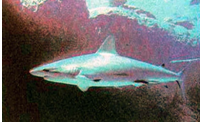 Let me tell you something about sharks.Sharks are among the oldest animals in the world.There are over three hundred fifty different kinds of sharks in the world.Most sharks are about two meters long and live in the oceans.