题目内容
Nathan Sawaya's childhood was a lot of fun. He drew cartoons, wrote stories, and played with plastic toy bricks (积木). His grandparents bought his first set of toy bricks when he was five years old and he's been building with toy bricks ever since. He even took his building bricks to college with him! Instead of books and a computer, he had a model of Greenwich Village made of bricks on his desk.
Nathan started as a lawyer but gave up His highly-paid (高薪的) job to become an artist that uses toys in his art. He uses toy bricks to build everything from the Statue of Liberty(自由女神像) to Superman! He has more than 1.5 million colored bricks in his working room in New York which he uses to make pieces of art. He started by building small models but then decided to do something big and created a self-portrait (自画像). It took him two days just to build the eyes.
Nathan's work has appeared in museums around the world. Children love his art because it is made out of the same toys that they play with at home and adults love his work because it is fascinating. Since it began in2007, Nathan's exhibition "The Art of the Brick" has been very popular with museum visitors everywhere.
"I'm proud that I took a dream I had as a child, to become an artist, and I have actually made a job out of it," says Nathan. "To do what you love in life is the most important thing."
1.What did Nathan put on his desk at college?
A. The Statue of Liberty. B. Superman.
C. His serf-portrait. D. A Greenwich Village modal.
2.Why did Nathan give up his job as a lawyer?
A. Because he made little money out of a lawyer.
B. Because he wanted to make toys for the children.
C. Because he decided to become an artist of toy bricks.
D. Because he was going to work in the museum instead.
3.What does the underlined word "it" in Paragraph 3 refer to?
A. Nathan's work. B. Nathan's exhibition.
C. Nathan's art. D. Nathan's self-portrait
4.What would be the best title for the passage?
A. The Brick Artist B. The Brick Exhibition
C. Toy Bricks for Adults D. The Artist's Childhood
 1. D
2. C
3. B
4. A
【解析】
试题这篇短文主要讲述了一个艺术家从小因为喜欢搭积木,长大后放弃了有高薪的律师工作,选择艺术做为自己的职业,并且他的作品深受儿童与家长们的喜欢的故事。
1.
2.
3.
4.
1. D
2. C
3. B
4. A
【解析】
试题这篇短文主要讲述了一个艺术家从小因为喜欢搭积木,长大后放弃了有高薪的律师工作,选择艺术做为自己的职业,并且他的作品深受儿童与家长们的喜欢的故事。
1.
2.
3.
4.

 期末1卷素质教育评估卷系列答案
I want to ____a No.6 bus to Tian’annmen Square.
A. get B. come C. go D take
D
【解析】
句意:我想要乘坐6路公交车去天安门广场。get得到,到达;come来;go去;take乘坐;带走。根据句意a No. 6 bus可知,这里指“坐公交车”,故应选D。 My parents had always shouted at each other before I told them I didn’t like that and that kept me a lot. It was an amazing that it worked and their relationship became better. I am so happy about that.
A. wasting B. repeating C. bugging D. hugging
C
【解析】
句意:在我告诉他们我不喜欢这种情况之前,我的父母总是互相吼叫,这让我很烦恼。考查动名词辨析题。keep保持,后接形容词或动名词作表语或宾语表状态。四个选项都是动名词形式,A. wasting浪费的;B. repeating重复的;C. bugging烦恼的;D. hugging紧抱的。根据句意语境,可知bug符合句意,故选C。 The most beautiful thing about learning is that ______ can take it away from you.
A. anybody B. somebody C. everybody D. nobody
D
【解析】
句意:关于学习最美好的事情就是没有人可以把它从你身上夺走。A.任何人B.某人C.每个人D.没有人,这里是在描述学习的美好之处,是说学习到的东西就是自己的,没有任何人可以把它从你身上抢走,表示“没有谁,没有人”用复合不定代词nobody,故选D。 —Tony, don’t eat _______ class.
—Sorry, I won’t do it again.
A. in B. on C. to D. by
A
【解析】
句意:-托尼,不要在上课的时候吃东西。-对不起,我不会再这样做了。没有on class 的说法,in class意为“在上课的时候,在课堂上”,介词to(去)和by(通过)在这里不能使用,前句是祈使句,是说不要“在上课中”吃东西,用in class短语表示,故选A。 找出每组中不同种类的词。
1.A. happy B. tall C. teacher D. tired
2.A. head B. cold C. leg D. arm
3.A. hurt B. little C. short D. long
4.A. finger B. stomachache C. headache D. have
5.A. matter B. stand C. cut D. feel
1.C
2.B
3.A
4.D
5.A
【解析】
1.A.高兴的;B.高的;C.老师;D.疲倦的。根据四个单词的词性可知,A,B和D都是形容词,C是名词,故选C。
2.A.头;B.冷的;C.腿;D.胳膊。根据四个单词的词义可知,A,C和D表示人体的部位,故选C。
3.A.受伤;B.小的;C.短的;D.长的。根据四个单词的词性可知,B,C和D是形容词,... All the students in Class l, Grade 9 at Woodland School agreed they loved going to the
movies. Different students loved different movies. Their teachers took a survey of the students’ favourite movies for the year. The graph below shows the results.
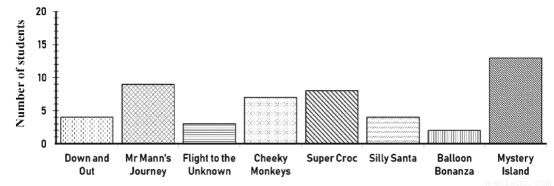
1.The graph shows the results of .
A. teachers’ favourite movies in a class B. students’ favourite movies in a class
C. teachers’ favourite movies in a grade D. students’ favourite movies in a grade
2.According to the graph, the most popular movie was .
A. Mr Mann’s Journey B. Cheeky Monkeys
C. Super Croc D. Mystery Island
1.B
2.D
【解析】
这篇短文利用文章加图表的形式,给我们介绍的是Woodland学校九年级一班的学生们最喜爱的电影。
1.主旨大意题。根据短文第一段All the students in Class l, Grade 9 at Woodland School agreed they loved going to the movies. Different studen... 书面表达
假如上周一你班举行了“爱护水、节约水”的主题活动,请你根据以下要点为你校校报写一篇活动报道。
活动内容 | 邀请王老师做报告;全班讨论如何节水和爱护水。 |
活动收获 | 我们知道我国一些地方水源受到污染;我市虽有一些河流和湖泊,但也缺水。所以……(节水和爱护水的方法至少各发挥一点) |
活动感受 | …… |
要求:1.词数不少于90, 文章的开头已为你写好,不计入总词数;
2.要点完整,层次清晰,语法正确,上下文连贯。
Last Monday our class held an activity
Last Monday our class held an activity about saving and protecting water.
Mr.Wang was invited to give us a talk.After his speech,we had a discussion about how to save and protect water.
Now we k... I prefer the failure rather than my dream.
A. experience; to give up
B. to experience; give up
C. experiencing; giving up
B
【解析】
句意:我宁愿经历失败也不愿放弃我的梦想。experience亲身经历;感受,动词;give up 放弃;Prefer to do rather than do是固定搭配,prefer后面跟to do,rather than后面跟动词原形意为“宁愿···而不愿···”所以正确答案选B。