题目内容

Can you imagine a life without arms or legs?Now let me introduce a disabled man named Nick for you.

Nick,a 31?year?old Australian,was born without lunbs (四肢),so life was not easy for him.At school many students played jokes on him.Because he looked different from everyone else,many students refused to be friends with him.So he always felt lonely.However,he faced that bravely.He learned to type on computer with two toes (脚趾) at the age of six,and he could even surf and play golf.In college,he achieved great success and was one of the excellent students in the studies.What's more,Nick also encouraged others to work hard for their dreams.

Now Nick is one of the most popular speakers in the world.He travels to many countries and gives speeches about his story against difficulties.“A meaningful life is about looking at what you have,not what you don't have,” he said.His story encouraged millions of people.

根据短文内容回答下列问题。

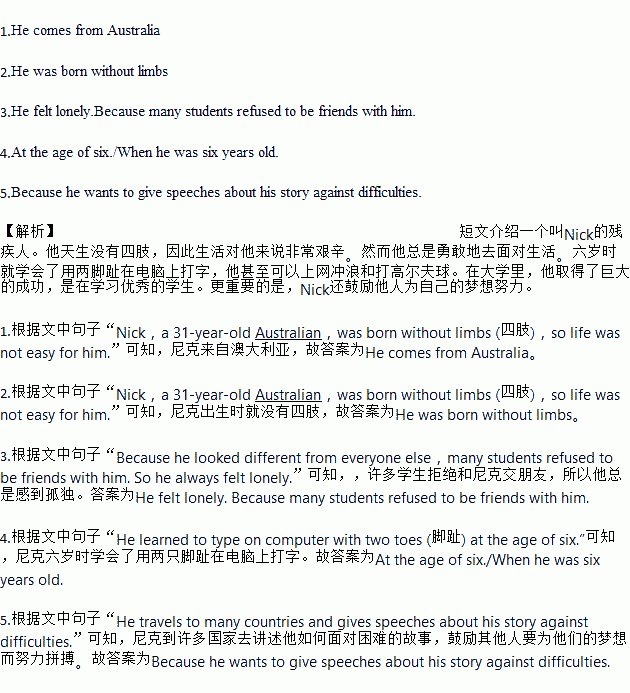
1.Where does Nick come from?

____________________________

2.What was the matter with Nick when he was born?

____________________________

3.How did Nick feel at school?Why?

____________________________

4.When did Nick learn to use computer?

____________________________

5.Why does Nick travel to many countries now?

____________________________

1.He comes from Australia 2.He was born without limbs 3.He felt lonely.Because many students refused to be friends with him. 4.At the age of six./When he was six years old. 5.Because he wa...
练习册系列答案
相关题目

You either have it, or you don’t-a sense of direction. But why is it that some people could find their way across the Sahara without a map while others can lose themselves in the next street?

Scientists say we’re all born with a sense of direction, but it is not properly understood how it works. One theory is that people with a good sense of direction have simply worked harder at developing it. Research being carried out at Liverpool University supports this idea and suggests that if we don’t use it, we lose it.

“Children as young as seven have the ability to find their way around,” says Jim Martland, research director of the project. “However, if they are not allowed out alone or are taken everywhere by car, they never develop the skills.”

Jim Martland also emphasizes that young people should be taught certain skills to improve their sense of direction. He makes the following suggestions:

If you are using a map, turn it so that it relates to(与……有联系) the way you are facing.

If you leave your bike in a strange place, put it near something like a big stone or a tree-something easy to recognize. Note landmarks on the route as you go away from your bike. When you return, go back along the same route.

Simplify(简化) the way for finding your direction by using lines such as streets in a town, streams, or wells in the countryside to guide you. Count your steps so that you know how far you have gone and note any landmarks such as towerblocks or hills which can help to find out where you are.

Now you will never get lost again!

1.Children have the ability to find the way around when they are ______years old.

A. 5 B. 6 C. 7 D. 8

2.Which of the following things cannot be used as landmarks?

A. Tower blocks. B. Hills. C. Wells. D. Bikes.

3.What does the underlined word “emphasize” mean in the passage?

A. To give special importance to something.

B. To express thanks for somebody.

C. To understand or become aware of a fact.

D. To admire somebody.

4.Scientists believe that __________.

A. some babies are born with a sense of direction

B. people learn a sense of direction as they grow older

C. people never lose their sense of direction

D. everybody has a sense of direction from birth

5.What may be the best title of the passage?

A. A research on direction. B. A sense of direction.

C. People’s ability of finding the way. D. Scientists’ research on skills.

1.C 2.D 3.A 4.D 5.B 【解析】试题分析:这篇短文重点讲述了人们与生俱来的方向感的问题,作并就如何提高自己辨别方向的能力提出了几点建议。 1. 2. 3. 4. 5.

违法和不良信息举报电话:027-86699610 举报邮箱:58377363@163.com

精英家教网