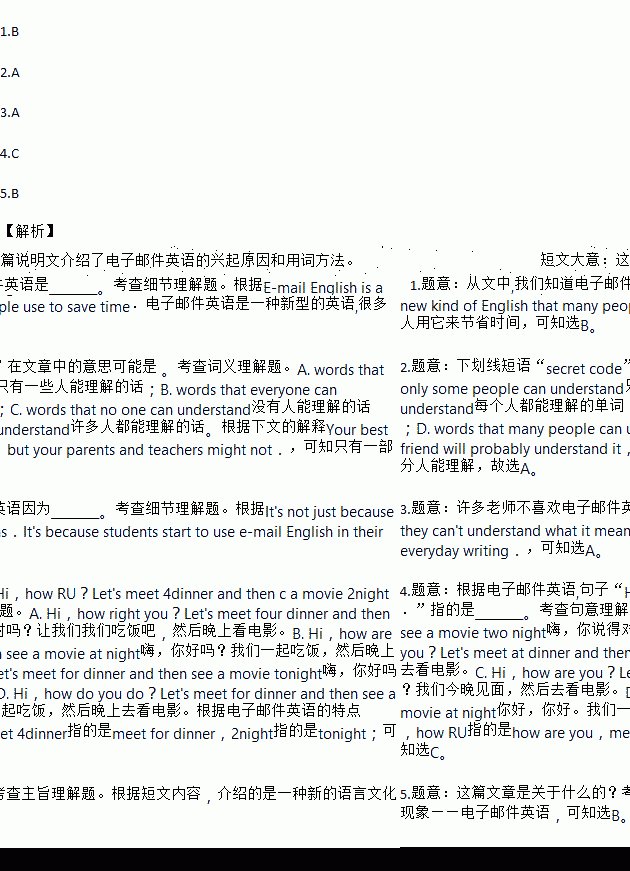
题目内容
Do you speak English?Yes?Well,do you speak e-mail English?Maybe not.E-mail English is a new kind of English that many people use to save time.A lot of e-mail English words come from a computer program called ICQ.It means/seek you.ICQ is an e-mail chatline that people use to send messages quickly.Ian Lancashire,a Canadian teacher,likes ICQ."People can use ICQ to talk with each other with computers."
A message in e-mail English mostly uses two kinds of new words.The first kind is made up of the first letters of other words.These are called acronyms (首字母组合词).The second kind is homophones(同音异义词).
Acronyms in an e-mail save space and time.It takes a long time to write by the way.BTW is much faster.F2F stands for face to face,CSL for can't stop laughing and DBEYR for don't believe everything you read!
Homophones often use letters and numbers that sound like words or parts of words.For example,8sounds like-ea^in great,so to save time,people write gr8.Another example is CU for see you,or sometimes CU18r( see you later).The number 2is used for to or too and the number 4is used instead of/or.*
E-mail English is fun.An e-mail message with lots of e-mail English starts to look like secret code.Your best friend will probably understand it,but your parents and teachers might not.Actually,many teachers don't like e-mail English.It's not just because they can't understand what it means.It's because students start to use e-mail English in their everyday writing.E-mail English is great for writing quickly.But most teachers say that e-mail English should only be used in e-mails to one's friends.
1.From the passage,we know e-mail English is ______ .
A. a computer program
B. a new kind of English
C. for everyday writing
D. made up of two kinds of letters
2.The underlined phrase"secret code"probably means in the passage ______ .
A. words that only some people can understand
B. words that everyone can understand
C. words that no one can understand
D. words that many people can understand
3.Many teachers don't like e-mail English because ______ .
A. students use it in their everyday writing
B. it is difficult for students to understand
C. they can understand what it means
D. students start to write it quickly
4.According to e-mail English,the sentence"Hi,how RU?Let's meet 4dinner and then c a movie 2night."means ______ .
A. Hi,how right you?Let's meet four dinner and then see a movie two night
B. Hi,how are you?Let's meet at dinner and then see a movie at night
C. Hi,how are you?Let's meet for dinner and then see a movie tonight
D. Hi,how do you do?Let's meet for dinner and then see a movie at night
5.What's the passage about? ______
A. Written English. B. E-mail English.
C. Everyday English. D. An e-mail message.