题目内容
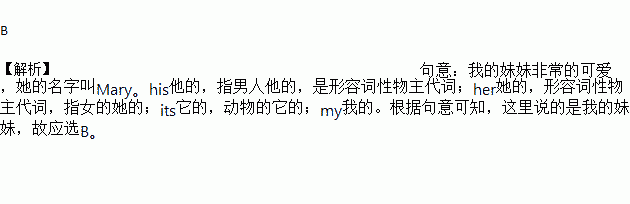
My sister is very lovely. name is Mary.
A. His B. Her C. Its D. My
Every morning I wake up after my alarm clock ____ at six.
A. goes off B. runs off C. puts off D. takes off
Mrs. Brown is Jack’s mother. She loves her family very much. She ____ to the store every day. She often buys ____ for Jack and her husband(丈夫). Now many clothes are ____ sale at Walmart. They are very cheap. Mrs. Brown went to the store ______ she wanted ____ some clothes for her family. Mrs. Brown bought a sweater____ red for herself. She bought a ____of sports shoes for her ____, Jack. The great T-shirts ____ the store are just eighteen dollars! She bought a white one for Mr. Brown because her husband likes ____. She is really a kind mother and a good wife(妻子).
1.A. went B. go C. goes
2.A. clothes B. books C. fruit
3.A. on B. in C. of
4.A. but B. and C. so
5.A. to buy B. buys C. buy
6.A. in B. on C. for
7.A. set B. piece C. pair
8.A. husband B. son C. brother
9.A. on B. in C. under
10.A. blue B. red C. white
In 1996, Joe Richman had been working as a radio reporter on US national radio for several years and was looking for a new idea for a radio programme. He met a teenager called John Cutler. John had Tourette's Syndrome—a brain illness. This meant that Josh did not always have control of his movements and speech.
John was just beginning high school when he agreed to work with Joy on a story about his illness. Joe wanted John to keep a radio diary of his daily life. He gave John a tape recorder and asked him to record what happened to him every day. John and Joe agreed that an important part of his story would be talking to his school friends about Tourette's Syndrome. John was embarrassed(尴尬) to record at school—his friends might laugh.
One day, John took the tape recorder to school, but he kept it inside his bag all day. He was too afraid to bring it out. After months of feeling afraid, he took the tape recorder out on lunch time. What happened next was a total surprise. John tells it best:“Everyone jumped at the chance. Everyone started asking me questions about that, I had never really talking about it to anyone—except my mom and dad. ”
That was an important day in John's life because he learned to be more open about his condition. Now John says he wants to do radio diaries until he's 80 years old. He learnt a lot about himself by doing the radio diary. It made a great radio programme, too. Being a reporter is like having a passport. You can ask questions, be curious and explore new worlds. Radio is the perfect way to be on the radio and everyone likes to listen!
1.Who was Joe Richman?
A. John's teacher. B. A radio reporter.
C. John's doctor. D. One of John's classmates.
2.What did Joe want John to do?
A. To keep a radio diary of his daily life. B. To talk to his school friends.
C. To take the tape recorder to school. D. To control his movements and speech.
3.How did John's classmates feel when he recorded for the first time?
A. Afraid. B. Shy.
C. Excited. D. Strange.
4.What did John learn by doing the radio diary?
A. To be more open. B. A lot about himself.
C. To make more friends. D. Much about radio programme.
I'd like to stay longer, I'm too busy.
A. and B. but C. or D. until
Clothing is a language. It tells us about individual people: their personality, their aye, their place in society and so on. If we want to know more about society,we can look at traditional clothing.
The continent of Africa has a long history and a rich culture,and this is shown in traditional dress . You often find three colours一red,gold and green in the clothing. The first colour stands for the blood of millions of people who suffered as slaves(奴隶); the second is for the rich resources of the African earth; and the third represents the grasslands of home.
The patterns(图案) on the clothing also have a meaning. A common pattern is in the form of a cross “×”, which stands for “unity”. Another pattern is a rectangular box, which represents “strength”.
Because clothing has a strong social meaning, people are very careful in choosing what to wear. It wouldn't be good to wear the wrong clothing, or to wear clothes in the wrong way. For instance, in Ghana, a woman should wear her waistband differently according to the importance of the social event.
Traditional dress also tells us about everyday life. African designs are famous for loose(宽松的) clothing. The climate, with the hot sun and wide temperature changes, requires that the clothes are comfortable for daily life.
Although many people wear western clothes, particularly in the big cities in Africa, traditional dress is very highly valued. This is because it has deep cultural meanings.
1.According to the passage,red .
A. represents the setting sun
B. stands for African unity
C. is chosen because it is a bight colour
D. is a reminder(暗示)of the sad history in Africa
2.According to the passage,which sentence is NOT RIGHT?
A. The rectangular box in the pattern represents“strength”.
B. Africa has a long history and a rich culture.
C. African dress has deep cultural meanings.
D. Afrian people seldom wear loose clothing because of the climate.
3.The passage is mainly about in Africa.
A. the history of clothes
B. modern fashion styles
C. the meanings of traditional dress
D. the materials used in traditional dress
It may not be a great hotel. But before is found,we'll have to stay here.
A. a good one B. a better one C. a best one D. the best one
The English people like take-away food.The most popular food is fish and chips.They usually go to a fish and chip shop.They put the food in paper bags, and take it home, or to their work place.At lunch time, many people eat take-away food in the park. Chinese
takeaways are also very popular in England.People in the USA and Australia like Chinese take-away food, too.But the most popular food in the USA is fried chicken.
根据短文内容判断正(T)误(F)
1.People in England like fish and chips.
2.They put the food in paper bags.
3.They take the food only to their work place.
4.Chinese takeaways are popular in England.
5.Fried chicken is the most popular food in the USA.
about,away,enough,how,other,relaxing,mark,turn,one,exercise
用所给词的适当形式填空。
We face more difficulties and pressure as we grow up. We shouldn’t run away from difficulties. How about 1. them into fun?
Yuan li, a middle school student, drew 123 comics(漫画), talking 2. her life in junior high school. For example, one drawing is about her first day at school. “The first thing you feel in middle school is stress,” she wrote in the drawing. “Three of my classmates won 3. prizes in big competitions. Some students got full 4. in their entrance exams. I feel quite out of place.”
Although the stories sound stressful, Yuan draws in a fun way. “Drawing comics is a way to 5.,” said Yuan.
There are many 6. creative ways to let go of your stress. Paper folding can help a lot, said another student, Song Yumeng. Politics and history give her much trouble. “My mom helped me out. She showed me 7.to make a doll and fold paper animals. After I get one done, I calm down and get a sense of achievement,” said Song.
Physical 8. is also helpful. Students in No.1 Middle School have a yoga class every week. It helps students to relax their body and takes 9.their pressure.
But whatever you do, first of all, make sure you get 10. sleep. Research shows that people without enough sleep perform poorly in many areas.