Pat Brown went to her bank to ask for an ATM card.It looks like a credit card(信用卡).A few weeks later, the bank posted her a card and a four-number personal identification number(PIN)Her PIN is 1234.
As Pat was getting ready for bed one night, she remembered that she had only $2 in her bag.The next day she had to give $10 for a lunch for a co-worker.She didn’t want to get up early to go to the bank.So she had to go to the bank that night.She used her ATM card to withdraw(take out)$50 from her checking account(现金账户).
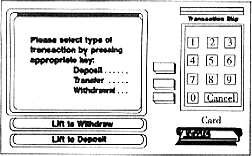
These are the steps she followed to withdraw money.First, she put her card in the lower slot(狭孔)on the right side of the machine.She made sure her card was facing the right way.Second, the computer screen(window)said,“Please enter(put in)your PIN.”Pat pressed(按)the numbers 1,2,3, and 4.Next, the screen said,“Please select type of transaction(交易)you want by pressing other keys.”Pat pressed the bottom key for withdrawing money.
Then the screen said,“From which account?”The choices it gave were Checking, Savings, and Money market.Pat pressed the key for Checking.Next, the screen said, “Please select(choose)amount of transaction.”Pat pushed the number 5 and then 0 three times, until the screen read,“50.00.”The screen then read,“Please wait.”In less than a minute, it read,“Please lift(put up)the lid and take your money.”
Pat lifted the lid market Withdraw.She counted her $50 to make sure the ATM hadn’t made a mistake.Then she waited for her withdrawal slip to come out of the slot at the upper right corner of the machine.Pat checked the slip to make sure it was correct.Then her ATM card was returned through the card slot.She put it in her bag and walked away.If Pat had made a mistake at any point by pressing the wrong button(number), she could have pressed Cancel and started over again.
(1)
What was Pat’s first step?
[ ]
A.
Pressing the withdrawal button
B.
Inserting(put…into)her ATM card
C.
Counting her money
D.
Getting her withdrawal slip
(2)
What did Pat do immediately after choosing the account?
[ ]
A.
Selected whether to withdraw, deposit, or transfer money
B.
Lifted the lid and removed her money
C.
Selected the amount of money she wanted to withdraw
D.
Got away her ATM card
(3)
When did Pat enter her PIN?
[ ]
A.
Right after inserting her card
B.
Right before selecting the account
C.
Right before selecting the amount of money
D.
Right after selecting withdrawal
(4)
When did Pat select the type of transaction?
[ ]
A.
Right after selecting which account she wants.
B.
Right before receiving her withdrawal slip.
C.
Right before selecting the amount
D.
Right after recording her PIN.
(5)
What did Pat do when the screen said,“Please lift the lid…”
[ ]
A.
Got out her card
B.
Took her $50
C.
Selected the type of transaction she wanted
D.
Picked up her withdrawal slip
阅读理解
Napping(小睡)after learning something new could help improve your memory--- as long as you dream, scientists say.
They found people who dream about a new task do it better on waking than those who do not sleep or do not dream.
Volunteers were asked to learn the layout(布局,设计)of a 3D computer maze(迷宫)so they could find their way several hours later.Those allowed to take a pap and who also remembered dreaming of the task, found their way to a landmark quicker.
The researchers think the dreams are a sign that unconscious(无意识的)parts of the brain are working hard to process information about the task..
Dr.Robert Stickgold of Harvard Medical School, said dreams may be a marker that the brain is working on the same problem at many levels.
Study tips
Co-author Dr.Erin Wamsley said the study suggests our non-conscious brain works on the things that it deem(认为)are the most important.
“Every day we are gathering lots of information and new experiences,” she said.“It would seem that our dreams are asking the question, “How do I use this information to inform(影响)my life?”
The scientists say there may be ways to use this phenomenon(现象)for improving learning and memory.For example, students might be better studying hard before bedtime, or taking a nap after a period of afternoon study.
(1)
Scientists say ________ could help improve your memory.
[ ]
A.
dream
B.
nap
C.
nap and dream
D.
nap without dream
(2)
What were volunteers asked to do?
[ ]
A.
Take a nap.
B.
Dream a task.
C.
Learn about 3D computer.
D.
Find their way out of a maze.
(3)
Which is right about dreams?
[ ]
A.
They are a sign that parts of the brain is unconscious.
B.
They can help us fall asleep and improve learning and memory.
C.
They tell us how to use this information to inform our life.
D.
They may be a marker that the brain is working on the same problem.

 By phone
  Online
  By Post
 Stating the performance and the
  Save pounds on ticket NOW!
 Get it Together!