题目内容
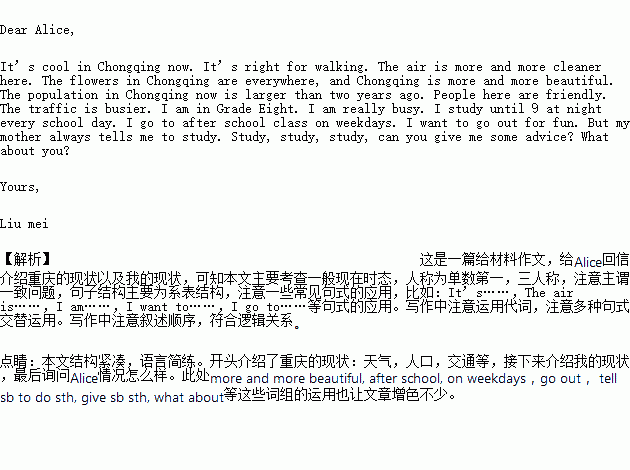
你的美国朋友Alice两年前来过重庆玩,她最近来信希望了解重庆的现状及你的现状。假设你是刘梅,请给她写一封回信。比如天气,人口,交通等等。
字数:80字左右
— A latest English newspaper, please!
— Only one copy left. Would you like to have _______, sir?
A. it B. one C. this D. That
What if you fall out of a boat and can’t swim? Don’t be frightened. Remember, your body is full of air. Learn to bounce(弹起) in the water bouncing can save your life.
First take a deep breath and hold it. Then stand up in the water. You really can float standing up. The water will cover your eyes, but the top of your head should stick out. Let your arms and legs hang loose. Put your chin on your chest.
Stay under the water until you need a breath. Then bounce out of the water to get one. Bouncing is very easy to do. Raise your arms in front of you, with your hands facing down. Keep them just under the top of the water. Then raise one leg. Pretend you’re trying to walk. Now push your hands down and step. After you do this, your head will come out of the water. Blow out all your air, and shout for help.
Now take a breath of air and hold it. Let yourself slip under the water again. Let your arms and legs hang loose. When you need more air, bounce up again. Keep doing this until people come to help you.
Anyone can learn bouncing. It doesn’t take long to learn. The man who thought of bouncing shows it to little children. Bouncing is easy. And it has saved many lives.
1.What should you do first to bounce in the water?
A. Bring your hands up in front of you.
B. Look around and shout for help.
C. Hold your breath and stand up in the water.
D. Try to get our head out of water.
2.What does the underlined word “one” refer to?
A. A shout. B. A rest. C. A walk. D. A breath.
3.What can we learn from the passage?
A. It’s not easy for children to learn bouncing.
B. When you bounce up for air, you should also shout for help.
C. You can stay under the water until people come to help you.
D. Bouncing in the water can produce fresh air for people.
4.What’s the passage mainly about?
A. How to bounce in water.
B. How to breathe in water.
C. The importance of bouncing in water.
D. The importance of swimming in the right way.
1.Your words gave me the strength to overcome those d_______.
2.The company has r_______ moved into a new office building.
3.The headmaster p_______ the prizes to the winners after the match.
4.We shouldn’t use p_______ bags when we go shopping.
5.The cake is d_______ into six parts.
6.It’s h_______ for Tom to pass the exam because he plays too much computer games.
7.Everyone is here, and no one is a_______.
8.They flew d_______ to London.
9.Please tell me her f________number so that I can pick her up at the airport.
10.She writes to her parents o________ a week.
—_____is more interesting than _____.
A. Lesson One, Lesson Two B. The first lesson, second lesson
C. First lesson, the second lesson D. First Lesson, Second Lesson
---How long have they ____________ Shanghai?
---About a week.
A. been to B. gone to C. left D. been in
Summer holiday is 1.(come). The kids have already 2.(make) great plans for the summer. Some of them will travel abroad.3. example, Guo Yuan will spend his holiday far away from his parents. He will visit Australia 4. some friends. Some kids will keep 5.(study) hard during the summer holiday. They have to 6.(go) to many after-school classes. Their 7. (parent) think this is good for their future studies. But the students 8.(them) don’t like it. Some will stay at home and do 9. same things as usual, like reading books and 10.(watch) TV. What is your plan for the summer vacation?
Sometimes your biggest weakness can become your biggest strength. A 10-year-old boy decided to study judo (柔道) though he had lost his left arm in a serious car accident. The boy began his lessons with an old Japanese judo master. The boy was doing well, so he couldn’t understand why, after three months of training, the master had taught him only one move.
“Sensei (老师),” the boy finally said, “shouldn’t I be learning more moves?” “This is the only move you know, and this is the only move you’ll ever need to know,” the sensei replied. Not quite understanding, but believing in his teacher, the boy kept training. Several months later, the sensei took the boy to his first competition. Surprising himself, the boy easily won
his first two matches. The third match proved to be more difficult, but after some time, his opponent (对手) became impatient. The boy skillfully used his one move to win the match. Still amazed by his success, the boy was now in the finals.
This time, his opponent was bigger, stronger, and more experienced. For a while, the boy appeared to be overmatched. Thinking that the boy might get hurt, the referee (裁判) called a timeout. He was about to stop the match when the sensei said to him, “No, let him continue.”
Soon after the match restarted, his opponent made a big mistake. The boy won! He was the champion. On the way home the boy gathered the courage to ask what was really on his mind. “Sensei, how could I win the competition with only one move?” “You won for two reasons,” the sensei answered. “First, you’ve almost mastered one of the most difficult throws in all of judo. Second, the only known defense (防御) for that move is for your opponent to catch your left arm.”
The boy’s biggest weakness had become his biggest strength.
1.The main idea of this passage is that .
A. the disabled can get success B. how the boy learnt Judo
C. weakness can turn into strength D. practice makes perfect
2.Though he didn’t quite understand why he was asked to practise one move for three months, the boy .
A. was shy to ask for the reason B. trusted his teacher very much
C. wanted to be a champion D. took part in the competition
3.According to the underlined sentence, we know that .
A. the boy seemed to give in B. the boy appeared brave
C. the boy was certain to win D. the boy seemed to be losing the match
4.What serious mistake did the opponent probably make in the finals?
A. He fell down on the ground.
B. He forgot to throw the boy to the ground.
C. He grew more and more impatient.
D. He tried to catch the boy’s left arm.
5.What can we learn from the story?
A. One should not compete with someone who does not have the left arm.
B. One should always listen to what the teacher tells him or her to do.
C. One should not be discouraged because of his or her weakness.
D. One should always wait until his or her opponent makes a mistake.
It’s Sunday morning. My parents, my aunt, my brothers and I are at home.
What are my father and mother doing? My father is reading a newspaper. My mother is watering the flowers in the garden. Some are red, and the others are yellow. My
aunt is my father’s sister. She is a shop assistant. She is watching TV now. She is a basketball fan(迷). And she is good at playing basketball. Now she is watching NBA on TV. Where are my brothers? Mike is over there. He is listening to the radio. He likes popular music very much. Jet is in his room. He has a computer. Now he is surfing the Internet(上网). He is writing an e-mail to his pen pal. What am I doing? I am doing my homework.
1.What day is it today?
______________________________
2.What’s my father doing?
_________________________________________
3.Are there any flowers in the garden?
_______________________________
4.What’s my aunt’s favorite?
________________________________________
5.Where is Jet?
_______________________________.

 快乐5加2金卷系列答案快乐5加2金卷系列答案