题目内容

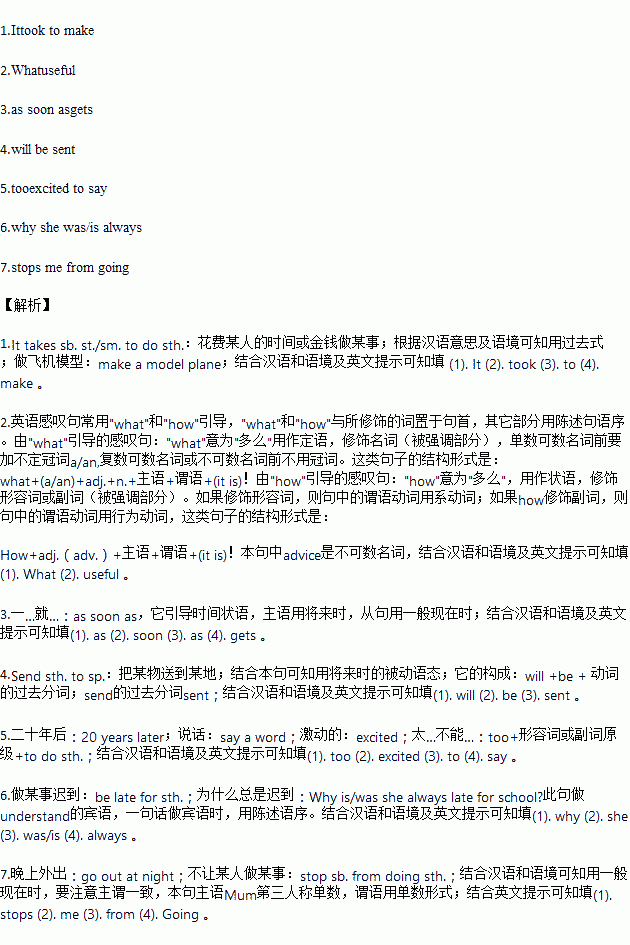
1.我花了两天时间做了一架模型飞机。

________ _________ me two days _________ _________ a model plane.

2.怀特先生给我们的建议真有用!

_______ ________ advice Mr. White gave us!

3.他一有消息就告诉你。

He will tell you _______ _______ ________ he _________ the news.

4.你买的书明天就会送到你家。

The books you bought _________ _________ ___________ to your house tomorrow.

5.二十年后再次相聚,他们都激动得说不出话来。

They were ________ ________ _________ _________ a word when they met again 20 years later.

6.我不明白她为什么总是迟到。

I don’t understand ______ ________ ______ _______ late for school.

7.妈妈不让我晚上外出。

Mum ________ ________ _________ ________ out at night.
练习册系列答案

相关题目

完形填空.

When I was a junior high school student in 1980,God gave me a gift, it was happiness.

One weekend, I went to visit my grandparents in the countryside. On my way home a car ran over me and cut off my____because of its high speed. Several days later when I woke up at the hospital, I realized I had to spend the rest of my life____arms. How sad I felt at that time! Even I was full of fears____slowly I knew I had to face the fact and got over it. I couldn’t get my arms back even though I_____every day.

However, it’s easier____than done. It took me nearly half a year to get out of the sadness____I got so much from my past story.

From then on, I could treat my life with a____mind. But in our daily life, I often see my classmates____about little things: They get a bad grade on a test; their bus comes____; they don’t have a mobile phone, but____have, and so on. But I only____life. I was lucky to realize from an accident.

It is a waste of our life to focus on what you have____We should always think of what we have. So why are so many people unhappy? Someone may say, “My whole life would improve____I have a new car.” But when you get the car and what____? For a whole week you are walking on air. Then you go right back to being unhappy.

Happiness depends on what we have! It’s in our heart. It’s a state of mind, even though you own the whole world, you may still feel____Happiness comes from mastering the art of appreciating(感激) and taking pleasure in what you really have.

1.A. feet B. legs C. arms D. ears

2.A. with B. without C. for D. on

3.A. Or B. But C. So D. Once

4.A. cried B. laughed C. sat D. stood

5.A. dreamed B. acted C. called D. said

6.A. strongly B. especially C. completely D. similarly

7.A. crazy B. normal C. full D. special

8.A. get excited B. get nervous C. get serious D. get worried

9.A. early B. first C. fast D. late

10.A. the other B. one another C. other D. others

11.A. hate B. dislike C. enjoy D. save

12.A. lost B. had C. found D. spent

13.A. because B. as C. if D. whether

14.A. happens B. takes place C. used D. uses

15.A. funny B. happy C. excited D. unhappy

Life is full of surprises and you never know how things will turn out.

Sir John Gurdon is a good example of this. As a boy, he was told he was hopeless at science and was at bottom of his class. Now, aged 79,the very same Gurdon shared the 2012 Nobel Prize in Medicine with Japanese stem cell (干细胞) researcher Shinya Yamanaka.

Like so many scientists, Gurdon shows us where the power of curiosity and perseverance(坚持) can lead.

When he was 15 in 1948,Gurdon ranked last out of the 250 boys at his high school in biology and every other science subject. Gurdon’s high school science teacher even said that his dream of becoming a scientist was “quite ridiculous”.

In spite of his teacher’s criticisms(批评), Gurdon followed his curiosity and kept working hard. He went to the lab early and left later than anyone else. He experienced thousands of failures.

“My own belief is that we will, in the end,understand everything about how cells actually work,”Gurdon said.

In 1962, Gurdon took a cell from an adult frog and moved its genetic (基因的) information into an egg cell. The egg cell then grew into a clone of the adult frog. This technique later helped to create the sheep Dolly in 1996,the first cloned mammal(哺乳动物) in the world.

In 2006,Gurdon’s work was developed by Yamanaka to show that a sample(样本) of a person’s skin can be used to create stem cells. Using this technique, doctors can repair a patient’s heart after a heart attack.

“Luck favors the prepared mind,” Gurdon told the Nobel Prize Organization. “Ninety percent of the time things don’t work, but when they do, you have to seize(抓住) the chance.”

1.Who won the 2012 Nobel Prize in Medicine?

A. Sir John Gurdon

B. Shinya Yamanaka

C. Sir John Gurdon and Shinya Yamanaka

D. Gurdon’s science teacher

2.What does the underlined word “ridiculous” mean?

A. 荒谬的 B. 无畏的 C. 荒废的 D. 无知的

3.In what order are the following events mentioned in the passage.

a. create the sheep Dolly

b. take a cell from an adult frog

c. use a person’s skin to create stem cells

d. move a frog’s genetic information into an egg cell

e. grow into a clone of the adult frog

A. b-a-c-d-e B. b-d-e-a-c C. b-d-a-e-c D. b-c-d-a-e

4.According to the passage, which statement is TRUE?

A. Sheep Dolly was the first cloned animal in the world.

B. Gurdon ranked first at his high school in biology.

C. It’s impossible for the doctors to repair a patient’s heart after a heart attack.

D. According to the science teacher, Gurdon was not a gifted student.

5.What’s the main idea of the passage?

A. Ninety percent of the time things don’t work.

B. Luck favors the prepared mind.

C. Life is full of pleasure.

D. How to know cells actually work.

违法和不良信息举报电话:027-86699610 举报邮箱:58377363@163.com

精英家教网