题目内容

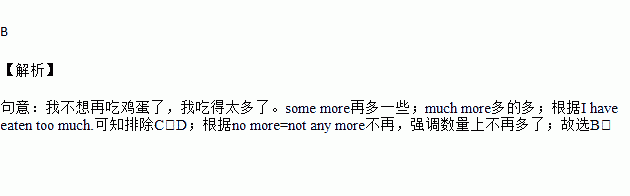
I want __________ eggs. I have eaten too much.

A. any more B. no more C. some more D. much more

B 【解析】 句意:我不想再吃鸡蛋了,我吃得太多了。some more再多一些;much more多的多;根据I have eaten too much.可知排除C、D;根据no more=not any more不再,强调数量上不再多了;故选B。
练习册系列答案
相关题目

In San Francisco, I had this amazing experience. While I was waiting for the bus, I saw a homeless person carrying a_______which said that he would like a cup of hot coffee.

As soon as I ______it, I knew it was time for me to carry out the task. I joyfully ran across the street, thinking that getting ______a cup of hot coffee would be great. I went to Uncle Bob's nearby and asked the young lady behind the counter to give me a _____. I then walked back to the street corner where the man had _______As I went up to him. I could see that the _____I got, the more joy in his eyes I could see.

When I _____him the hot coffee, I just said, "This is_______you, my dear. "I could see so much _____in his face and even a tear (眼泪) was running down. He kept thanking me and holding his coffee like the biggest _____and prize in his life. It made me cry that a(n)_______action can bring so much joy and make someone feel really warm.

I walked back to the _____with such a happy hop. When the bus driver opened the door and I wanted to pay the bus fee, _____, he waved me through and said, "Honey, you don't need to pay. This is on me. " He explained that it ______ his heart to see that I gave away free coffee.

This _______moment was the warmest in my heart and it gave my day and my life a brand new start. It brings me such a joy to simply love and bless.

1.A. poster B. notice C. picture D. sign

2.A. reached B. read C. faced D. held

3.A. me B. you C. her D. him

4.A. ticket B. hand C. coffee D. prize

5.A. stayed B. visited C. shared D. expected

6.A. better B. closer C. farther D. more

7.A. showed B. sold C. handed D. made

8.A. for B. with C. from D. about

9.A. sadness B. worry C. joy D. hope

10.A. lesson B. treasure C. secret D. chance

11.A. unusual B. simple C. strange D. careless

12.A. homeless person B. young lady C. coffee shop D. bus stop

13.A. in the end B. in fact C. to my surprise D. to be honest

14.A. took B. touched C. broke D. controlled

15.A. lucky B. interesting C. amazing D. successful

1.D 2.B 3.D 4.C 5.A 6.B 7.C 8.A 9.C 10.B 11.B 12.D 13.C 14.B 15.C 【解析】本文主要描述了作者在圣弗兰西斯科的令人惊奇的经历。它带给作者一种单纯的爱和祝福的喜悦。 1.句意:在我等车的时候,我看到了一个无家可归的人拿着一个指示牌上面写着他想...

阅读短文,根据短文内容回答问题。

Idioms are one of the hardest parts of learning a language. An idiom is a phrase which has a meaning, but the meaning is not clear from the words themselves. They are like puzzles. If you translate an idiom word for word, it sometimes makes no sense at all. That’s why even native speakers can get confused when someone uses a phrase that they’ve never heard of.

Here are four common English idioms every English student should know in a lot of situations.

1.Get your act together (Meaning: you need to improve your behaviour/work)

This might be something your teacher says to you if you score badly in an exam or if you misbehave in class. You can also use it to talk about people in general. For example, if your friend is being mean for no reason, then you can tell them that they need to get their act together.

2.Pull yourself together (Meaning: calm down)

It’s not polite to say “pull yourself together”to tell people to relax while they’re overreacting (反应过激). Only use this if you think the person you are speaking to is getting upset over something important. When your friend tells you that their close relative has died, it is NOT the time to tell them to pull themselves together.

3.I’m feeling under the weather (Meaning: I’m sick)

Yes, it’s longer and more difficult to say than “I’m sick”, but if your English teacher asks you why you haven’t done your homework, he or she is more likely to forgive (原谅) you if you say that you were feeling under the weather.

4.Break a leg (Meaning: good luck!)

This is perhaps one of the most confusing yet well-known English idioms. If someone says this to you, do not think they are frightening you; they are just wishing you luck. It is most often used for people wishing success to actors and actresses before they perform on the stage, but it can be said in other situations, too.

All in all, learning a new language can be challenging. It’s certainly not a piece of cake, especially when there are so many confusing idioms. However, with enough hard work and interest, you will succeed in no time. Break a leg!

1.What is an idiom?

2.How many common English idioms are talked about in the passage?

3.Is it polite to say“pull yourself together”to tell people to relax while they’re overreacting?

4.Which idiom can you use to wish somebody luck?

5.What is the passage mainly about?

1.An idiom is a phrase which has a meaning, but the meaning is not clear from the words themselves. 1’档:①Idioms are one of the hardest parts of learning a language. ②They are like puzzles. If...

违法和不良信息举报电话:027-86699610 举报邮箱:58377363@163.com

精英家教网