题目内容

The wife asked the husband, “In this life, what did you miss?”

When she was 25, the husband replied, “I missed a chance of finding a new job.”

When she was 35, the husband angrily told her that he had just missed the bus.

At 45, the husband sadly said, “I missed the chance of seeing my closed relative before his last breath.”

At 55, the husband said disappointingly, “I missed a good chance to retire.”

At 65, the husband hurried replied, “I missed the dentist’s appointment.”

At 75, the wife didn’t ask the husband any more, the husband was kneeling in front of the very sick wife. Remembering the question the wife used to ask him, this time he asked the wife the same question. The wife, with a smile and peaceful look, replied, “43In this life, I didn’t miss having you!

The husband was full of tears. He always thought that they could be together forever. He was always busy with work. So much that he had never been thoughtful to his wife. The husband hugged his wife tightly and said, “Over 50 years, how I had allowed myself to miss your deep love for me.”

In the busy city life, there are many people who are always busy with work. These people revolve(旋转) their lives around their jobs. They are unwilling to spend time on health care. They missed the chance to be with their children in their growing up. They neglect(忽略) the loved ones who care for them, and also their health.

44Nobody knows what is going to happen one year from now.

Life is not permanent(永恒的), so always live in the now. Express your gratitude to your loved ones in words. Show your care with actions. Treat every day as the last day of life. In this way, when you are gone, your loved ones would have nothing to feel sorry about.

请务必将41—45小题的答案写在答题卡的相应位置!

(一)根据短文内容简要回答问题。

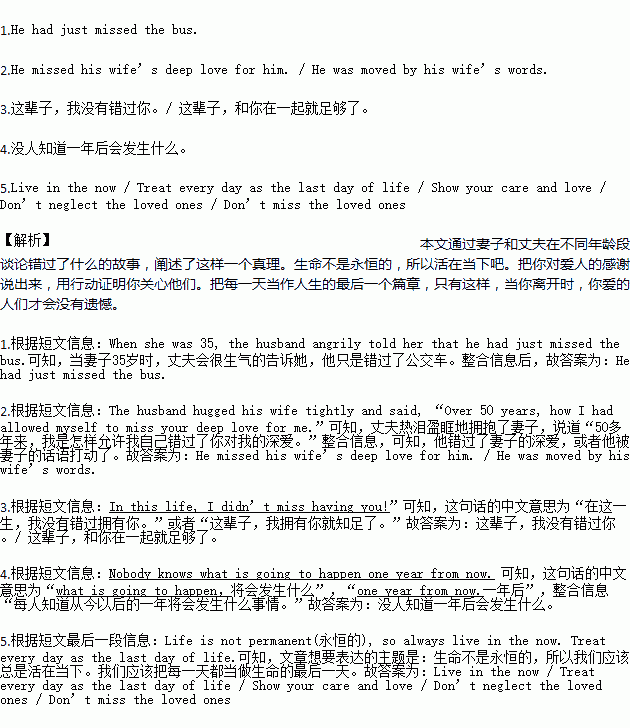
1.How did the husband answer the question when his wife was 35?

2.Why was the husband full of tears?

(二)将短文中划线的句子译成汉语。

3.______________________________

4.______________________________

(三)请给短文拟一个适当的标题。

5.______________________________
练习册系列答案
相关题目

Isabel Allende’s novels are enjoyed all over the world. She is famous for her creativity and imagination. And her own personal story is as amazing as any she has ever told in a novel. Born in 1942, Allende’s family moved often during her childhood. She went to school in South America, Europe, and Asia. As a young woman, she became a journalist in Santiago, Chile’s capital city. Then, she got married and had two children. In 1970, everything began to change.

² Leaving home

Isabel Allende’s uncle was a political leader named Salvador Allende. In 1970, her uncle was elected president of Chile. In 1973, President Allende was killed during the fighting. When Isabel Allende began to fear for her life, she and her family decided to move to Venezuela.

² From Newspaper to Novels

It was really a painful experience for Isabel Allende to leave her country. Without this experience, however, Allende said she never would have begun writing novels. Then she got a phone call from Chile. Her grandfather was dying. She knew she could not return home to be with him, but she wanted to respect him in some way. “I decided to write a letter about all the things he told us when we were young,” Allende explained. Later, she wrote a long letter which became Allende’s first novel, The House of the Spirits.

² The Writing Life

“I spent ten, twelve hours a day in a room, writing,” Allende says, “I don’t talk to anybody; I don’t answer the phone.” When she finished the first draft of a new novel, Allende mailed a copy to her strictest critic(评论家).“I send it to my mother. She read it and came here with a red pen. We fight for a month at least.” Allende then went back to work until she felt the book was finished. “The storytelling is the fun part,” she said. “The writing can be a lot of work!”

1.What does the writer think of Isabel Allende’s story?

A. interested B. moving C. painful D. amazing

2.What was Isabel Allende before she got married?

A. She was a journalist. B. She was a teacher.

C. She was a political leader. D. She was a president.

3.According to the last paragraph, the underlined words “strictest critic” refer to__________.

A. Isabel Allende’s father B. Isabel Allende’s mother

C. Isabel Allende’s grandfather D. Isabel Allende’s uncle

4.Why did Isabel Allende start writing her first novel?

A. Because she wanted to make money.

B. Because she liked writing novel.

C. Because she wanted to respect her grandfather.

D. Because she wanted to write against the government.

5. In Paragraph 4, when Allende said “We fight for a month at least”, she meant that “___________”.

A. Isabel Allende and her mother discussed and argued a lot about the draft.

B. Isabel Allende and her mother often fought because of the draft.

C. Isabel Allende and her mother didn’t have a good relationship.

D. Isabel Allende’s mother didn’t like Isabel Allende’s draft at all .

Today we are developing a new idea—Money is the measure of all things. More and more, people are being judged by what they own, and not by their good qualities. This is certainly true among many people in China.

According to a survey that was done in 2013, China is the most materialistic(物欲的) country in the world. Twenty-three percent of Chinese said they measured success by the things they owned (cars, homes, jewelry, designer clothes) compared with just 21 percent in America, 20 percent in Canada, and 16 percent in Britain.

This love of materialistic has spread into schools where some kids like to show off their Apple Watches, iPhone7 and expensive running shoes. Some poorer students now feel worried by their richer classmates and sad by their poor families. In some cases this has affected their performance in school.

But having rich parents doesn’t automatically(自动地) bring good grades and having poor parents doesn’t certainly bring bad grades. It is hard wok that is the key to success, not the cost of your running shoes. And hard work is what develops good characters, not money, that should be the measure of all things.

1.What is the measure of all things for many people in China?

A. Success. B. The good quality. C. The good grades. D. Money.

2.According to the survey, how many Chinese judged success by the things they owned?

A. 23% of Chinese. B. 21% of Chinese. C. 20% of Chinese. D. 16% of Chinese.

3.Why do some students like showing off expensive things in school?

A. Because their families are very rich.

B. Because of the worship of materialism.

C. Because expensive things can bring good grades.

D. Because they are good at all kinds of subjects.

4.What can we infer from the passage?

A. Poor students can hardly get good grades.

B. Rich students have the worship of materialism.

C. We should correct the worship of materialism.

D. Canadians have the least the worship of materialism in rate.

违法和不良信息举报电话:027-86699610 举报邮箱:58377363@163.com

精英家教网