题目内容

There was a boy and his family was very rich. One day his father took him on a trip to a place. He wanted to show his son how poor people were there. They spent several days on a farm. There were many poor families living on the farm.

On their way home, the father asked the son, “How was the trip?” “It was great, Dad,” the son answered. “Did you notice how poor people were there?” asked his father. “Oh, yes,” said the son. “So, tell me,” said his father. The son said, “Well, we have one dog and they have four. We have a pool in our garden, while they have a river that has no end. We have expensive lanterns(灯), but they have stars above their heads at night. We have only a small piece of land to live on, while they have the endless fields. We buy our food, but they grow theirs. We have high walls around our houses to protect us, but they don't need walls, because their friends will protect them.”

The father had nothing to say. Then the boy added, “Thank you, Dad, for letting me see how poor we are.”

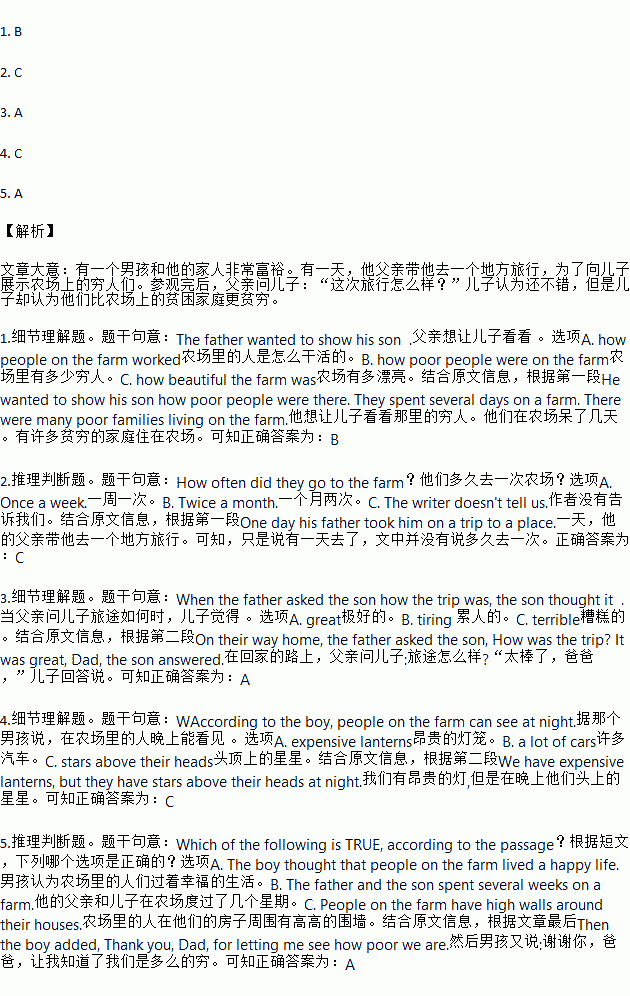
1.The father wanted to show his son .

A. how people on the farm worked

B. how poor people were on the farm

C. how beautiful the farm was

2.How often did they go to the farm?

A. Once a week.

B. Twice a month.

C. The writer doesn't tell us.

3.When the father asked the son how the trip was, the son thought it .

A. great B. tiring C. terrible

4.According to the boy, people on the farm can see at night.

A. expensive lanterns

B. a lot of cars

C. stars above their heads

5.Which of the following is TRUE, according to the passage?

A. The boy thought that people on the farm lived a happy life.

B. The father and the son spent several weeks on a farm.

C. People on the farm have high walls around their houses.
练习册系列答案
相关题目

There's much to see under the sea, but you need to remember that light behaves differently in water than in air. The objects appear closer to you than they exactly are. You might find yourself reaching out to touch something and completely missing it.

Objects under water will appear larger than they would on the surface, too. Be careful not to tell any stories about the big fish that got away. That fish might not be so big after all! It's just because sometimes things can seem to be as much as about 33 percent bigger in water!

What's more, in deeper water, colors just don't seem as bright. In fact, it looks as if some colors are missing. Remember the color of an object results from the wavelengths(波长) of light that are reflected(反射) from its surface. And light is taken in as it moves down through the water.

Swimmers wear wet suits to keep warm underwater. Let's take a bright red, yellow, and blue wet suit as an example. These colors are hard to miss on the surface of water. Watch carefully the changes in color as you descend in the water. The red part now looks almost black because the red light wavelengths, the longest among these three colors, are missing. As you go down deeper, the same thing will happen to the yellow part and in the end to the blue part. Even at a place of about 6 to 9 meters underwater, you will look terrible, like a ghost(鬼怪)! And you have to wait for your return to the surface to enjoy the bright colors again!

1.You miss the object underwater when you want to touch it because .

A. your eyesight is quite poor

B. you are not quick enough

C. it is not as close as it seems

2.The underlined word “descent” probably means “ ” in Chinese in this passage.

A. 下潜 B. 漂浮 C. 屏息

3.Which of the following is true?

A. A four?meter?long fish looks three meters long underwater.

B. The wavelengths of red light are longer than those of blue light.

C. Much water will be taken in by the swimmer deep in the water.

4.The best title of this passage is .

A. The Standard of Color Underwater

B. The Direction of Light Underwater

C. The Behavior of Light Underwater

A poor boy once went to a ragged(破旧的) school, where his face was well washed. When he returned home, the neighbors looked at him in surprise.

They said, “That looks like Tom Rogers, and yet it can't be, for he is so clean.”

After a while, his mother looked at him, and seeing that his face was so clean, she thought that her own face was dirty, and she washed it at once.

The father soon came home from his work, and, seeing his wife and his son so clean, he thought that his face was dirty, and so he followed their example.

Father, mother and son being clean, the mother began to think that the room looked dirty; so she went down on her knees to scrub the floor clean.

A woman lived next door. Seeing so great a change in her neighbors, she thought that her face and her room were very dirty; so she, too, quickly set about cleaning them.

This story shows how two houses and their families were made tidy and comfortable, simply by the example of the clean face of one ragged school boy.

Children, as well as grown?up people, should always set a good example. We never know how much good may be done in that way; nor can we tell how much harm results from a bad example.

1.The poor boy got his face washed at

A. school

B. home

C. his neighbor's

2.What does the underlined word “scrub” in Paragraph 5 mean in Chinese?

A. 取消 B. 擦洗 C. 分离

3.The woman next door cleaned her face and room because

A. her neighbors asked her to do so

B. she loved to keep clean all the time

C. she learned from her neighbors

4.What's the best title of the story?

A. A Poor Boy and His Parents

B. A Good Example

C. Good Neighbors

Scientists have always believed that snails are not able to find their way home. But Briton Ruth Brooks, a retired teacher, has found that it is not true.

Brooks started working on snails after she got angry with the snails in her garden. The snails ate her vegetables. She didn't want to kill them, so she took them to another place. But she found they always seemed to come back. Brooks tried to mark the snails in her garden with nail polish (指甲油). She placed the snails in the place around her home and made notes of their movements. She found that snails have a strong homing instinct (本能); the longest returning snail traveled back 90 meters.

People started to call Brooks Britain's best amateur (业余的) scientist after her work won the BBC's prize “To Be A Scientist”. She said, “I've always wanted to know whether the snails that eat my plants just come back when I move them, and if they do, how far is it from their home?” "I would say on the evidence (证据) that it would be safe to take your snails away 100 meters or even farther. If you put them somewhere nice with some food, you can be almost sure that they won't come back."

1.What does the underlined word “it” in the first paragraph refer to?

A. The snails are in her garden. B. Ruth Brooks has a garden.

C. Snails have a strong homing instinct. D. Snails can't find their way home.

2.Why did Brooks take the snails to another place?

A. She wanted to kill them in a quiet place. B. She wanted to know about the snails' growth.

C. The snails ate her vegetables D. She is retired and has a lot of free time

3.She marked the snails to fiind out________.

A. which one ate her vegetables B. whether they could come back

C. which one would travel the farthest D. how many snails there were in her garden

4.According to Brooks, which of the following statements is TRUE?

A. Snails are good at finding their way home. B. Most of her snails traveled 90 meters

C. It's impossible to stop snails from coming home. D. Snails can travel anywhere and come back

5.What is Brooks' advice for keeping snails away?

A. You'd better kill them. B. Take them to scientists.

C. Mark them with nail polish. D. Move them to a nice place with food.

违法和不良信息举报电话:027-86699610 举报邮箱:58377363@163.com

精英家教网