题目内容

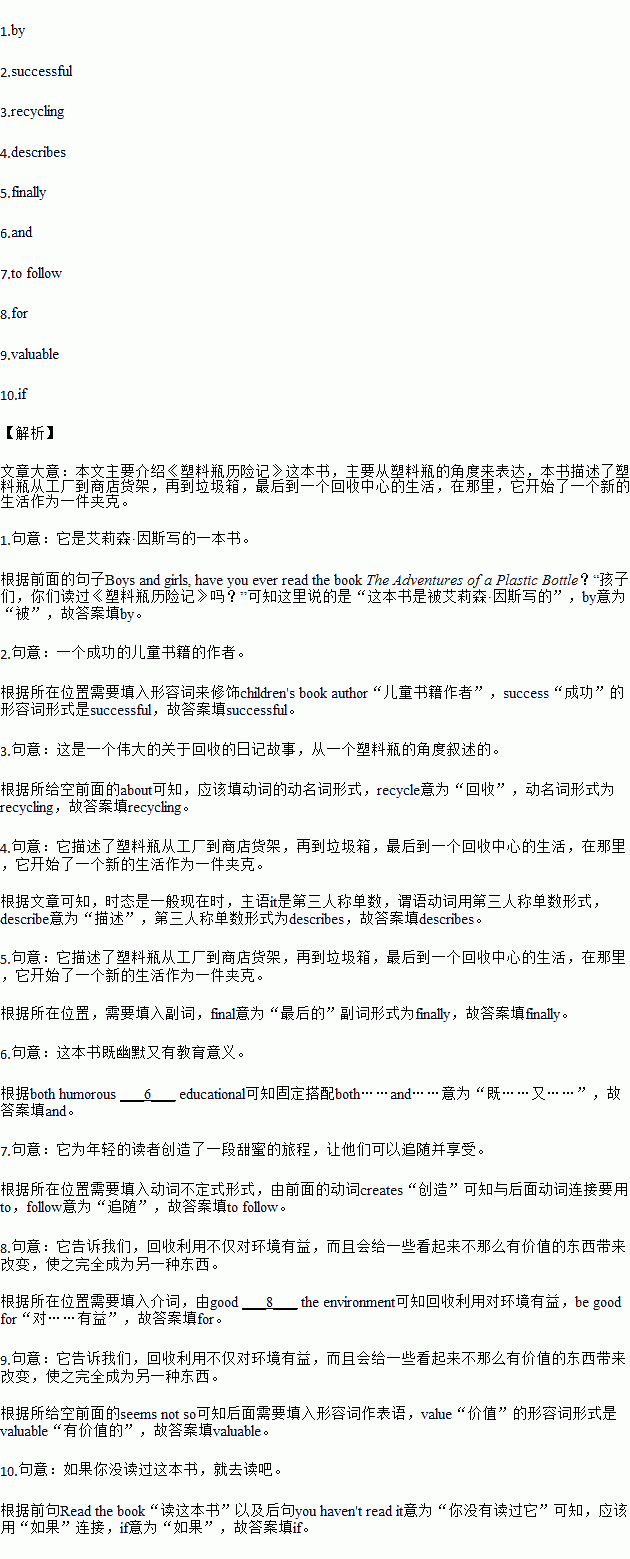
Boys and girls, have you ever read the book The Adventures of a Plastic Bottle?It's written _____ Alison Inches, a _____(success)children's book author.

This is a great diary story about _____(recycle), told from the point of view of a plastic bottle. It _____(describe)the life of the plastic bottle from the factory to the store shelf, then to the rubbish bin and _____(final)to a recycling centre where it starts a new life as a jacket.

This book is both humorous _____ educational. It creates a sweet journey for its young readers _____(follow)and enjoy. It teaches us that recycling is not only good _____ the environment, but also gives something that seems not so _____(value)a change to be something else entirely. Read the book ______ you haven't read it. And you will never look at a plastic bottle the same way again!

1.________

2.________

3.________

4.________

5.________

6.________

7.________

8.________

9.________

10.________
练习册系列答案
相关题目

We are often told to pay attention to what our mothers tell us. Most of us enjoy listening to our mothers speak. Scientists have found that compared to other people’s voices, our brains greatly prefer(更喜欢) the voices of our own mothers.

Scientists at Stanford University, US, recently studied this. They scanned (扫描) children’s brains while they were listening to different sounds, including their mothers’ voices. They found that 97 percent of the time, children could recognize their mothers’ voices at once.

Hearing their mothers’ voices makes children’s brains more active. We usually just use one part of our brain to deal with sounds when we hear something. But when we hear our mothers’ voices, many parts of the brain, including those in charge of (负责) reward (奖赏) and emotion (情感), start to work as well.

Why do we respond so strongly to our mothers’ voices? It starts even before we’re born. When children are still in the womb (子宫) or have just been born, they hear their mothers talking. This makes babies feel comfortable and teaches them language and social skills, even though they are still very young. The babies learn to recognize(辨别) their mothers’ voices as a rewarding (奖励性的,有益的) sound. Later, when this sound is heard again, more attention is paid to it.

Some sounds are necessary for our survival (生存) or bring us pleasure. These sounds are recognized by our brains as rewarding sounds. Most human voices are not recognized in this way, since we hear them so often. But mothers’ voices are different. They bring us a lot of comfort.

1.What is the story mainly about?

A.Why we should listen carefully to our mothers. B.Why we prefer to hear our mothers’ voices.

C.How we recognize our mothers’ voices. D.How we respond to different kinds of sounds.

2.What will happen when children hear their mothers’ voices?

A.Many parts of their brains become active. B.They will need time to recognize the voices.

C.Their language skills start to improve. D.They will remember some bedtime stories.

3.According to Paragraph 4, why do children pay more attention to their mothers’ voices?

A.Because they can recognize their voices quickly.

B.Because their voices make them more comfortable.

C.Because they can get a reward for doing so.

D.Because they can get love from their mothers.

4.“Rewarding sounds” refers to sounds that _____.

A.we can recognize B.we often hear C.we hear as babies D.make us happy

5.What do you think it is about?

A.Medicine B.Lifestyle C.Education D.Science

Dick often goes traveling in the summer holidays and almost always has a good time. But he was out of luck this summer.

He went to an old temple(庙) on a high mountain by himself. On his way there, it began to rain hard and he went down the mountain as soon as possible. When he got to the foot of the mountain, he found the bridge was under the water. So he had to spend the rainy night in an old farm house. He was so hungry that he hardly fell asleep.

The next morning the rain stopped and he found the bridge was damaged. He saw the river was not too deep(深的) and tried to swim across it. In the middle of the river, the water nearly washed him away. Luckily, two farmers saved him, but he lost his bag. They gave him some food and dry clothes. He thanked them and went to the nearest town to call up his parents. At the end of the street, Dick found a small hotel and went in. He asked the price for a room. “A room on the first floor is twenty dollars, on the second floor, fifteen dollars, and on the third, ten dollars,” answered the waiter(服务员). The young man had only eight dollars in all his pockets(口袋). He said thanks and was leaving.

The waiter asked, “Don't you like our hotel?”

“Yes, it's good,” said Dick, “but it's not tall enough!”

1.Dick spent the rainy night ________.

A.in a hotel B.in a farm house C.in an old temple D.under a bridge

2.The underlined word “damaged” in Paragraph 3 means “________” in Chinese.

A.古朴的 B.结实的 C.被损坏的 D.雄伟的

3.From Dick's words “... but it's not tall enough!” in the last paragraph, we can infer that Dick _____.

A.liked tall buildings very much

B.would borrow some money from his good friends

C.was very careful when choosing a hotel for himself

D.didn't want to tell the waiter he didn't have enough money

4.According to the passage, Dick's summer holiday this year was ________.

A.terrible B.relaxing C.boring D.fascinating

You may know about “junk food” like hamburgers. But do you know about “junk sleep” ?

A British survey found that electronic products(电子产品) in teenagers' bedrooms are affecting(影响) their sleep.

The survey was among(在……之间) 1,000 British children between 12 and 16. It found that 30% of them got just 4 to 7 hours of sleep every day. But doctors say they need 8 to 9 hours.

Almost 25% of the kids said they fell asleep more than once a week while watching TV, listening to music or using other electronic products.

“This is very worrying,” said Dr.Chris Idzikowski, a British expert. “We call it ‘junk sleep’. It means you don't get enough sleep and the quality(质量) of the sleep is bad, too. If you don't get a good rest, you won't perform well in school the next day.”

The survey found that 40% of the kids felt tired each day, with girls between 13 and 16 feeling the worst. Nearly all the teenagers have a phone, an MP4 or a TV in their bedrooms. And many of them have all three.

1.This passage is mainly about ________.

A.junk food B.junk sleep

C.the importance of sleep D.electronic products

2.________ of the children in the survey sleep only 4 to 7 hours a day.

A.200 B.300 C.500 D.1,000

3.“Junk sleep” means ________.

A.people don't have enough sleep B.the quality of the sleep is good

C.people don't like sleeping D.people have enough sleep

4.Which of the following is TRUE according to the passage?

A.Teenagers need 4 to 7 hours of sleep each day.

B.Few teenagers have a phone in their bedrooms.

C.Teenagers spend too much time on electronic products.

D.Girls between 15 and 16 spend the least time on electronic products.

违法和不良信息举报电话:027-86699610 举报邮箱:58377363@163.com

精英家教网