题目内容

Lucy

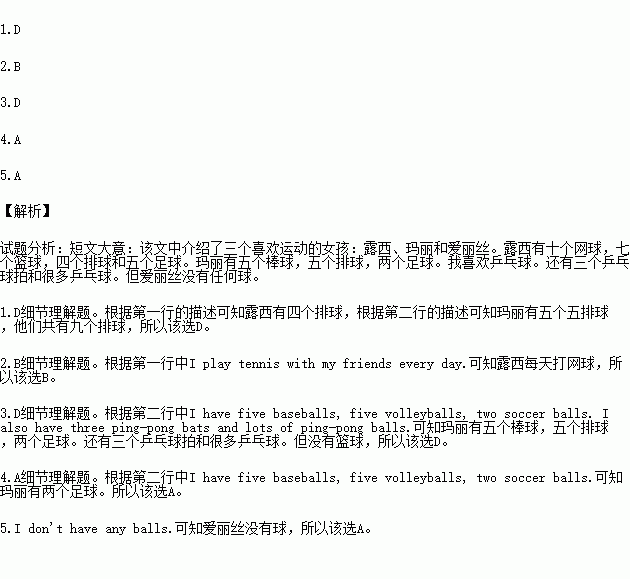
I like sports. I have ten tennis balls, seven basketballs, four volleyballs and five soccer balls. I play tennis with my friends every day.

Mary

I have five baseballs, five volleyballs, two soccer balls. I like ping-pong. It's easy for me. I often play ping-pong with my classmates. I also have three ping-pong bats and lots of ping-pong balls.

Alice

I don't have any balls. I love sports, but I don't play them. I only watch them on TV.

根据表格里的内容,选择最佳答案。

1.Lucy and Mary have volleyballs.

A. four B. five C. eight D. nine

2.Lucy plays every day.

A. ping-pong B. tennis C. baseball D. soccer

3.Mary doesn't have .

A. volleyballs B. ping-pong balls

C. baseballs D. basketballs

4. has two soccer balls.

A. Mary B. Lucy C. Alice D. Mary and Lucy

5.Alice .

A. has no balls

B. doesn't like sports

C. thinks ping-pong is easy

D. plays sports with her classmates
练习册系列答案
相关题目

Almost every child in cities has the chance to go to school, but not all children in the countries are so lucky.

There is a girl called Xiao Fang. She is eight years old and lives in a small village in Guangxi. When she was young, she wanted to go to school. But she could not, because her family was too poor to afford the school fees for her, so her parents had to keep her at home. Instead of studying, Xiao Fang worked in the fields with her parents every day. Then Hope Project heard about Xiao Fang. It agreed to help Xiao Fang to go to school. Her wish of study came true, and now she is studying in a school.

Unluckily there are many thousands of children who can not go to school. You can join in Hope Project and help these children. You know all the good work needs money. Hope Project needs your help.

If you give Hope Project ¥300 each year, it can pay for one child to go to school for a whole year. With more money, Hope Project can build new schools, buy good desks, chairs, blackboards and books. Let's help the children together and give them a chance to have a good start in life.

1. can go to school.

A. Almost every child in China

B. Almost every child in big cities

C. Almost every child in the world

D. Almost every child in small villages

2.The words "school fees" in the second passage mean ______.

A. 交通费 B. 住宿费 C. 学费 D. 生活费

3.Hope Project helped Xiao Fang because______

A. it heard about her

B. she knew someone working there

C. she went to ask for help

D. she wrote a letter to the newspaper

4.Which of the following is TRUE?

A. Hope Project helps to build new schools

B. Hope Project helps the poor children to go to school

C. Hope Project helps schools to buy desks, chairs, books, etc.

D. All the above

“I sometimes get up at three or four in the morning to surf the Internet.”

“ I checked my e-mail almost forty times a day.”

“I seldom spend less than three hours each time on the net.”

“I spend more time in chat rooms than with my ‘real-life’ friends.”

Do you know any people like these? They are part of a new addiction* called Internet addiction. According to experts, Internet addicts* spend at least thirty hours online every week. They lose control of the time they spend on the Internet.

For example, one college student was missing for several days. His friends were worried and looked for him everywhere but couldn’t find him. They called the police. The police found the student in the computer lab: he was surfing the Internet---for seven days straight.

A study shows that about seven to ten percent of Internet users become addicted. The teenagers spend more time on the Internet than with friends and family. That’s why some experts worry most about young people.

Is “surfing the Internet” a hobby or an addiction for you? You may have a problem if you have one of the following symptoms*.

★ You go out with your friends less and less.

★ You’ve decided to spend a short time online, but then you spend several hours.

★ You do not go to important family events or you do not do school projects because you like to spend hours on the Internet.

What is the situation? Some experts suggest that people set strict limits on their time for internet use. You have to learn to control it, or the Internet would control you.

1.Internet addicts at least spend ________ hours online every week.

A. twenty B. thirty C. forty D. fifty

2.Some experts worry most about young people because__________.

A. they spend too much time on the Internet.

B. they spend too much time with their friends

C. they get up too early to surf the Internet

D. they spend too much money shopping online.

3.Where may you find this passage?

A.In a guidebook B. In a magazine

C. In a movie poster D. In a storybook

A habit is any action that we have performed so often that it becomes something that we do almost without thinking. Some of them are thought to be bad habits. People spend countless hours and dollars each year trying to get rid of these bad habits but often fail. Why? Change is hard work and there is no shortcut to achieve it. However, there is still some advice for you to follow.

First, look at why you do it. In other words, what’s the result of doing this thing? If your bad habit is shouting at people when you are unhappy or under pressure, what do you get from it? It may make you feel a little better for the moment. Or maybe you have a bad habit of leaving your homework undone. The result could be that you get more time to spend on the Internet!

Next, take a look on the other hand. What are you losing because of your habit? Shouting at other people is a bad habit because it makes people around you feel bad and unhappy. Leaving your homework undone is a bad habit because you may be punished by your teacher. Having more Internet time means that you are losing the chance to learn the things that you need to learn. When you think that way, you’ll find that it’s not wise to keep your bad habit! Now it is time to make a decision. What will you choose? I’m sure you will choose to do what you think is more important.

1.From the first paragraph we know that __________.

A. a habit is a terrible thing that we can never change

B. people spend countless hours and dollars to get rid of habits

C. none of the people who try to break bad habits are successful

D. though it is difficult, we can still do something about our bad habits

2.The underlined sentence “there is no shortcut to achieve it” means that ________.

A. it is not easy to get rid of bad habits

B. there is a long way and a short way

C. something dangerous may happen

D. we must cut it in a short time.

3.According to the reading, if you want to get rid of your habits, you have to _____.

A. talk to others when you are in low spirits

B. know why you do what you do

C. finish your homework first

D. spend less time on the Internet

4.Which of the following does NOT happen because of a bad habit according to the reading?

A. You are punished later.

B. Making people around you feel unhappy.

C. You feel a little better after shouting at others.

D. You leave your homework at home by accident.

5.The main purpose of this passage is to __________.

A. introduce and describe B. complain(埋怨)and disagree

C. explain and advise D. discuss and argue(争论)

违法和不良信息举报电话:027-86699610 举报邮箱:58377363@163.com

精英家教网