题目内容
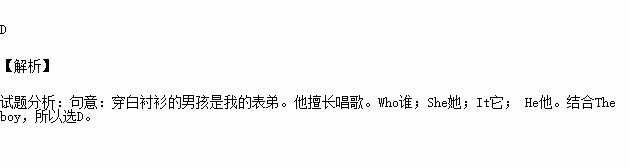
The boy in a white shirt is my cousin. ___________ is good at singing.
A. Who B. She C. It D. He
Only ___________ the students exercise for more than half an hour every day.
A.five percent B.five percents
C.five percent of D.five percents of
We often ask for information or help, especially(尤其) when we visit a foreign country. So knowing how to ask for information politely is important. In English, “Where are the restrooms?” and “Could you please tell me where the restrooms are?” are correct English, but the first could sound rude(粗鲁). It’s important to use correct language, but sometimes we need to learn how to be polite(礼貌).
In English, just like in Chinese, we change the way we speak when talking with different people. If you say to your teacher, “Where is my book?” This will sound rude. But if you say, “Excuse me, Mr West. Do you know where my book is?” Your question will sound much more polite. Of course it might be all right to say “Where is my book?” in some situations, perhaps with people you know well.
“Peter, lend me your pen.” can sound rude in English. Usually in English, polite questions are longer such as “Could you please…?” or “Can I ask…?” It sounds more polite to say, “Peter, could you please lend me your pen?” Sometimes we might even need to spend some time when you stop a stranger in the street. We might first say, “Excuse me. I wonder if you can help me” or “I’m sorry to trouble you but,” before asking them for help.
It might seem that speaking politely is more difficult than being direct(直接). However, in order not to offend(冒犯) people, learning about language etiquette(规矩) is just as important as learning grammar or vocabulary. And doing this will also help you become better at English, or any other language you wish to speak.
1.What is the polite way when you ask for help?
A. Pass me the watch, Li Tao.
B. Where is the supermarket?
C. Tell me where I can find a bank.
D. Excuse me, how could I get to the book shop?
2.Why do we need to learn polite language? Because _____.
A. they can improve our grammar and vocabulary
B. they can help us become better at English
C. everyone wants to be polite
D. the teachers tell us to do so
3.What’s the main idea of the passage?
A. When and how to use correct language is important.
B. How to start a polite talking with strange people.
C. Correct language is as important as polite one.
D. People should learn to speak politely.
—May I use your bike? —_____
A. Of course not.
B. Of course. Here you are.
C. I don’t have a bike.
D. No, thanks.
句型转换。
1.I often visit my grandparents during the summer holiday. (用he做主语改写)
He often grandparents during the summer holiday.
2.Lucy does the homework every evening. (改为一般疑问句)
Lucy the homework every evening?
3.People often plant trees in the park every spring. (对划线部分提问)
people often plant trees every spring?
4. There are some football cards in the bag. (改为否定句)
There football cards in the bag.
5.What about going to the park for a walk? (改为同义句)
go to the park for a walk?
—Boys and girls, welcome to my home and ____.
--Thank you.
A. help yourself B. help yourselves
C. helps yourself D. help you
Because of the dry weather, trees have died in this area and is over 100.
A. the number; a number of
B. a number of; the number
C. the number of; a number of
D. a number of; the number of
People usually give us some apples_______ a treat.
A. like B.in C.for D.as
The elephant can eat plants a day.
A.14kilo of B. 14kilo
C. 14kilos of D. some kilo of