题目内容

根据所给中文,完成句子翻译。

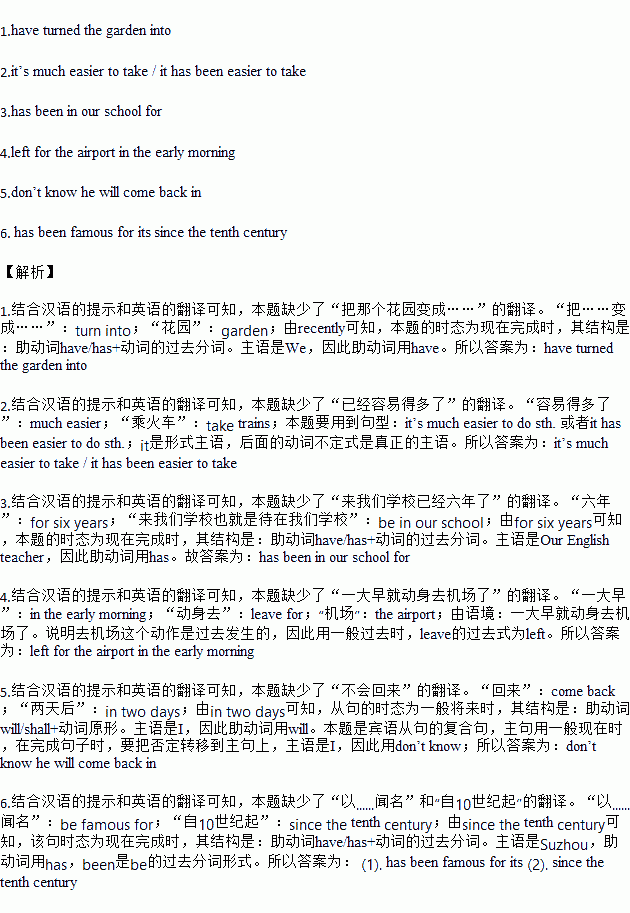
1.我们最近把那个花园变成了游泳池。

We ______________________________________________ a swimming pool recently.

2.现在从我们家乡到杭州有直达火车已经容易得多了。

Now______________________________ direct trains from our hometown to Hangzhou.

3.我们的英语老师来我们学校已经六年了。

Our English teacher ____________________________________________ six years.

4.我和父母一大早就动身去机场了。

My parents and I ______________________________________________________.

5.我想他两天后不会回来。

I ____________________________________________________________two days.

6.自10世纪起,苏州就以它的丝织业闻名。

Suzhou _________________________________ silk industry____________________.
练习册系列答案
相关题目

A man walked into a restaurant. The restaurant advertised (宣传) that it had the ______menu in the world. The manager was very proud of being able to provide any dish, no matter how (无论怎样) ______ it was.

At the bottom of the ______, there was a notice that said, “If you do not see the dish you need on this menu, please tell us and we will ______ it to the menu at once.”

The man ____ the menu and decided to make sure if it was true. He would order (点…菜) ______ that was very unusual.

When a waiter came up to take his order, he said, “You say you can serve ______ dish, even if it’s not your longest menu in the world.”

“That’s right, sir. We are able to meet everyone’s requirements (要求).”

“Well,” the man said, “Bring me a sandwich with two elephant ears. ____, not African.”

The waiter wrote down on his paper: Two Indian elephant ears on bread.

“Very good, sir,” he said. “That shouldn’t ______ long.”

The waiter walked away quickly.

The man was very surprised. Then he smiled ______ the waiter returned with a very unhappy look on his face.

“Ah!” the man said. “You can’t ______ it to me, can you?”

The waiter made an apology (道歉).

“I’m very ______, sir, and this is the most embarrassing (令人尴尬的),” he said, “but I’m afraid we can’t because we’ve run out of bread.”

1.A. biggest B. thickest C. heaviest D. longest

2.A. unfair B. unusual C. beautiful D. important

3.A. menu B. dish C. restaurant D. table

4.A. add B. buy C. sell D. make

5.A. looked for B. took out C. looked at D. picked up

6.A. anything B. nothing C. everything D. something

7.A. any B. some C. each D. every

8.A. American B. Indian C. Canadian D. Australian

9.A. pay B. cost C. take D. spend

10.A. as B. any C. so D. though

11.A. catch B. take C. fetch (去拿) D. bring

12.A. happy B. sorry C. excited D. right

How could we tell time if there were no watches or clocks anywhere in the world? The sun was probably the world’s first “clock”, except in the far north, where the Eskimos live. There, it’s dark most of the winter, and light most of the summer. But in most of the world, people have used the sun for a clock. Even today, if you don’t have a clock, you still know that when the sun shines, it’s day, and when it’s dark, it’s night. The sun can also tell you if it’s morning, noon, or afternoon.

People who live near the sea can tell time from the tides. In the daytime, for about six hours, the water rises higher and higher on the beach. And then it goes down and down for about six hours. The same thing happens again at night. There are two high tides and two low tides every 24 hours.

Seamen on a ship learn how to tell time by looking at the moon and the stars. The whole sky is their clock.

In some places in the world the wind comes up at about the same time every day or changes direction or stops blowing. In these places the wind can be the clock.

A sand clock is an even better clock. If you had fine dry sand in a glass shaped like the one in the picture, you would have what is called an hourglass. The sand in the hourglass goes from the top part to the bottom part in exactly one hour. When the hourglass is turned over, the sand will take another hour to go back again.

1.According to(根据)the passage, there are _______ ways to tell time besides the clock and watch.

A. 3 B. 4 C. 5 D. 7

2.The Eskimos in the far north can’t use the sun for a clock because __________.

A. they know very little about the sun

B. the sun there never goes down in winter

C. it’s too cold for them to go out to watch the sun

D. it has long dark winters and long light summers

3.The underlined(下划线)word “tides” in the passage means __________.

A. 洋流 B. 潮汐 C. 海啸 D. 波浪

4.What’s the best title for the passage?

A. Different Ways to Tell Time B. Useful Machines to Tell Time

C. The History of the Clock D. The Development of the Clock

违法和不良信息举报电话:027-86699610 举报邮箱:58377363@163.com

精英家教网