题目内容
The food on the table smells ________.
- A.nicely
- B.well
- C.delicious
- D.badly

 精英口算卡系列答案
 应用题点拨系列答案
 状元及第系列答案
 同步奥数系列答案
They drove on to Sand field, the next town. They got there the next morning. Mr Hill looked at his watch.
"Why did it take us so long? " he asked. "Three hundred and four kilometers in seven hours?"
Mrs Hill went white in the face. "Something is strange, "she said." But I can't remember anything."
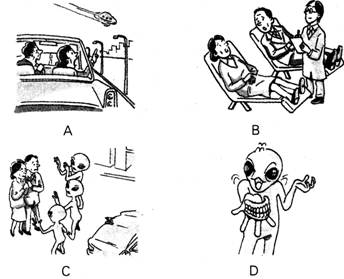
Later, with the help of, a doctor, they remembered everything. After they saw the spaceship, they got out of their car and then they "lost" several hours.
They remembered they heard a "bleep, bleep" noise from the spaceship. When they tried to run back to their car, there were three aliens (外星人) between them and their car.
The aliens took them to their spaceship. They asked them questions about the food and drink on Earth. They were very interested in Mr Hill's teeth because his teeth could come out!
Finally, the aliens took them back to their car and the spaceship flew away.
【小题1】What time do you think the Hills arrived at Sand field?
| A.At4 a.m. on 15 September. | B.At 4 a.m. on 16 September. |
| C.At 6 a.m. on 15 September. | D.At 6 a.m. on 16 September. |
| A.Short way but long time. | B.Short time but long way. |
| C.Poor memory during the drive. | D.Careful driving on Motorway 3. |
a. they got out of the car b. they saw a spaceship
c. they were asked some questions d. they met three aliens
| A.b;a;d;c | B.a;b;c;d |
| C.d;a:b:c | D.c:d:b:a |
One thing that British and Chinese cultures share is a love for tea. Today, when we think of western tea culture, we often think of the English and beautiful china tea cups.
Afternoon tea:
People believe that an English lady, Anna, first introduced the idea of afternoon tea. In the 18th and 19th centuries, the English ate only two main meals each day, breakfast and a heavy supper that would last for several hours in the evening. As a result, people often got very hungry during the long wait between these two meals. To solve this problem, Anna came up with the clever idea of inviting some friends to join her for an afternoon meal between four and five o’clock. This meal included cakes, sandwiches, and tea was served to wash down the food. In order to make this afternoon meal important, fine china cups, plates, and silver teapots, knives, forks and spoons were used. Soon, afternoon tea parties became popular social occasions. Today, afternoon tea parties continue to play an important part in the social life in modern Britain.
Will you come for coffee:
Coffee also has an important role in British culture. People often use words “Will you come for coffee?” to mean “Would you like to come to my home for a chat?” Normally, several different drinks such as tea, hot chocolate or a soft drink like orange juice will be served as well as coffee, and you will be asked what you would like. However, you will not normally be offered wine at a “coffee” party.
Coffeehouses and the London Stock Exchange:
In the 17th century London coffeehouses were busy and noisy places. Businessmen and bankers went to coffeehouses to do their business, as well as to drink coffee. In fact, the London Stock Exchange(股票交易所)is believed to be started from these coffeehouses.
【小题1】Anna introduced the idea of drinking afternoon tea because she ____________.
| A.enjoyed chatting with her friends at home |
| B.loved tea and beautiful china tea cups |
| C.wanted to share nice food with her friends |
| D.found people felt hungry during the long wait between the two meals |
| A.集体婚礼 | B.社交活动 | C.社区表演 | D.公共场合 |
| A.will be offered coffee only |
| B.will be asked what you would like to drink |
| C.will be asked to have a chat with him or her |
| D.are invited to take part in an afternoon tea party |
| A.a new business was started in coffeehouses |
| B.coffeehouses are still used by businessmen and bankers |
| C.businessmen and bankers went to coffeehouses just for coffee |
| D.most people wouldn’t like to go to coffeehouses because of the coffee |
| A.British and Chinese Culture |
| B.The Beginning of Tea and Coffee |
| C.Coffeehouses and Business |
| D.English Tea and Coffee Culture |