题目内容
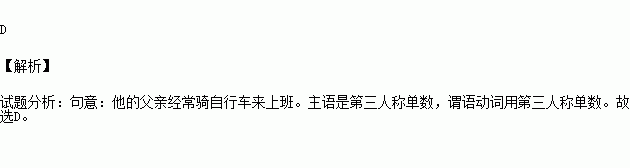
.His father often ___________to work.
A.takes a bike B.by bike C.on foot D.rides a bike
根据所给单词或中文提示在空格内写出其正确形式。
1.The Smiths have decided to move house because of water _________(pollute).
2.Simon shouted to me, “ It’s none of your _______________(busy).”
3.Tim’s relative has been ___________(die) for two weeks.
4.The young girl hopes to get ____________(marry) soon.
5.Snakes live on birds and _____________ (mouse).
6.Chinese market is much ____________(huge) than before.
7.Broadway has been famous for its theatres since the early _________(twenty) century.
8.The ___________(Asia) games take place every four years.
9.When we were young, all of us have a lot of _____________(美妙的) dreams.
10.After watching the football match, all the boys still felt ___________(激动的).
11.More and more people like to travel _________(去国外) to spend their holidays.
12.They had to stay in the __________(国际的) airport because of the bad weather.
13.I think both of the _____________(网站) are good for children.
14.Come on, boy! You need to _____________(放松).
15.Have you ever been to _____________(欧洲) before ?
请先通读下面的短文,掌握其大意,然后从每小题所给的A、B、C、D四个选项中选出最佳选项,并在答题卡上将该项涂黑。
I have had thousands of classes since I started school nine years ago. But only one was the most important.
It happened last term just after I had got a result in an exam. I was sad and had lost my confidence. I decided to go to a class which can tell me how to be .
The speaker walked into the room. But he did not start talking a teacher. In-stead, he held up a twenty yuan note(钞票) !
"Who wants this?" he asked. Unsurprisingly, of us in the class held up our hands.
The speaker smiled. Then he put up the note on the blackboard and asked the same question. Again, we all put up our hands. The speaker smiled again, but nothing. Sud-denly, he threw the note onto the floor! Then he asked the same a third time.
I didn' t what the speaker was doing. Why was he asking the same question again and again? I didn't know what to do. I wanted the note, I put my hand up again. Af-ter a while, he the note and started to laugh. "You have all just told me how to be-come successful, " said to us with the note in his hand.
"The note is worth twenty yuan. It is worth twenty yuan, even though I throw it on the floor. You are like the note. No matter happens to you, you still have your worth."
When I heard those words, I was deeply moved. Suddenly, I I was worth a lot. I may have done in an exam, but it doesn't I can' t do well in the future. If I believe in myself, I will be successful!
1.A. classroom B. subject C. class D. school
2.A. same B. good C. lucky D. bad
3.A. comfortable B. successful C. famous D. rich
4.A. like B. for C. about D. by
5.A. both B. neither C. all D. none
6.A. said B. bought C. saw D. wanted
7.A. student B. teacher C. question D. way
8.A. remember B. understand C. notice D. find
9.A. so B. though C. if D. or
10.A. took out B. threw away C. picked up D. put down
11.A. you B. he C. she D. they
12.A. never B. sometimes C. hardly D. always
13.A. when B. who C. what D. how
14.A. realized B. forgot C. dreamed D. decided
15.A. know B. mean C. think D. complain
—Did you hear the news about the fire in our building?
—Yes. It took the firemen two hours to __________ the fire.
A. put off B. put out C. put up D. put down
阅读短文,根据短文内容回答问题
People have always wanted to know what our future will look like. Go on reading this text, and you will know what will happen in the next fifty years.
How can we know what the future will look like? To be able to understand the future, you have to know the past, what has taken us to where we are today and what has changed along the way? The world has changed a lot in the last 150 years, but people are driven by the same basic needs as they were 150 years ago. Will this change in the next 150 years? No.
What inventions have really made a different in the last 150 years? In the past years, the inventions that have changed most people’s everyday life are telephone, radio, television, computer, the car and the internet. Then we of course have a lot of inventions that have made life easier, like new medicine, faster cars, trains, etc. In general, people have been working hard in the last 150 years to make inventions that will make the world a better place. Since there is still much to do in the area, this will be important for at least the next 150 years.
Why do we need to guess the future? Guessing the future is important for two reasons: First, we need to start to think about what kind of future we would like for ourselves and our children. And then we need to know what decisions we need to make today that will give us the best future.
1.What does the author try to tell us in the second paragraph?A.Our basic needs will not change in the future.
B.The world is quite different from what it was.
C.Humans will no longer enjoy food in the future.
D.The world will be completely changed tomorrow.
2.Our past inventions have made .
A.our daily life more stressful
B.it easy for us to live
C.our work easily done
D.us work less time
3.What will humans do in order to keep the world under control?
A.To produce more cars for transportation.
B.To spend more time working on the Internet.
C.To work much harder to achieve their goals.
D.To focus on making more inventions.
Of all the students in his class, Xiao Ming writes_______________.
A. very careful B. the most careful
C. most carefully D. much more carful
In Britain, people often invite friends for a meal, a party or just coffee. People who know each other very well—close friends, family or neighbors—visit each other's houses without an invitation(邀请), but usually an invitation is needed. When people invite someone to their homes, they often say, “Would you like to come for dinner on Saturday?” Answers are:“ Thanks. We'd love to. What time?” or “I'm sorry. We'd love to but we have tickets for the concert.” However, it is not polite to say “No, we wouldn't!”
Sometimes, the British use expressions(表达) that sound like invitations but which are not invitations. For example, “You must come over for a drink sometime.” or “Let's go out for a meal one of these days.” These are usually just polite ways of ending a talk. They are not real invitations because they don't mention(提及)a certain time or day. They just show that the person is trying to be friendly and the answers are, “Yes, that would be nice.” or “OK, yes, thanks.”
So next time you hear what sounds like an invitation, listen carefully. Is it a real invitation or is the person just being friendly?
1.It is not polite to answer the real invitation by saying “_________”
A. Sorry, we'd love to but we have tickets for the concert.
B. Thanks. We'd love to. What time?
C. Sure. We'd like to, thanks a lot.
D. No, we wouldn’t!
2.If the British just want to end a talk politely, they may say, “_________”
A. Would you like to come for dinner on Saturday?
B. Let's go out for a meal one of these days.
C. Let's go out for a meal on Saturday.
D. Shall we go for a drink this afternoon?
3.The British often use “________” to answer the invitations that are not real.
A. Yes, what time?
B. No, that's not a real invitation.
C. OK, yes, thanks.
D. No, you just want to be friendly.
4.Which is the best title (标题) for the passage?
A. Britain
B. Invitation
C. A talk with friends
D. A letter to friends
书面表达
假如李家湾(Lijiawan)是对外开放单位,请用英语为来访外宾写一篇短文,介绍
该村的简况。
要点如下:(词数80个左右)
1. 李家湾远离城镇,有2,000多人口;
2. 过去这里没有工厂、学校,村民们(villagers)生活艰苦;
3. 1990年以来该村发生了很大的变化;
4. 现在村里已有两家工厂和一所学校;
5. 村民们都住进了新居,生活越来越好。
6. 这些变化给这个镇带来了优势,但也导致了很多问题。空气污染比其它镇多。
________________________________________________________________________________________
If you want to talk to your teacher, you should _ _first.
A. called to her B. called up her
C. call her up D. called her up

 名校课堂系列答案名校课堂系列答案