题目内容
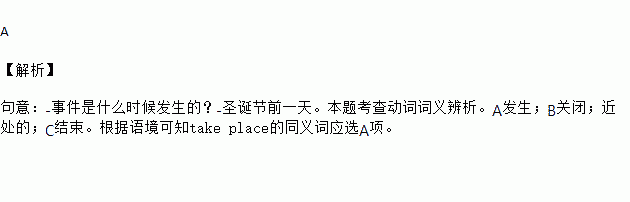
— When did the event take place?
—The day before Christmas.
A. happen B. close C. end
We often do lots of experiments in our ________ classes.
A. chemical B. history C. Chinese D. physics
As traditional Chinese art, paper cutting has a long history. The first and earliest paper cutting was found in China 1,500 years ago. But this traditional art is at risk of disappearing now. Luckily, Voyo Woo, a Chinese immigrant(移民)in America, is trying to bring this art back to life.
One Saturday in 2014, Ms. Woo held a paper cutting show at a shopping center near Washington. She got much fun and peace doing it. She hoped more people would enjoy it.
Ms. Woo began to study the art of paper cutting as a 14-year-old girl in her hometown in China. She said all the students at school had to learn paper cutting. But she had a deep love for it. So her teacher spent more time teaching her after class. Later, she won the second prize in a national painting and art competition. Ms. Woo went to America after she finished collage in 2008. Soon after that, she took part in an activity to promote(宣传)Chinese paper cutting. And then she was invited to show the art in many important activities. “It is important to promote this art to Americans or anyone who is interested in it. Maybe it will make this art more popular. ”Woo said.
From the art of paper cutting, people can know about Chinese cultural values, history and stories of people’s life. Ms. Woo uses the art as a tool to show Chinese culture to people who know little about it. Chinese art is not only for Chinese, but also for people all over the world.
1.In the passage, the writer thinks the art of paper cutting is________ now.
A. very popular in America B. very popular in China
C. for people who know about it D. in danger of disappearing
2.What did Ms Woo do in 2014?
A. She won the second prize in a national painting and art competition.
B. She was invited to many activities to show paper cutting.
C. She held a paper cutting show at a shopping center near Washington.
D. She took part in an activity to promote Chinese paper cutting.
3.Ms. Woo began to study the art of paper cutting_______.
A. when she was fourteen B. after she got to America
C. when she was in college D. after she finished college
4.What’s the writer’s opinion about paper cutting?
A. Paper cutting doesn’t have a long history.
B. People can know about Chinese cultural values, history and stories of people’s life from paper cutting.
C. Ms Woo uses the art as a tool to show American culture to people.
D. Chinese art is only for Chinese.
Amy Cuddy thinks positive (积极的) body language includes things like proper eye contact, active listening, and gestures. Studies show that people who use positive body language are more likely to be accepted. However, most people don’t realize the importance of it. This passage may change their ideas.
Positive body language changes your attitude (态度).
Cuddy found that changing your body language to make it more positive improves your attitude because it makes a great difference to your body.
Positive body language makes you be liked more easily.
In a study, people watched soundless videos of doctors getting along with sick people. Just by studying the doctors’ body language, people were able to guess which doctors were more popular. Body language plays a big role in how you’re treated (被对待) and can be more important than your voice. Learning to use positive body language will make people like you and trust you more.
It improves your EQ (情商).
Your ability to express your emotions and ideas is important to your EQ. People without positive body language have a bad effect on people around them. Working to improve your body language has a great effect on your EQ. We often think of body language as the result of our attitude or how we feel. This is true, but scientists have also shown that the opposite is true.
1.What are the people like if they use positive body language?
A. Interesting. B. Hard-working.
C. Popular. D. Intelligent.
2.Why does developing positive body language improve one’s attitude?
A. It has a great effect on one’s body.
B. It decides how one is treated.
C. It makes one more positive.
D. It makes one have high EQ.
3.What is the purpose (目的) of the study?
A. To further support the main idea.
B. To show us the main idea.
C. To introduce the topic.
D. To give us a happy ending.
4.What does the underlined word “This” refer to?
A. Your attitude doesn’t change your body language at all.
B. Changing your attitude changes your body language.
C. Your attitude has nothing to do with your body language.
D. Your body language is not the result of your attitude.
5.Who was this passage written for?
A. People who are good at using body language.
B. People who don’t take body language seriously.
C. People who want to be more intelligent than others.
D. People who are interested in using body language.
— What’s your secret of living a healthy life?
—I exercise three times a week to keep ________________.
A. fit B. funny C. happy
— What should people do if they fall into a pool?
— they should try to hold their heads above the water.
A. shake B. nod C. keep
阅读下面短文,根据短文内容判断句子正误。正确的涂“A”,错误的涂“B”。
Hello! my name is Li Lei. I am a Chinese boy. I have three good friends. They are Bob, Jim and Jenny. We like sports.
My favorite sport is ping-pong. It's interesting. I have ten ping-pong bats and six ping-pong balls. They are all in a big box under my bed.
Bob and Jim are both American boys. They think ping-pong is boring. Their favorite sport is basketball. They think basketball is relaxing and fun. They often play basketball together at school. They have three basketballs. Bob's two basketballs are in his bedroom. And Jim's basketball is in the classroom.
Jenny is an English girl. Her favorite sport is volleyball. She thinks it's easy and fun. She plays it well. She has nine volleyballs and four tennis rackets. They are in her mother's room.
1.Li Lei has three American friends.
2.Li Lei doesn’t like ping-pong, but Jim and Bob do.
3.Bob and Jim often play basketball together at school.
4.Both Bob's and Jim's basketballs are in the classroom.
5.Jenny likes volleyball best.
阅读下面短文。根据短文内容,从短文后的选项中选出适当的选项补全短文(有一多余选项),并将选项的编号依次填涂在相应位置(即选择题79-83题)。
“kwik kwik-kwik”1.It's the common cuckoo(布谷鸟). They live in the trees in many countries. When can you see them? 2.
The birds don't build(修建)nests(鸟巢). They don't raise(养育) young birds,either3. How do they do that? 4.They have a special skill(特殊技能):they can copy(模仿) the sound of other birds' enemies(敌人). When other birds hear the sound,they become scared(感到害怕的)and fly away. 5. They are sneaky(鬼祟的)birds!
A.The answer(答案)is the sound they make.
B.Who makes that sound(声音)?
C.The cuckoos then go to their nests to lay eggs.
D.You may see them during summer.
E.They lay(下蛋) their eggs in other birds' nests.
F.The cuckoos likes eating(吃) worms very much.
根据下列要求完成句子。
1.Caitlin went away angrily after she found out the truth.
Caitlin went away angrily after ______ ________ the truth
2.Not only students, but also teachers like the smart well-behaved boy very much
Students,______ ______ _____ teachers like the smart well-behaved boy very much
3.James doesn't believe in anything he says. I don't believe in it,either.
James doesn't believe in anything he says. ______ __________ _________
4.You have to drive on.Look at the sign! It says “Don't Park”.
You have to drive on.Look at the sign! It says “_________ ________”.
5.The new apartment's got very little future in it,________________?(tag question)
6.Jon visited his parents once a month after he got a job with the new company.
(Please emphasize the underlined part)
7.Jenny told us an extremely wonderful story last night.
(Please change it into an exclamatory sentence)
8.A lot of action films were too violent for children under 16 to watch
(Please rewrite the sentence with “so ...that...”)
9.It took James two hours to finish typing the letter yesterday.
(Please ask a question according to the underlined part)
10.We all think that travelling by plane is the safest and fastest way.
(Please change it into a simple sentence)