题目内容

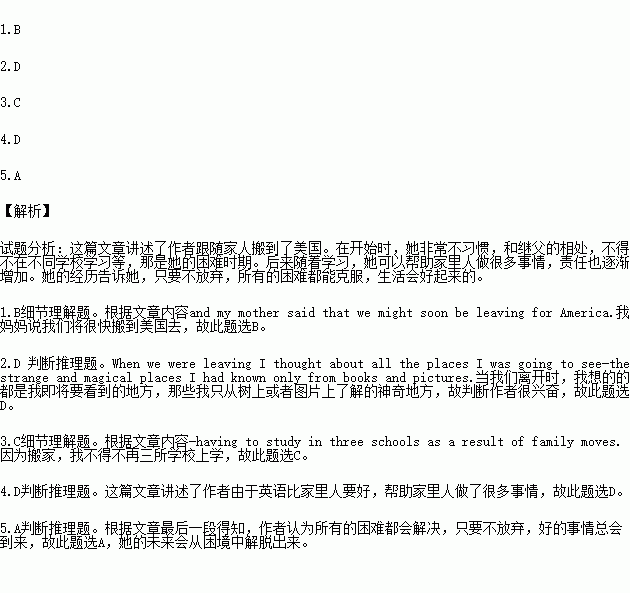
I began to grow up that winter night when my parents and I were returning from my aunt's house, and my mother said that we might soon be leaving for America. We were on the bus then. I was crying, and some people on the bus were turning around to look at me. I remember that I could not bear the thought of never hearing again the radio program for school children to which I listened every morning.

I do not remember myself crying for this reason again. In fact, I think I cried very little when I was saying goodbye to my friends and relatives. When we were leaving I thought about all the places I was going to see-the strange and magical places I had known only from books and pictures. The country I was leaving never to come back was hardly in my head then.

The four years that followed taught me the importance of optimism (乐观主义), but the idea did not come to me at once. For the first two years in New York I was really lost-having to study in three schools as a result of family moves. I did not quite know what I was or what I should be. Mother remarried, and things became even more complex for me. Some time passed before my stepfather and I got used to each other. I was often sad, and saw no end to "the hard times."

My responsibilities in the family increased a lot since I knew English better than everyone else at home. I wrote letters, filled out forms, translated at interviews with immigration officers, took my grandparents to the doctor and translated there, and even discussed telephone bills with company representatives.

From my experiences I have learned one important rule: Almost all common troubles eventually go away! Something good is certain to happen in the end when you do not give up, and just wait a little! I believe that my life will turn out all right, even though it will not be that easy.

1. How did the author get to know America?

A. From her relatives. B. From her mother.

C. From books and pictures. D. From radio programs.

2.The writer felt_______ upon leaving for America.

A. worried B. upset C. amazed D. excited

3.For the first two years in New York, the author .

A. often lost her way

B. did not think about her future

C. studied in three different schools

D. got on well with her stepfather

4.What can we learn about the author from Paragraph 4?

A. She worked as a translator.

B. She attended a lot of job interviews.

C. She paid telephone bills for her family.

D. She helped her family with her English. .

5. The author believes that .

A. her future will be free from troubles

B. it is difficult to learn to become patient

C. there are more good things than bad things

D. good things will happen if one keeps trying
练习册系列答案
相关题目

Around the world, people have different ideas about what good manners are.

When you go to restaurants in different parts of the world, it’s to know the right and wrong things. For example, in China it’s OK to a lot of noise in a restaurant. In fact, if a restaurant isn’t noisy or , you may think there is something wrong with it. However, in many western countries, restaurants are places. If a table is too loud, other people who are eating there even to to complain(抱怨) to the owner(主人) of the restaurant.

Paying the bill is also different country to country. In China, one person usually pays for 6 . In western countries, one person pays if he or she is entertaining clients(宴请宾客), but 7 friends eat together, they usually share the cost. This is called “going Dutch”(均摊费用). Also, when westerners pay the bill, they usually leave some money for the waiter. This is called “leaving a tip”. Leaving a tip is thought to be . In the U.S., it’s to leave tips of 10%, 15%, or 20% of the bill, which is decided by how good the service is. Good waiters can make a lot of money!

The food people eat is different in the world, but you can the same kind of food in many countries. Chinese and Italian food, for example, are popular all over the world.

1.A. popular B. difficult C. important D. easy

2.A. cause B. keep C. hear D. make

3.A. lively B. friendly C. lucky D. happy

4.A. noisy B. quiet C. busy D. clean

5.A. at B. to C. from D. of

6.A. everybody B. nobody C. somebody D. none

7.A. until B. when C. unless D. since

8.A. badly B. bad C. polite D. impolite

9.A. terrible B. common C. serious D. usually

10.A. invent B. find C. prefer D. look for

Dear Boris,

Thanks for your nice letter.

After I had spent a week with my English family, I slowly began to understand their English a little better. It’s very different from what I learned at school! Students in my group are from different cities of Britain and their dialects (方言) are different too! Some of their accents (口音) are quite strong and they also have their own words and expressions.

But it’s not the language that’s different and surprising. Before I came to England I had thought that fish and chips were eaten every day. That’s quite wrong! I get rather mad now when I hear all the foolish words about typical (典型的) English food.

I had expected to see “London fog”. Do you remember our texts about it? We had no idea that most of this ‘thick fog’ disappeared many years ago when people stopped using coal in their homes. But the idea to speak about the weather was very helpful. The weather in London is really changeable.

On the other hand habits are different. People tell me what is typically British here in London is not always typical in Wales or Scotland. Local habits and traditions are not the same as what we knew.

But what is ordinary for all British is that they follow traditions. Probably Britain has more living signs of its past than many other countries. And people have always been proud of having ancient buildings in capitals, big cities and the countryside.

I will tell you more about Britain in my other letters.

Love from Britain,

Peter

1.What does Pete feel about the English language?

A. At first it was difficult for him to understand people.

B. He can understand different dialects and accents.

C. He can speak English better than others.

D. People can’t understand his English.

2.Typical English food _______.

A. makes people mad B. can’t be seen now

C. is always fish and chips D. is not what he knew

3.The British people like to talk about weather because ________.

A. there is thick fog in London

B. they like the weather in Britain

C. the weather changes a lot

D. it can be helpful

4.What do you know about habits in Britain from the passage?

A. They are not the same in different parts of Britain.

B. Habits in Wales and Scotland are typically British.

C. There are no typical British habits in Britain.

D. All that is typically British is in London.

5. Which is NOT true according to the passage?

A. What he’s seen is quite different from what he’d learned

B. British people like to follow traditions.

C. Peter had learned about Britain before.

D. Peter doesn’t like his life in Britain.

违法和不良信息举报电话:027-86699610 举报邮箱:58377363@163.com

精英家教网