题目内容

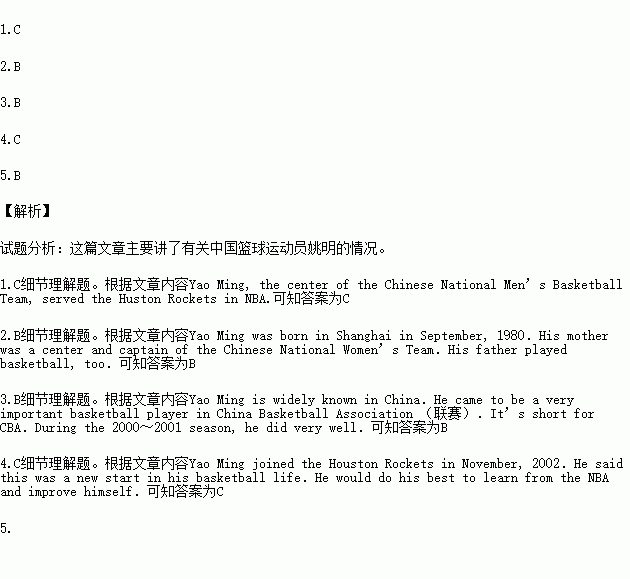
Yao Ming was born in Shanghai in September, 1980. His mother was a center and captain of the Chinese National Women’s Team. His father played basketball, too.

Yao Ming is widely known in China. He came to be a very important basketball player in China Basketball Association (联赛). It’s short for CBA. During the 2000~2001 season, he got 27. 1 scores for the Shanghai Oriental (东方) Sharks in every match.

Yao Ming joined the Houston Rockets in November, 2002. He said this was a new start in his basketball life. He would do his best to learn from the NBA and improve himself.

Sport analyst (分析家) Bill Walton said, “Yao Ming has the potential (潜力), the capability(能力) of changing the future of basketball.”

1.The Houston Rockets is the name of a ______ team.

A. table tennis B. volleyball C. basketball

2.Both Yao Ming’s father and mother were ___________.

A. football players

B. basketball players

C. the centers of the Chinese National Team

3.Yao Ming ________ in CBA during the 2000~2001 season.

A. did badly B. did well C. was good

4.Yao Ming ________ the Houston Rockets in November, 2002.

A. did his best to join

B. was well-know in

C. became a member of

5.Sport analyst Bill Walton thought Yao Ming was able to _______.

A. learn from the NBA

B. change the future of basketball

C. improve himself
练习册系列答案
相关题目

All the time you spent memorizing multiplication tables(乘法表)may have made you a better mathematician, according to a new study. A team of scientists from Stanford University, in California, have shown how the brain reorganizes itself as kids learn math.

After a certain amount of time spent practicing math, kids can put away the calculator(计算器). They don’t even need to count on their fingers. They simply know the answers to subtraction(?), addition (+), and multiplication (×) facts. The quicker kids can recall basic math facts, the easier it is for them to solve more difficult math problems.

The Stanford University researchers observed(观察)the brain activity of 28 students, ages 7 to 9, for the study. They took scans of the students’ brains as the students solved math calculations without the help of a calculator, pen or paper. A calculation—three plus four equals seven, for example—flashed on a screen. The students pushed a button to say if the answer was right or wrong. The scientists also recorded the response speed, and what parts of the brain became active as the kids pushed the button.

These observations showed a process called fact retrieval. Rather than using their fingers to count, or scrawling out equations(列算式)on a piece of paper, the students pulled the answers from memory. It’s as if the answers to basic subtraction, addition, and multiplication problems are kept in a long-term storage part in the brain. The storage part was built from repetition. “Experience really does matter,” said Dr. Kathy Mann Koepeke of the National Institutes of Health.

Children make the changefrom counting to fact retrieval when they are 8 to 9 years old, the study says. This is the time when most students are learning basic addition and subtraction. When kids have basic math facts memorized, the brain has more free space to learn more difficult math.

This process has benefits for the future. The study showed, as kids got older, their answers relied more on memory and became quicker and more correct. Less brain activity was involved in counting. Some children make this change quicker than others.

Scientists hope to use this research to develop new strategies(策略)to help kids learn math at all levels. One strategy the study suggests is for students to test themselves in different orders—solving five times three before five times two, for example. Mixing up the order keeps the brain active. Keep these trainings up, and you may be a math whiz in no time.

1. In the study, kids put away calculators because they can ______.

A. use calculators well

B. scrawl out equations

C. recalling basic math facts

D. count on their fingers

2.The process of “fact retrieval”in Paragraph 4probably means ______.

A. picking out results by working together with their partners

B. finding out answers based on practicing carefully and patiently

C. trying out ways of dealing with problems by attending training

D. working out problems according to what they have remembered

3.What can we know from the study?

A. Kids need to practice using calculators to keep their brains active.

B. Math learners should change to counting practice at the age of 8 to 9.

C. Training by mixing up the order of multiplication tables can help learn math better.

D. Less brain activity may be involved in solving difficult problems when kids get older.

4.What is the best title of the passage?

A. Math from Memory B. Strategy Development

C. Brain Reorganization D. Training by Repetition

违法和不良信息举报电话:027-86699610 举报邮箱:58377363@163.com

精英家教网