题目内容
完成句子。
1.----打扰一下,请问你能告诉我如何去书店吗?
---- 当然。沿着主大街走,直到经过中央大街。
---Excuse me, could you please tell me _______ _______ _______ ________ the bookstore?
--- Sure, just ______ _______ Main Street_______ ___ ________ Center Street.
2.请到二楼。银行和超市之间有一家饭店。
Please go to ______ _______ _______. There is a restaurant _______ the bank ______ the supermarket.
3.你知道洗手间在哪里吗?
Do you know _______ _______ ________ ________ ?
4.书店就在你的右边,银行的旁边。
The bookstore is _____ ______ _______, _______ _______ the bank.
1.how to gettogo alonguntil youpass 2.the second floor betweenand 3.wherethe restrooms are 4.on yourrightnext to 【解析】 1.“特殊疑问词+动词不定式”这种结构,它是名词性短语,在句子中可以做主语和宾语;how to get to the bookstor...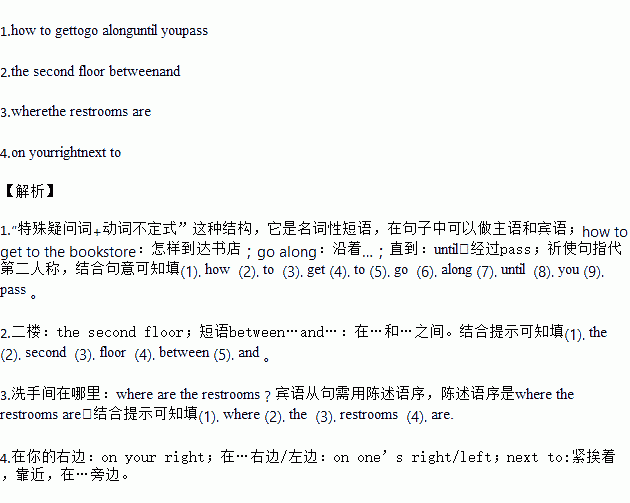

 学练快车道快乐假期暑假作业新疆人民出版社系列答案
 浙大优学小学年级衔接导与练浙江大学出版社系列答案
 小学暑假作业东南大学出版社系列答案
 津桥教育暑假拔高衔接广东人民出版社系列答案
 波波熊暑假作业江西人民出版社系列答案
Teamwork is just as important in science as it is on the playing field or in the gym. Scientific investigations (调查) are almost always carried out by teams of people working together. Ideas are shared, experiments are designed, data are analyzed, and results are evaluated and shared with other investigators. Group work is necessary, and is usually more productive than working alone.
Several times throughout the year you may be asked to work with one or more of your classmates. Whatever the task your group is assigned, a few rules need to be followed to ensure a productive and successful experience.
What comes first is to keep an open mind, because everyone’s ideas deserve consideration and each group member can make his or her own contribution. Secondly, it makes a job easier to divide the group task among all group members. Choose a role on the team that is best suited to your particular strengths. Thirdly, always work together, take turns, and encourage each other by listening, clarifying, and trusting one another. Mutual (相互的)support and trust often makes a great difference.
Activities like investigations are most effective when done by small groups. Here are some more suggestions for effective team performance during these activities: Make sure each group member understands and agrees to the task given to him or her, and everyone knows exactly when , why and what to do; take turns doing various tasks during similar and repeated activities; be aware of where other group members are and what they are doing so as to ensure safety; be responsible for your own learning, though it is by no means unwise to compare your observations with those of other group members.
When there is research to be done, divide the topic into several areas, and this can explore the issue in a very detailed way. You are encouraged to keep records of the sources used by each person, which helps you trace back to the origin of the problems that may happen unexpectedly. A format for exchanging information (e.g., photocopies of notes , oral discussion, etc.) is also important, for a well-chosen method not only strengthens what you present but also makes yourself easily understood. When the time comes to make a decision and take a position on an issue, allow for the contributions of each member of the group. Most important of all, it is always wise to make decisions by compromise and agreement.
After you’ve completed a task with your team, make an evaluation of the team’s effectiveness — the strengths and weaknesses, opportunities and challenges.
Title | Working Together |
Theme | Effective performance needs highly cooperated 1.1.. |
General rules | Keep an open mind to everyone’s2.2.. Divide the group task among group members. 3.3. and trust each other. |
4.4. | ● Understand and agree to the 5.5. task of one’s own. ● Take turns doing various tasks. ● Show concern for others to ensure safety. ● Take6.6. for one’s own learning. ● Compare your own observations with those of others. |
Explore an issue | ● Break the7.7. into several areas. ● 8.8.the sources just in case. ● 9.9. your information with others via proper format. ● Make all decisions by compromise and agreement. |
10.10. effectiveness | ● Analyze the strengths and weaknesses. ● Find out the opportunities and challenges |