题目内容
“Cool” is a word with many meanings. Its old meaning is used to express a temperature that is a little bit cold. As the world has changed, the word has had many different meanings.
“Cool” can be used to express feelings of interest in almost anything. When you see a famous car in the street, maybe you will say, “It’s cool.” You may think, “He’s so cool.” when you see your favorite footballer.
We all maximize (扩大) the meaning of “cool”. You can use it instead of many words such as “new” or “surprising”. Here’s an interesting story we can use to show the way the word is used. A teacher asked her students to write about the waterfall they had visited. On one student’s paper was just the one sentence, “It’s so cool. Maybe he thought it was the best way to show what he saw and felt.
But the story also shows a scarcity (缺乏) of words. Without “cool”, some people have no words to show the same meaning. So it is quite important to keep some credibility (可信性). Can you think of many other words that make your life as colorful as the word “cool”? I can. And I think they are also very cool.
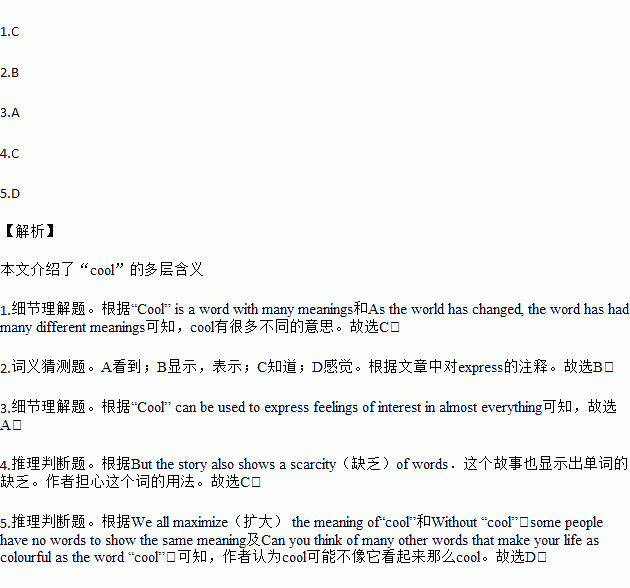
1.We know that the word “cool” has had ______.
A.only one meaning B.no meanings
C.many different meanings D.the same meaning
2.In the passage, the word “express” means “______”.
A.see B.show C.know D.feel
3.If you are ______ something, you may say, “It’s cool.”
A.interested in B.angry about C.afraid of D.unhappy with
4.The writer takes an example to show he is ______ the way the word is used.
A.pleased with B.strange to C.worried about D.careful with
5.In the passage, the writer suggests (暗示) that the word “cool” ______.
A.can be used instead of many words
B.usually means something interesting
C.can make your life meaningless
D.may not be as cool as it seems

 天天向上一本好卷系列答案
 小学生10分钟应用题系列答案
假设你是Lin Tao,根据表格中提供的信息写一封e-mail向你的笔友Kitty 介绍一下你的两位好朋友的过去与现在。80-120个单词。
Name | In the past | Now |
David | short, shy, play basketball | tall, outgoing , play football |
Yu Mei | Straight black hair, glasses | Curly brown hair, contact lenses(隐形眼镜) |
Dear Kitty,
I have two friends. One is David, and the other is Yu Mei.
_______________________________________________________________________________________________________________________________________________________________________________________________________________________________________________________________________________________________________________________________________________________________________________
Yours,
Lin Tao
Complete the table about countries, nationalities and capitals.
Country | Nationality | Capital |
1. | French | 2. |
America | American | 3. |
Spain | 4. | Madrid |
Japan | 5. | 6. |
Korea | Korean | 7. |
Russia | Russian | 8. |
Greece | Greek | 9. |
Egypt | 10. | Cairo |