题目内容
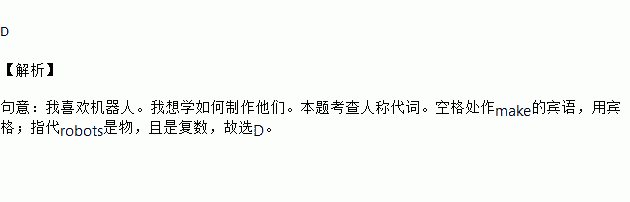
I like robots. I want to learn how to make ________.
A. it B. him C. her D. them
--Alice, please tell Eric to call me when he _____ back.
--No problem.
A. come B. comes C. came D. will come
How to investigate
①Planning
Decide on a scientific problem to investigate
For example, a student named Mary has decided to research into how quickly sugar dissolves(溶解) in water.
Write down your hypothesis
You may already have an idea of what you expect to happen in your investigation. This idea is called your hypothesis. It may not be right! It is just an idea, though it may be based on work in science which you have done before. The aim of your investigation is to test your idea.
Decide what variables(变量) you are dealing with Things like temperature, size, weight, and colour are called variables. Variables are things you can measure(测量).
In your investigation, you have to decide what the variables are, which ones you will keep fixed, and which you will change.
You need to change just one variable at a time. If lots of variables change at once.it won't be a good test.
Decide what equipment you need, and in what order you will do things
Prepare tables for your results
②Getting your evidence(数据)
•Make your measurements, and record your results
③Reaching conclusions
Look for patterns in your results
Present your conclusions
What links(关联) did you find between any of the variables? How would you explain these links?
④Checking your findings
Compare your conclusions and hypothesis
Do your results support your idea?
1.What does the underlined word "hypothesis" most probably mean?
A. reason
B. result
C. method
D. guess
2.In Mary's investigation, which of the following about the variables is true?
A. She can only change one variable at a time.
B. Some of the variables can't be measured.
C. Her weight and age can be the variables.
D. The temperature of water cannot be a variable.
3.What is the passage mainly about?
A. How to do a scientific research.
B. How to explain a scientific finding.
C. How to deal with a chemistry problem.
D. How to understand some chemistry knowledge.
根据对话内容从方框中选择能填入空白处的最佳选项补全对话,其中有两项多余。
A: Hello, Li Wei!
B: Hi, Su Qi!
A: I’m planning a trip to Beijing. 1.
B: Sure. What would you like to know about Beijing?
A: 2.
B: Yes, it is. It’s cool in autumn.
A: Great!3. Which place shall I visit first?
B: 4.
A: Sounds good! I will go there first. What else can I do in Beijing?
B: 5.
A: Thanks a lot.
B: You’re welcome.
A. I’ll go there in October (十月).
B. The Great Wall, of course.
C. Can we go there in May?
D. When will you go to Beijing?
E. You can also go shopping there.
F. Is autumn the best time to go there?
G. Can you tell me something about the city?
Xiaoming is 15 years old. He is able ________ a bike.
A. ride B. riding C. rides D. to ride
根据汉语意思完成句子。每空一词。
1.这个故事比另一个有趣的多。
This story is _______ _______ ______than that one.
2.法国以其葡萄酒而闻名。
France _______ _______ ______ its wine.
3.他们想创办自己的公司。
They want to _______ ______ their own business.
4.大明正在考虑去哪里过暑假。
Daming is _______ ________ where to spend the summer holiday.
This coat is ______ cheaper.
A. very B. quite C. little D. much
There was once a cave (岩洞) near a town. It was called “Cave of Fear”. Anyone who tried to enter it didn't return. People in the town said that there was a monster in the cave. In order to stop the monster from getting out of the cave, people often left gifts and food at the mouth of the cave, and these things always disappeared soon.
One day, a young man came to the town. When he heard about the cave, he decided to enter the cave and found out whether there was a monster in it. As he went deep into the cave, he heard some strange sounds. So he followed the sounds. Suddenly, he felt that something was pushing his back. He was too scared to turn around to look at it. Finally, he was pushed into a huge cavern (洞穴). As he entered the cavern, he got very surprised. He found that he was right in the middle of a big party. There were a lot of people in the party. They were all those people who had never returned to the town.
Then those people told him that this was the idea of an old wise man in the town. The old wise man wanted to show people that if someone wanted to make a change, he should be brave and wanted to have a try. So the wise man made up the story of the monster. Only brave people could enjoy big parties in the cavern.
1.The cave is called “Cave of Fear”,because _______.
A. there was a wise man in the cave
B. people who tried to enter it didn't return
C. there was a big party in the cave
D. people liked to live in the cave
2.People left gifts and food at the mouth of the cave in order to ________.
A. attract the young man to enter the cave
B. thank the wise man for his good idea
C. stop the monster to get out of it
D. help the people to hold the party
3.What can we learn from the passage?
A. Success belongs to the brave.
B. No pains, no gains.
C. Seeing is believing.
D. Where there is a will, there is a way.
– Beautiful skirt!______ I try it on?
– Sorry. It’s sold already.
A. Need B. May C. Will D. Must

 文敬图书课时先锋系列答案文敬图书课时先锋系列答案