题目内容
A child asks all kinds of ________while he is growing up.
- A.troubles
- B.matters
- C.problems
- D.questions
解析:固定词组ask a question。

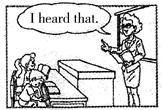
In many high schools,there are strict rules about using mobile phones. If your phone rings in class,for example,the teacher will be very angry.
Every mobile phone has a ringtone (铃声). It tells you that someone is calling you. Now,there is a ringtone called “mosquitotone (蚊子铃声)”. Using it,students can receive calls and text messages (短信) in class but the teacher will not realize what is happening. How?
Mosquitotone has a special sound. Only children and teenagers can hear it. As we get older,we are unable to hear some sounds with high frequencies (频率). As a result,a child or teenager can hear the mosquitotone ringtone, but it’s_inaudible_to someone 20 or older.
But sometimes,people over 20 can hear the ringtone. One British student’s phone uses mosquitotone. In class,the student’s phone rang. The 32yearold teacher looked at the student and became unhappy. “I heard that. You know the rule:no mobile phone in class.”
Not all the students are interested in mosquitotone. Jerry Jones,a high school student of 17,says,“Using mosquitotone too often is bad for our hearing. I may use it for pleasure,but not in class. It’s unfair to the teachers!”
What do parents think of mosquitotone?“I think it is perfect for places like movie theaters,” says Connie Neeson,44.“Think about it. Yon’re watching a film and someone’s mobile phone rings. Mosquitotone is good because many people don’t hear it. However,it also has a bad influence on their study if students use it in class.”
【小题1】Mosquitotone works because ________.
| A.it is very loud | B.it has no sound |
| C.it has a beautiful sound | D.it uses high frequencies |
| A.it can’t be seen by | B.it can’t be heard by |
| C.it isn’t popular with | D.it isn’t healthy for |
| A.was late for class | B.didn’t do his homework |
| C.couldn’t answer her question | D.was using a mobile phone in class |
| A.has no bad influence | B.is unfair to the teachers |
| C.has its advantage and disadvantage | D.can’t be used in any public place |
Why are so many people so afraid to fail? Quite simply because no one tells us how to fail so that failure (失败) becomes an experience that means growth. We forget that failure is part of the human condition and that every person has the right to fail.
Most parents work hard at preventing failure or protecting their children from the knowledge that they have failed. One way is to lower standards(标准). When a child finishes making a table, the mother describes it as “perfect” even though it doesn’t stand still. Another way is to blame (责怪) others. If John fails in science, his teacher is unfair or stupid.
There’s a problem with the two ways. It makes a child unprepared for life in the real world. The young need to learn that no one can be best at everything, no one can win all the time, and that it’s possible to enjoy a game even when you don’t win. A child who’s not invited to a birthday party, who doesn’t make the honour list on the baseball team, feels terrible, of course. But parents should not offer a quick consolations (安慰), prize or say, “It doesn’t matter.” Because it does. The young should be allowed to experience failure and be helped to come out of it.
Failure never gives people pleasure. It hurts both grown-ups and children. But it can be really good to your life when you learn to use it. You must learn to ask “Why did I fail?” Don’t blame anyone else. Ask yourself what you did wrong and how you can improve. If someone else can help, don’t be shy about asking them.
【小题1】How do most parents prevent their children from failure?
| A.They give them some presents. |
| B.They don’t tell them that they have failed. |
| C.They don’t blame others. |
| D.They help them to come out of failure. |
| A.It’s impossible to enjoy a game if he misses it. |
| B.He is the worst of all. |
| C.It’s natural not to win a game and no one can win all the time. |
| D.His teammates are not good enough. |
| A.give him a small prize |
| B.advise him to repeat failure |
| C.blame others |
| D.encourage him to learn from failure |
| A.Learning from Failure |
| B.Ways of Preventing Failure |
| C.Reasons of Failure |
| D.Getting Pleasure from Failure |