题目内容
My wife wanted me to take another woman out to dinner and watch a movie. She said, “I love you, but I know that woman also loves you and would like to spend ___ with you.”
The other woman ____my wife asked me to pay attention to was my mother. My father has been dead for many years. My mother lived ____, but sometimes I was too busy to visit her.
That evening I called her and invited her to dinner and watch a movie. She seemed very______ when I arrived at her house. We went to a restaurant. My mother took my arm and walked as if she was my first lady.
____ dinner, we had a very good conversation. It was nothing special. We simply_____the latest events in our lives. But we were so busy talking______we missed the movie. At last, she said,” I’ll go out with you again, but only if you let me invite you.”I agreed.
A few days later, my mother died of a heart attack. It happened so suddenly that I didn’t have a ______ to do anything for her. Not long after that, I received a payment receipt (收据) from the restaurant as well as an attached (附加) note:
“I paid the bill for our second dinner in advance(提前). I am not sure____I could have dinner with you or not. So I paid for two people, you and your wife. I have no words to explain how important that dinner meant to me. My son, I love you.”
At that moment, I understood the importance of saying in time “I LOVE YOU” and giving our loved ones the time that they deserve (应得) . ____ in life is more important than our family.
1.A. time B. money C. movie D. dinner
2.A. whose B. whom C. why D. which
3.A. there B. home C. alone D. herself
4.A. upset B. angry C. worried D. excited
5.A. Before B. During C. After D. When
6.A. told B. shared C. talked D. spoke
7.A. and B. but C. that D. because
8.A. chance B. time C. hope D. will
9.A. that B. when C. where D. whether
10.A. Nothing B. Everything C. Something D. Anything
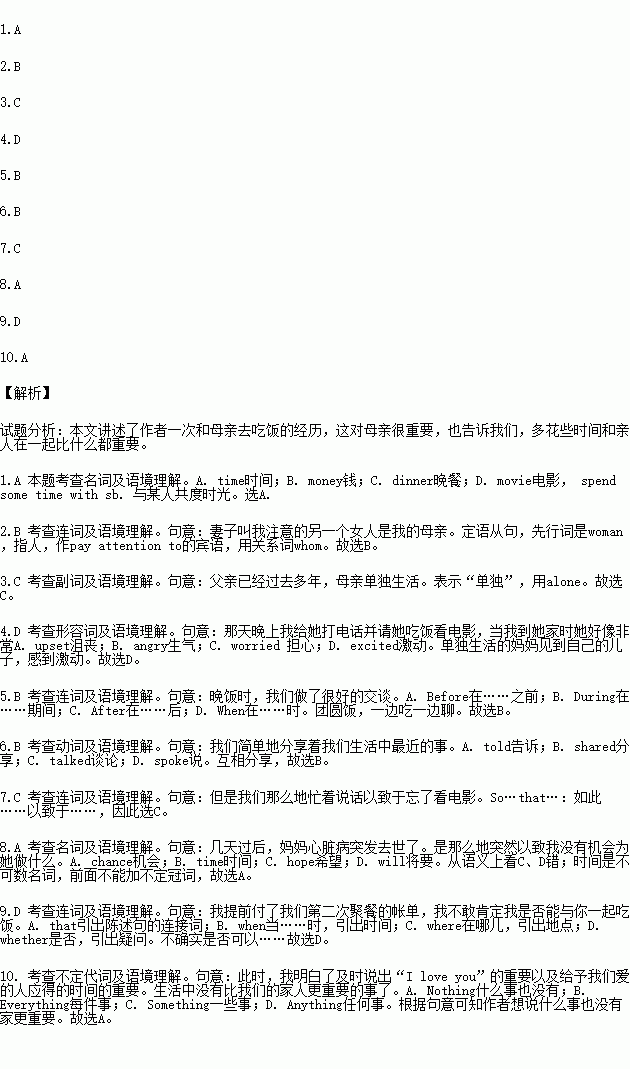


Helen Keller was an American educator and journalist, who became one of the leading humanitarians in the history of the United States. Born on June 27, 1880 in Tuscumbia, a small town in Alabama, Keller was stricken with a childhood disease that left her deaf, and blind. The illness Keller suffered (遭受) is a mystery to this day. Unable to see, or hear, Keller became difficult to deal with as her behaviour was described as wild by her family and friends.
Soon Keller and her family developed their own type of sign language that allowed them to communicate with each other. Helen’s mother needed help for her anguished (痛苦的) child, which eventually led to Anne Sullivan, who was a recent graduate (毕业生) of the Perkins Institute for the Blind. The school had been successful in the past in educating blind students, and Sullivan was one of its star graduates. Once Sullivan and Keller got through the difficult beginnings, their friendship, and association (合作) lasted for 49 years.
Keller was determined to become educated, and to teach herself to communicate. After attending several schools, she became the first deaf and blind person to earn a college degree. She became very well-known, and began a lecture tour where she made speeches on social and political issues, including women’s suffrage (选举权), and birth control. Also she required the government to raise awareness to the situation of the blind. She devoted much of her later life to raising funds for the American Foundation for the Blind.
On September 14, 1964, President Lyndon B. Johnson awarded her the Presidential Medal of Freedom, one of the United States’ two highest civilian honours. In 1999, Keller was listed in Gallup’s Most Widely Admired People of the 20th century.
Helen Keller—Overcoming Disability | |
Childhood | Keller was made deaf and blind by an 1. illness. Her family and friends 2. her as wild because of her disabilities. |
3. | The Keller family 4. their own type of sign language to make their communication possible. Anne Sullivan 5. Keller’s life and gave her a lot of help. Keller made up her 6. to teach herself to communicate. Keller earned a college degree after 7. several schools. |
Social Activities | While travelling around the country, Keller made a series of 8. on social and political issues. Keller 9. much of her later life in raising funds for the American Foundation for the Blind. |
Awards | In 1964, Keller was awarded the Presidential Medal of Freedom. In 1999, her name was on the 10. in Gallup’s Most Widely Admired People of the 20th century. |