题目内容

               A Note

Dear Mr. Wang,

  Someone comes to the office to see you in the morning,but you and your wife are out. He comes here at 10 a.m. Because he is very busy,he goes away half an hour later. He tells me that he is your classmate at college (大学). Now he teaches Chinese in a high school (高中) in this city and he lives near the No. 6Middle School. He is a very tall man with short hair. He wears a pair of glasses. He tells me his telephone number is 33426685. He is often at home at 7:00 p.m. So you can call him in the evening.
       

() 1. The author (作者) writes this note (便条) to .

   A. Mr. Wang            B. Mr. Wang's wife

   C. Mr. Wang's classmate   D. me

() 2. Mr. Wang' s  classmate is .

   A. a teacher   B. a worker   C. a farmer   D. an actor

() 3. When is Mr. Wang's classmate often at home?

   A. In the morning.           B. In the afternoon.

   C. At 7: 00 p.m.            D. We don't know.

() 4. How long does Mr. Wang's classmate stay in the office?

   A. Ten hours.             B. An hour. 

    C. Two hours.             D. Half an hour.

() 5. Which of the following is TRUE?

   A. Mr. Wang and his wife are classmates.

   B. Mr. Wang,s classmate is short.

   C. Mr. Wang goes out with Mrs. Wang in the morning.

   D. Mr. Wang's classmate meets Mr. Wang in the morning.

1. A 2. A 3. C 4. D 5. C

本文是一张便条。王先生的同学来找王先生,但是王 先生不在,他同学就走了。接待者把此事用便条告知王 先生。

1. A 细节理解题。根据便条开头的称呼“Dear Mr.Wang,”可知选A.

2. A细节理解题。根据第五句“Now he teaches Chinese in a high school (高中) in this city."”可知选A.

3. C细节理解题。根据倒数第二句“He is often at home at7:00 p.m. ” 可知选C.

4. D细节理解题。根据第三句中“…he goes away half an hour later. ”可知选D.

5. C细节理解题。根据第一句“Someone comes to the of fice to see you in the morning,but you and your wife are out. ” 可知选C.

练习册系列答案
相关题目

Children ’ s Rights

If you want to do a school project on children's rights(权利) ,you can look on the Internet for some information. A United Nations website can show you plenty of useful information for the project.

The United Nations lists the rights of children. Most countries a-gree all of them,but some countries do not. The following are some of the most important rights of children

Children have the right to be properly fed,clothed and shel-

tered (庇by their family. If their family can't do so,the government should take responsibility.

Children have the right to an education and medical care,which should be provided by the government.

Children must not be cruelly punished (惩罚) by their parents or any others.

Children have the right to expect the government to protect them from all kinds of abuse (虐待) and neglect (忽略 ).

No child under fifteen should be made to fight in an army.

people. In some countries children do not have these rights. Many young children are made to work long

hours in factories and on farms. In some countries there are so few schools that only rich children get an education. There are not enough doctors or nurses to help many children when they are sick.

The rights of children are,therefore,the rights people think children should have. They are not always the rights children really have.

() l.   agree with the United Nations’ list of children's rights.

   A. All countries   B. A few countries   C. No countries   D. Most countries

() 2. The underlined word “responsibility” in the passage means .

   A. something people have to do   B. something people want to do

   C. something people know how to do   D. something people love to do

() 3. Which of the following sentences is TRUE according to the passage?

   A. Parents should punish their children.

   B. Children should make money for other people.

   C. Governments should protect children from neglect.

   D. Children under sixteen should not fight in an army.

() 4. Some children can't get an education because .

   A. there aren't enough schools  B. there are no school

   C. they come from rich families   D. they want to work in factories

() 5. What's the main idea of this passage?

   A. Children are made to work long hours on farms.

   B. The United Nations website is useful for the school project.

   C. Children have the right to be properly fed,clothed and sheltered.

     D. The United Nations has listed the rights it thinks children should have. 

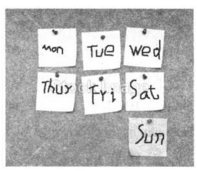
                Seven Days in a Week

    Monday......oh,I don ’t like Monday because I have to (必须) go back to school after the weekends (周末).

Tuesday is not so bad. I usually (通常) play tennis with my friends after school.

    On Wednesday evening I don,t  go out. I stay at home and do my homework.

    I like Thursday because the next day is Friday.

    I always go out on Friday-maybe (或许) to the cin- ema  (电影院).

    I love the weekends. On Saturdays I stay in bed until (直至lj) lunchtime,and I sometimes (有 日寸) go to the shops in the afternoon. In the evening we go to a club (俱乐部) — there are good bands (乐队) every Saturday. Then on Sundays I go to my friend's house or she comes to mine. I usually visit (拜访) my grandmother for an hour in the afternoon.

    Then the weekend is over (结束) and it’ s Monday......and I feel bad again!


() 1. The writer doesn 't like Monday because .

   A. Monday is the first day of the week

   B. he just spent (度过) a happy weekend

   C. Monday is the first school day of a week

() 2. The writer thinks Tuesday is not so bad because .

   A. he can play tennis with his friends   

    B. he has a P. E. class   

    C. he is free (空闲的)

() 3. The writer may go to the movies on

   A. Tuesday   B. Wednesday   C. Friday

() 4. What does the writer not do on weekends?

   A. Stay in bed until lunchtime.

    B. Watch football games on TV

   C. Go to his friends house.

() 5. From the text,we know that the writer .

   A. doesn ’ t like school very much   

    B. likes to stay at home

   C. only likes Friday

违法和不良信息举报电话:027-86699610 举报邮箱:58377363@163.com

精英家教网