题目内容
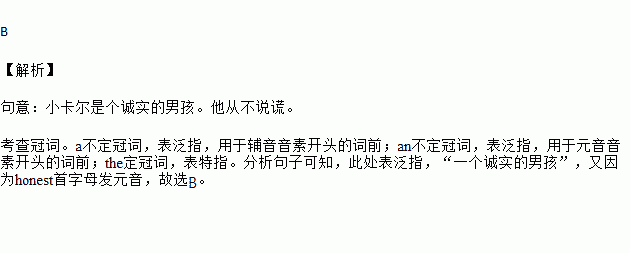
Little Carl is__________honest boy. He never tells lies.
A.a B.an C.the
What is she going to __________ when she __________?
A.be;grow up B.be;grows up C./;grow up D./;grows up
—Would you like to visit the library with me this afternoon?
—Sorry,I it a few times.
A.visit B.am visiting C.have visited D.will visit
—Listen, our music teacher is singing in the office.
—It__________be our music teacher. I saw her leave school a few minutes ago.
A.can't B.doesn't C.mustn't
My daughter is years old. Today is her birthday.
A. nine; nineth B. nine; ninth C. ninth; nine
When Justin Tong was a child, other kids felt sorry for him. His parents always made him do lots of housework such as taking out the rubbish and sending newspapers. But when he grew up, he was better than his childhood friends and lived a happier and healthier life.
This is the finding of a 40—year study in London. It showed that the children who worked hard in childhood had a richer and a happier future. "Children who worked in the home or community(社区)got more abilities and felt they were good people.” said Daniel Brown, the leader of the study. "Because they felt good about themselves, and others felt good about them.”
Brown's study followed 456 children. It compared the children's mental health(心理健康)with their childhood activity. The children who do part—time jobs, housework or work hard in school are much better at dealing with problems when they grow up.
Working at any age is important. Childhood activities help a child have the sense of responsibility(责任), independence, confidence(自信)and competence (竞争). They also help him understand that people must learn to work with others. The most successful people are those who know how to do this.
However, work isn't everything. As Tolstoy once said, “One can live wonderfully in this world if one knows how to work and how to love, to work for the person one loves and to love one's work.”
1.How was Justin's childhood?
A.Relaxing. B.Interesting. C.Busy.
2.According to the passage, the study in London ________.
A.lasted 40 days B.followed 456 children C.was done by Tolstoy
3.The study shows____________.
A.childhood activities have nothing to do with the children's future
B.the most successful people have a happy childhood
C.people who do more childhood activities have a better future
4.What is the meaning of the underlined word "independence"?
A.负担 B.骄傲 C.独立
5.What's the purpose of the passage?
A.To talk about an interesting study.
B.To tell us about childhood activities.
C.To encourage children to work hard.
Changsha is becoming more and more popular, and ________tourists visited it during National Day holiday.
A.thousand B.thousands C.thousands of
Rewrite the following sentences as required
1.My friend used to spend the weekends in the countryside.(改为一般疑问句)
______ your friend ______ to spend the weekends in the countryside?
2.Tommy’s never been to Shanghai Disney Resort before.(改为反义疑问句)
Tommy’s never been to Shanghai Disney Resort before, ______ ______?
3.Mike weighted only 3kg when he was born.(对划线部分提问)
______ ______ did Mike weight when he was born?
4.I think Amy is not different from most other students.(保持句意不变)
I think Amy is ______ ______ most other students.
5.saw, I, football, home, playing, boy, my, yesterday, a, way, on(连词成句)
__________________________________________________________________
He used to love sport ____________he hurt his legs in an accident.
A.when B.until C.as D.if

 口算能手系列答案口算能手系列答案