题目内容
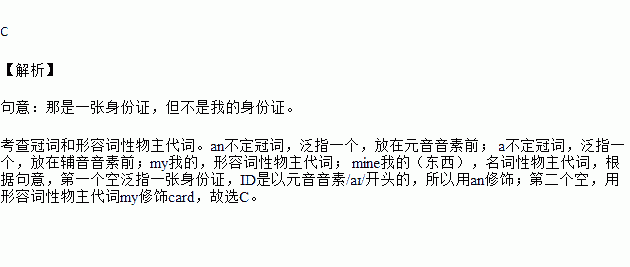
That is _________ ID card, but it’s not __________ card.
A.an;mine B.a;mine C.an;my D.a;my
---Jane won first prize in the English speech competition.
--- great progress she has made! Her English used to be pretty bad.
A.How a B.How C.What a D.What
---We’ll have a picnic _______ it doesn’t rain tomorrow.
---Have a nice day.
A. when B. because C. if D. since
This Saturday is our mother's birthday. We need to __________the gifts(礼物).
A.ask for B.look for C.play with D.think about
-___________ does her mother have _________dinner?
-Rice and vegetables.
A.How;for B.How;/ C.What;for D.What;/
We are often told to pay attention to what our mothers tell us. Most of us enjoy listening to our mothers speak. Scientists have found that compared to other people’s voices, our brains greatly prefer(更喜欢) the voices of our own mothers.
Scientists at Stanford University, US, recently studied this. They scanned (扫描) children’s brains while they were listening to different sounds, including their mothers’ voices. They found that 97 percent of the time, children could recognize their mothers’ voices at once.
Hearing their mothers’ voices makes children’s brains more active. We usually just use one part of our brain to deal with sounds when we hear something. But when we hear our mothers’ voices, many parts of the brain, including those in charge of (负责) reward (奖赏) and emotion (情感), start to work as well.
Why do we respond so strongly to our mothers’ voices? It starts even before we’re born. When children are still in the womb (子宫) or have just been born, they hear their mothers talking. This makes babies feel comfortable and teaches them language and social skills, even though they are still very young. The babies learn to recognize(辨别) their mothers’ voices as a rewarding (奖励性的,有益的) sound. Later, when this sound is heard again, more attention is paid to it.
Some sounds are necessary for our survival (生存) or bring us pleasure. These sounds are recognized by our brains as rewarding sounds. Most human voices are not recognized in this way, since we hear them so often. But mothers’ voices are different. They bring us a lot of comfort.
1.What is the story mainly about?
A.Why we should listen carefully to our mothers. B.Why we prefer to hear our mothers’ voices.
C.How we recognize our mothers’ voices. D.How we respond to different kinds of sounds.
2.What will happen when children hear their mothers’ voices?
A.Many parts of their brains become active. B.They will need time to recognize the voices.
C.Their language skills start to improve. D.They will remember some bedtime stories.
3.According to Paragraph 4, why do children pay more attention to their mothers’ voices?
A.Because they can recognize their voices quickly.
B.Because their voices make them more comfortable.
C.Because they can get a reward for doing so.
D.Because they can get love from their mothers.
4.“Rewarding sounds” refers to sounds that _____.
A.we can recognize B.we often hear C.we hear as babies D.make us happy
5.What do you think it is about?
A.Medicine B.Lifestyle C.Education D.Science
Tom isn't feeling very well. He seems to have a cold _______ the weather changes suddenly.
A.before B.so C.because D.because of
听短文,完成下面小题。
1.Where did the writer have lunch?
A.At a village inn(客栈) B.At a village hotel C.At a city restaurant
2.Where did the writer put her bag?
A.Under a chair beside the door. B.On a chair beside the door. C.On a chair behind the door.
3.What did the writer think of the meal?
A.Delicious. B.Terrible C.Special
4.When did the writer find that her bag lost?
A.Before she had lunch. B.While she was having lunch. C.After she finished her lunch.
5.Who took the writer’s bag?
A.The waiter in the inn. B.The inn-keeper. C.The dog.
— What did the headmaster say just now?
一 Sorry, I didn’t catch it. I about something else.
A.thought B.was thinking C.think D.am thinking