题目内容

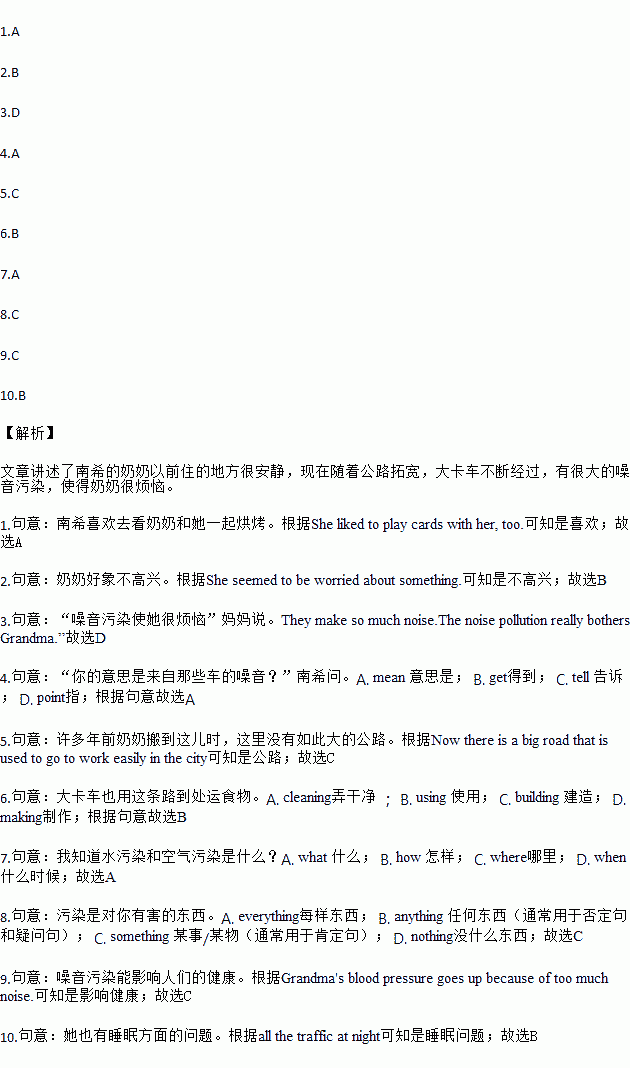
Nancy's grandma lived in a big old house in New York. Nancy and her parents went to see her each summer. Nancy ____ to see Grandma and bake (烘烤) with her. She liked to play cards with her, too. This summer, however, Grandma did not seem ____.She seemed to be worried about something.

“What's wrong with Grandma?” Nancy asked her mom.

“The ____ pollution is bothering (使烦恼) her,” Mom said. “Do you ___ the noise from all those cars?” Nancy asked.

“Yes,” Mom said. “When Grandma moved here many years ago, there wasn't such a big __ here. Now there is a big road that is used to go to work easily in the city. Big trucks deliver (运载) food all over, too, by ____ this road. They make so much noise. The noise pollution really bothers Grandma.”

“I know ____ water pollution and air pollution are. I learned about them in school, but what is noise pollution?” Nancy asked.

“Pollution is ____ that is bad for you,” Mom said. “Noise pollution can influence someone's ____.Grandma's blood pressure goes up because of too much noise. She also has trouble ____ with all the traffic at night. Grandma's hearing has been hurt by the noise, too.”

1.A. loved B. hated C. wanted D. feared

2.A. interesting B. happy C. healthy D. well

3.A. water B. soil C. air D. noise

4.A. mean B. get C. tell D. point

5.A. factory B. pool C. road D. railway

6.A. cleaning B. using C. building D. making

7.A. what B. how C. where D. when

8.A. everything B. anything C. something D. nothing

9.A. diet B. habits C. health D. feelings

10.A. listening B. sleeping C. walking D. thinking
练习册系列答案
相关题目

There was a time when hot summer days brought children outdoors to local rivers to catch minnows (米诺鱼). Walking in cool rushing water to catch the small, silver fish was a fun chance on a hot summer's day. Before setting out for the river in their neighborhood, however, children first had to look for a bag. Both boys and girls loved this outdoor activity a lot.

While reaching the side of the river, the children pulled off their shoes and socks and put their feet first into the cold water. Walking carefully in the water, they looked for the right place where the minnows flashed (闪光). Catching minnows was very easy if two children worked together. Taking two corners of the bag, each child stood in the water and slowly lowered the bag until it was at the bottom of the river. Then, standing very still (静止的), the children waited for the fish in the river to do normal activity. The children would again get a corner of the bag in each hand and raise the bag straight up quickly, keeping it as level as possible. Lots of tiny silver fish would cover the bag.

The joy of catching minnows is that, once caught, the fish are thrown back into the water to continue their natural lives. Perhaps they will be taken up by other children and then return to their watery home again. So the bag is lowered back into the river, and the small fish swim off. Then the whole process is repeated once more as more minnows are caught and then released (释放).

1.Why did children first have to look for a bag?

A. They looked for something to protect themselves.

B. They looked for the tool to catch fish.

C. They had to use the bag to take the fish home.

D. They had to use the bag to divide the fish.

2.What does the second paragraph mainly tell us?

A. Why the children catch minnows.

B. Why the children like playing in the water.

C. When the children go to the river.

D. How the children catch minnows.

3.What does the underlined word “lowered” mean in Chinese?

A. 把……混合 B. 把……擦掉 C. 把……放低 D. 把……分开

4.How do the children deal with the fish they catch?

A. They throw them back into the water. B. They take them home and cook them.

C. They keep them as pets. D. They sell them for money.

二、完成对话。在对话空格中填上适当的单词,使对话完整、正确。一空一词。

A: Hi, Mary. When do you get up in the morning?

B: At six.

A: Oh. You get up 1.. I usually get up at seven. So what do you usually do after you get up?

B: I 2. for half an hour. I either run or play basketball. Then I have breakfast at about 7:00.

A: What do you usually have for breakfast? Hamburgers, eggs or bread?

B: I 3. have hamburgers. They are not good for my health. I have some bread and milk.

A: Oh, I like hamburgers and I think they 4. so good. Do you go to school after breakfast?

B: No, I usually 5. my room. I don’t like a dirty (脏的) room. Then I go to school.

A: Do you take the bus to school? You live 6. from the school.

B: No. I usually 7. to school. I think it’s good exercise. And it usually takes me half an hour.

A: I also take my bike to school. But it’s only two kilometers from my home to school. What do you usually do after school?

B: On Monday and Thursday, I go to the music club. I like singing and playing the guitar. I want to be a 8.. On Wednesday, I go to the sports club. I like playing football with my friends there.

A: How about the weekend? What do you usually do?

B: I sometimes go to my uncle’s home. He 9. in a small village. A river is there and a big bridge and a ropeway are over the river.

A: A ropeway?

B: Yes. Many people are 10. to cross the river by ropeway. They think it’s dangerous (危险的). But I like to take the ropeway. It’s interesting.

A: Oh, I never see a ropeway.

B: You can go there with me next time.

违法和不良信息举报电话:027-86699610 举报邮箱:58377363@163.com

精英家教网