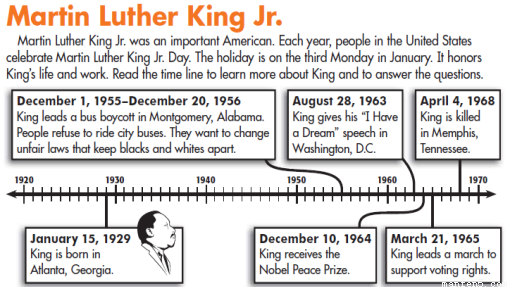
题目内容

1.Which month is Martin Luther King Jr. Day in?

A. January. B. March. C. August. D. December.

2. Which of the following is RIGHT?

A. King was born in Tennessee.

B. King led a bus boycott in Alabama.

C. King received the Nobel Peace Prize in 1963.

D. King gave his “I Have a Dream” speech in 1965.

3.How old was King when he died?

A. 29. B. 39. C. 65. D. 68.

4.What’s the purpose of the time line in this article?

A. To teach the students to draw a time line.

B. To introduce Martin Luther King Jr. Day.

C. To tell more about Martin Luther King Jr.

D. To explain why whites and blacks were separated.
练习册系列答案
相关题目

Imagine the situation. You are driving alone in a desert or on a mountain. You have no idea where you are. You passed the last house two hours ago. Then your car breaks down. It is night and it is cold. You have no mobile phone. What do you do? Well, next time take a GPS with you. This invention may be able to help you. It is a device(装置) which uses satellites to find the users’ position. It can find your position within 20 metres. A GPS cannot start your car, but at least you will know where you are.

The GPS, which means the Global Positioning System, is a small radio receiver. It looks like a mobile phone. You can hold it in your hand, or put it in your pocket. It is sometimes put into a watch or a telephone. We also find GPS devices in cars, planes, or boats. Some of these devices have electronic maps, so you know where you are. For example, in a city they can tell you the name of the street.

There are three parts to the Global Positioning System. The first part is the receiver. You can hold it in your hand, or have it fixed into your car, plane, etc. The second part is a group of satellites orbiting the Earth. The receiver contacts at least four of the satellites and calculates its position. The third part of the system is a network of ground stations. They are all over the world. They control the satellites and make sure they are working well.

Some people think that in the future the GPS will be as common as the mobile phone. They are becoming cheaper and more and more accurate. There are also new uses for the GPS. Perhaps they will become like watches. Everyone will have one and you will never be lost again.

1.According to the passage, with the help of the GPS, people ____________.

A. can’t be lost in a new city

B. can’t find their way in different countries

C. can learn about the culture of an unknown place

D. can spend the least time getting to another place

2.We can learn from the passage that __________.

A. a GPS can help you start your car

B. a GPS can’t be put into a watch

C. there are three parts to the GPS

D. the GPS are becoming more and more expensive

3.The underlined word “They” in paragraph 3 means ___________.

A. Receivers B. GPS devices

C. Satellites D. Ground stations

4.The passage is mainly about __________.

A. the history of the GPS B. the introduction of the GPS

C. the shape of the GPS D. the three parts of the GPS

5.What can we learn from the passage?

A. All GPS devices have electronic maps.

B. The GPS can not only start your car but also know where you are.

C. The receiver of the GPS contacts all the satellite to calculate its position.

D. The GPS will become more and more common in everyday life.

Many of us have had this annoying(令人烦恼的) experience: You are waiting at a bus station when someone nearby begins to smoke. You move away, but there isn't much you can do about it.

In Beijing, a new law is set to fight against smoking. It is regarded as China's toughest ever tobacco control rule(最严厉的控烟条例). Smoking is not allowed in all indoor or public places. If people break the rules, they will have to pay up to 200 yuan.

Smoking in schools is specially mentioned in this law. Teachers can not smoke in front of students in schools. Schools should also help students give up smoking and teach them about the danger of smoking.

To get everybody to take part in the activity, Beijing has set up a report hotline and WeChat account(微信号). The public is invited to vote on no-smoking signs on WeChat The most popular sign is a picture of a gir1. It has got more than 1 million votes unti1 now.

China is not the only country fighting smoking. In March 2004 Ireland became the first country to introduce a law on smoking in workplaces and public places. Many countries, including England and the US, then fo1lowed.

1.When someone begins to smoke, there is little you can do except _

A. staying there B. moving away

C. Smoking together D. getting mad

2.In order to make people give up smoking, a new _ is passed in Beijing.

A. law B. plan C.sign D.topic

3.If people break the new rule in Beijing, they wil1 have to pay up to _

A.¥100 B.¥200 C.¥300 D.¥400

4.The underlined(画线的) word vote in the passage means_ .

A.计票 B.监票 C.唱票 D.投票

5.According to the last paragraph(段落), we can infer(推断) that _ .

A. Ireland was the last to introduce a law on smoking

B. China is the only country against smoking

C. many countries fight smoking in public places

D. England and the US didn't say no to smoke

违法和不良信息举报电话:027-86699610 举报邮箱:58377363@163.com

精英家教网