题目内容
A group of people asked this question to a group of 4-to-8-year-old children. "What does love mean?" The answers were surprising. The children would answer like they did below.
"When my grandmother hurt her knees, she couldn’t bent (弯腰) over and paint her toenails (脚指甲) any more. So my grandfather does it for her all the time, even when his hands hurt too. That’s love."(Rebecca–age 8)
"Love is when someone hurts you. And you get so mad but you don’t shout at them because you know it would hurt their feelings." (Samantha–age 6)
"Love is what makes you smile when you’re tired." (Terri–age 4)
"I let my big sister pick on (捉弄) me because my mum says she only picks on me because she loves me. So I pick on my baby sister because I love her." (Bethany–age 4)
"I know my older sister loves me because she gives me all her old clothes and has to go out and buy new clothes."(Lauren–age 4)
"Love is when Mommy gives Daddy the best piece of chicken."( Elaine –age 5)
"My mommy loves me more than anybody. You don’t see anyone else kissing me to sleep at night."(Clear–age 5)
"You really shouldn’t say ‘I love you’ if you don’t mean it. But if you mean it, you should say it a lot. People forget." (Jessica–age 8)
1.The passage mainly tells us about ___________.
A. what "life" means to children B. what "family" means to children
C. what "friends" means to children D. what "love" means to children
2.Who told us the love between mum and dad?
A. Clear. B. Elaine. C. Rebecca. D. Lauren.
3.What is love according to Terri?
A. Love is what pleases you when you are tired.
B. Love is the care between husband and wife.
C. Love is a rest when you are tired.
D. Love is a kiss from parents.
4.What does Jessica mean about love?
A. Too much love is no love. B. You should say love more often.
C. You mean what you think. D. Say love more often if you mean it.
5.Which of the following is NOT true?
A. Rebecca’s grandmother ever couldn’t bend over.
B. Bethany is willing to be picked on by any other person.
C. If Samantha becomes angry, she will not shout at others.
D. Lauren likes to wear her sister’s old clothes better.
1. D 2. B 3. A 4. D 5. B 【解析】 本文讲述了一群人向一群4至8岁的孩子提出“爱意味着什么?”的问题,孩子们给出了很多不一样的答案。 1.句意:这段话主要告诉我们“爱”对孩子意味着什么。A.“生活”对儿童意味着什么B.“家庭”对儿童意味着什么C.“朋友”对孩子的意义D.“爱”对孩子意味着什么。原文“A group of people...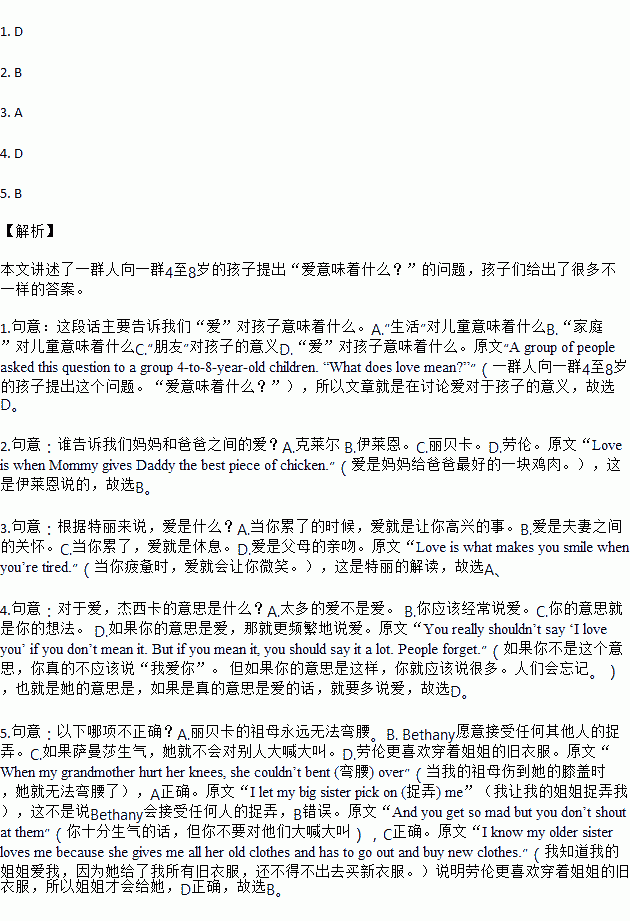

 轻巧夺冠周测月考直通名校系列答案
British people pride themselves on their polite manners towards one another in public. They often use the word ‘sorry’—even when they don’t really mean it! Usually, if they want to ask a stranger for the time, they would start by saying ‘Sorry to bother you. Do you know what time it is?’ If they’re five minutes late for an appointment (约会), they would generally greet the person by saying ‘Sorry I’m late!’
They use the word ‘sorry’ in so many different situations that the meaning of the word has changed a little over time. The two main dictionary definitions (释义) of ‘sorry’ are: 1) feeling sad for someone else because of their problems or bad luck; 2) feeling regret because you’ve done something wrong. Now, think about this. Normally, when they want to ask a stranger a question, they start with ‘Sorry to bother you’. In this situation, they aren’t saying sorry because they feel sad for that person or because they feel regret.
So what does ‘sorry’ really mean? And why do British people use it so much? Well, in the British culture, saying ‘sorry’ is a way to be polite, especially to people who they don’t know very well. It’s also a very clever way to get what they want. In a recent experiment, an actor went up to a different strangers on a rainy day to ask if he could use their mobile phones in order to make a call. When he went up to one group of strangers and asked them without saying ‘sorry’ first, he was only 9 per cent successful in borrowing their phones. However, when he said ‘sorry’ to another group of strangers about the bad weather before asking if he could use their mobile phones, he was 47 per cent successful. So maybe saying ‘sorry’ is not just being polite, but it is also a good method to get what they want too!
Title: Why do 1. people say sorry? | |
Main points | Detailed information |
The situations in which they say ‘2.’ | Asking for the time Being 3. for an appointment |
The change of the meaning of ‘sorry’ | The two main 4. definitions of ‘sorry’; Feeling sad for 5. problems or bad luck Feeling regret 6. of one’s own mistakes When British people ask a stranger a question by 7. with ‘sorry’, they are saying sorry neither because they feel sad for that person nor because they feel regret. |
The 8. meaning of ‘sorry’ | A way to be polite A good way to get 9. they want The result of an experiment shows it’s 10. for one to succeed in borrowing a mobile phone by saying ‘sorry’. |
 B.
B.  C.
C. 