Now the traffic in cities is very terrible. Sometimes you will find it's very slow to take a car. So bikes are popular with people in some big cities. They think it's much faster to ride a bike. What's more, riding bikes is good for our health. It can make us much stronger. We can be greener people if we often ride a bike to work.

But bikes can have some problems, too. A bicyclist must be very careful when he rides on the road. Bikes are called a kind of transport (交通工具), so a bicyclist must obey (遵守) the rules of the road like car drivers. Bike riders are so easy to get hurt because the traffic is always heavy in the city, so they should wear a fine bicycle helmet (头盔) to keep from the danger of hurting.

If a bicyclist wants to know more about traffic rules, he should go to the traffic station. That's the best way to keep him safe.

1.Why are bikes popular with people in some big cities?

A. Because bikes are very cheap.

B. Because people want to save money.

C. Because bikes can stop traffic accidents.

D. Because riding bikes is much faster in the heavy traffic.

2.What's the meaning of the underlined word “bicylist”?

A. 汽车司机 B. 交通警察 C. 自行车手 D. 修理工人

3.Bikers should be ________ when they ride on the road.

A. green B. strong C. fast D. careful

4.Which is NOT true according to the passage?

A. Traffic in cities is very good.

B. Riding a bike is good for our health.

C. a bicyclist should obey the traffic rules, too.

D. The traffic station is a good place to learn traffic rules.

5.What is this passage mainly about?

A. Traffic accidents. B. Ride a bike to work.

C. Some things about riding a bike. D. How to be a good bicyclist.

请阅读下面短文,从每小题A、B、C三个选项中,选出可以填入空白处的最佳选项,并将其字母标号填入题前括号内。

Bill is a middle school student. He has many subjects every day. Of all the subjects, he hates(讨厌) math most. After school, he doesn’t want to do math homework because he really doesn’t like it.

After he comes back home one evening, he says to his mom, “I don’t want to have math.” His mom asks him why and he says he doesn’t know what the teacher talks about. He thinks math is not easy for him. His mom thinks for a while and says, “Don’t be disappointed, dear. I can be your math teacher.” “That sounds great!” Bill says happily.

Every day after school, Bill and his mom study math together for one hour. Bill likes his mother’s “classes”. He becomes more and more interested in math.

One day, when Bill goes to bed after doing homework, he finds his mother is doing something at the desk. He opens the door and sees his mother studying math on the Internet. He knows why his mother is good at math.

There is nothing a mother cannot do for her children. As children, we must thank our moms for everything they do for us.

1.Bill doesn’t want to do math homework because ______.

A. he really doesn’t like it

B. he has no math class at school

C. he doesn’t like his math teacher

2.Bill thinks math is ______.

A. easy

B. difficult

C. great

3.The underlined word “disappointed” means ______.

A. 骄傲的

B. 失望的

C. 积极的

4.From the passage, we know ______.

A. Bill doesn’t do his homework

B. Bill’s mother teaches math at school

C. Bill likes math now with his mother’s help

5.The best title(题目)for this passage is ______.

A. A Happy Boy

B. An Easy Subject

C. A Good Math Teacher

Choose the best answer (根据文章内容,选择最恰当的答案):

It’s a cold, grey Sunday afternoon in March. The light is slowly fading, but all over Britain people are working in their gardens. They’re digging, cutting leaves and planting new weeds. By summer, their gardens will be full of bright colors.

The British love their gardens. A British newspaper recently asked people for their opinions about them. Seventy percent of people felt it was important to spend time in the garden, and over half of these described gardening as the most enjoyable thing they ever did.

Only one in ten houses in Britain do not have a garden. You can, of course, just grow house plants inside or on your balcony.

Once it was only the very wealthy who had a garden. You can still see the huge gardens that surround historic houses such as Chatsworth House or Castle Howard. Ordinary people used their land to produce food to eat or sell, or grew herbs to make medicine.

In the nineteenth century, however, gardening became a hobby. About the same time, better transport meant people could buy different kinds of seeds and plants for their gardens. Although roses, sunflowers, onions and tomatoes are often grown in British gardens, they grew wild in other countries before.

In many villages and towns there are competitions for the best looked-after gardens. This year the winner was a little village in Northern Ireland. It’s already won four prizes for its beauty. People also take part in competitions to grow the largest vegetables, but don’t expect to win. Britain’s biggest carrot is almost six meters long!

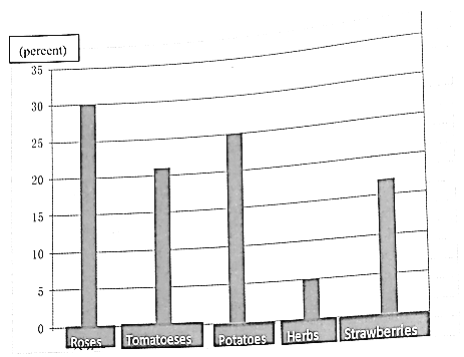
A newspaper asked people what they grew in their gardens. Look at the diagram which shows their answers.

1.Most of the British love to spend time in _____.

A. fishing B. hunting C. gardening D. farming

2.Only ____ houses in Britain don’t have a garden.

A. 10% B. 20% C. 50% D. 70%

3.Chatsworth House and Castle Howard are examples to show that ______.

A. people feel it important to spend time in the garden

B. only rich people had a garden in old days

C. the big gardens have lasted for a long time

D. there are vegetables and plants in the gardens

4.The winner of the competitions for best gardens this year was from _____.

A. England B. Wales C. Northern Ireland D. India

5.According to the diagram, more people prefer to grow _____ than potatoes.

A. roses B. tomatoes C. herbs D. strawberries

6.The underlined words “better transport” refers to the following except ______.

A. by train B. by sea C. by car D. by bike

Last Friday a storm swept through two villages in the New Territories, destroying (摧毁) fourteen homes. Seven others were so badly damaged (破坏) that their owners had to leave them, and fifteen others had broken windows or broken roofs. One person was killed, several were badly hurt and taken to hospital, and a number of other people received smaller hurt. Altogether over two hundred people were homeless after the storm.

A farmer, Mr. Tan, said that the storm began early in the morning and lasted for over an hour.

“I was eating with my wife and children,” he said, “When we heard a loud noise. A few minutes later our house fell down on top of us. We tried our best to climb out but then I saw that one of my children was missing. I went back inside and found him, safe but very frightened.”

Mrs. Woo Mei Fong said that her husband had just left for work when she felt that her house was moving. She ran outside at once with her children.

“There was no time to take anything,” she said, “A few minutes later, the roof came down.”

Soldiers helped to take people out of the flooded (水淹的) area and the welfare department (福利机构) brought them food, clothes and____

1.How many homes altogether (总共) were damaged in the storm?

A. Fourteen B. Twenty-one

C. Twenty-nine D. Thirty-six

2.Where was Mr. Tan when the storm first began?

A. He was in bed. B. He was inside the house.

C. He was outside the house. D. He was on the roof.

3.Mrs. Woo and her family didn’t get hurt because _________.

A. her husband knew there would be a storm

B. they were all inside the house when the storm became worse

C. she felt the house was moving

D. the welfare department helped her

4.The underlined word “shelter” in this passage means ______.

A. something to eat B. something to wear

C. somewhere to study D. somewhere to stay

5.Which of he following may be the best title for this passage?

A. A Terrible Storm B. A Lucky Woman

C. Good Soldiers D. Clever People

违法和不良信息举报电话:027-86699610 举报邮箱:58377363@163.com

精英家教网