题目内容

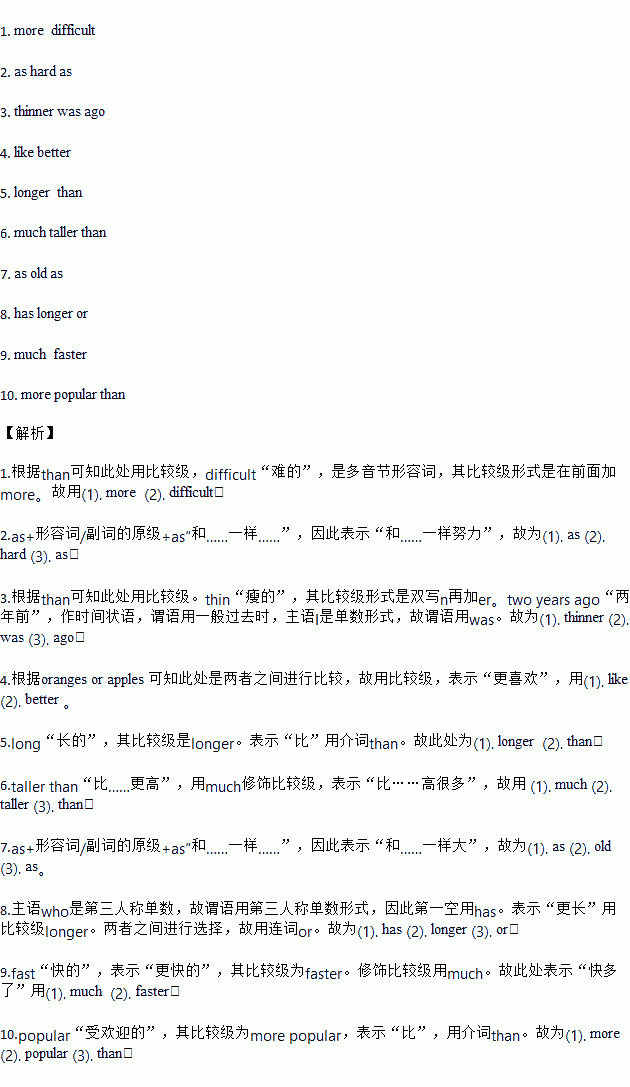
根据汉语意思完成句子

1.数学比英语难。

Math is __________________ __________________ than English.

2.你爸爸和妈妈工作一样努力吗?

Does your father work __________________ __________________ __________________ your mother?

3.现在我比两年前廋。

I’m __________________ now than I __________________ two years __________________.

4.橘子和苹果你更喜欢哪一个?

Which do you __________________ __________________, oranges or apples?

5.你的头发比我的长。

Your hair is __________________ __________________ mine.

6.你弟弟比你高很多吗?

Is your brother __________________ __________________ __________________ you?

7.琳达和她的堂妹一样大。

Linda is __________________ __________________ __________________ her cousin.

8.李芳和李平,谁的头发更长一些?

Who __________________ __________________ hair, Li Fang ___________ Li Ping?

9.露西比玛丽跑得快多了。

Lucy runs __________________ __________________ than Mary.

10.在学校,李丽比王红更受欢迎。

Li Li is __________________ __________________ __________ Wang Hong in school.
练习册系列答案
相关题目

One day a teacher did an experiment his students would never forget.

As he stood in front of the students, he pulled out a very big glass cup and put it on the table.

He then took out some fist-sized (拳头大小的) rocks and carefully placed them, one at a time, into the cup. When the cup was filled to the top he asked, "Is the cup full?"

Everyone in the class said, "Yes."

He replied, "Really?"

He reached under the table and pulled out a bag of gravel (碎石), then put some gravel in and shook the cup, and the gravel went down into the space between the big rocks.

He asked the students once more, "Is the cup full?"

"Perhaps not," one of them answered.

"Good!" he replied.

He reached under the table and brought out a bag of sand. He started putting the sand in the cup and it went into all the spaces left between the rocks and the gravel. Once more he asked the question, "Is the cup full?"

"No!" the class shouted.

Once again he said, "Good!"

Then he took out a cup of water and began to pour it in until the cup was filled. Then he looked at the class and asked, "What can you get from this experiment?"

One eager student raised her hand and said, "The point is, no matter how busy you are, if you try really hard you can always put some more things in!"

"Good answer, but no," the speaker replied, "that's not my point. The truth this experiment teaches us is: If you don't put the big rocks in first, you'll never get them in at all. What are the big rocks' in your life? In my life they are my education, my health, and my family. Remember to put these BIG ROCKS in first or you'll never get them in at all."

1.What did the teacher put into the cup first?

A. Water. B. Rocks. C. Gravel. D. Sand.

2.Why would the students never forget the experiment?

A. Because it had a deeper meaning than what the students thought of.

B. Because the teacher prepared for the experiment carefully.

C. Because the teacher had much experience of teaching.

D. Because the teacher thought his family was a "big rock".

3.What can we infer when the class shouted "No"?

A. The students knew they could get praise from the teacher.

B. The students were sure something else could be put into the cup.

C. The students had known the purpose of the experiment.

D. The students wanted to know what the teacher would do next.

4.According to the teacher, water refers to in our life.

A. drinks B. very important things C. boring things D. less important things

5.Which of the following is the best sentence as the end of this passage?

A. The bigger the size is, the more important the matter is.

B. If you put small things first into a cup, you can't put big ones into it any longer.

C. If you are always busy with little things, you can't have time to do big, important things.

D. In our life, we should make full use of time and do what we like.

Every scientist has a childhood dream. A scientist in China once had a(n) _______. He wished to grow a new type of rice which could produce a lot. This person is Yuan Longping, _______ was born in 1930. He graduated from the Southwest Agricultural (农业) University in 1953. Yuan Longping came up with an idea for a hybrid rice in the 1960s. Since then, he has devoted himself to the research and development of new varieties (品种).

In 1973, together with other people, he _______ in the development of hybrid rice. This made China a worldwide leader in rice production. For this, he was called "Father of Hybrid Rice". In 1980, the technology for hybrid rice was _______ to the United States. _______ Professor Yuan’s hard work, China now produces enough rice to _______ her people every year.

In his spare time, he loves playing _______ violin and listening to music. Every night, he reads _______ half an hour before he goes to sleep. He likes swimming, too. People think that Professor Yuan is one of the _______ people in China because he cares about ________ but his research.

Now Professor Yuan is working on developing super hybrid rice. He goes to the fields twice a day.

1.A. dream B. idea C. thought D. will

2.A. where B. whom C. which D. who

3.A. success B. succeeded C. successfully D. successful

4.A. given B. grown C. showed D. introduced

5.A. Because of B. Because C. In order to D. Instead of

6.A. look after B. feed C. send D. fed

7.A. an B. / C. a D. the

8.A. on B. in C. for D. to

9.A. greatest B. richest C. cleverest D. most careful

10.A. everything B. anything C. nothing D. something

阅读下面短文,根据短文内容,完成下列各题

About one hundred years ago, many educated people spoke French when they met people from other countries. Today most people speak English when they meet foreigners. It has become the new international language. There are more people who speak English as a second language than people who speak English as a first language. Why?

There are many reasons why English has become so popular. One of them is that English has become the language of business. Another important reason is that popular American culture, like movies, music, and McDonald’s has quickly spread throughout the world. It has brought its language with it.

Is it good that English has spread to all parts of the world so quickly? I don’t know. It’s important to have a language that everyone has in common. Our world has become global and we need to communicate with one another. On the other hand, English is a rather hard language to learn and it brings its culture with it. Do we really need that?

Scientists have already tried to make an artificial(人造的)language that isn’t too difficult and isn’t from any one group’s culture. It is called Esperanto. But it hasn’t become popular. Maybe the popularity of English won’t last that long, either. Who knows? There are more people in the world who speak Chinese than any other language. Maybe someday Chinese will be the new international language.

1.What was the world language a century ago?

________________________________________________________________________________

2.Why has English become an international language today? Give at least two reasons.

_________________________________________________________________________________

3.What can we get from Paragraph 3?

________________________________________________________________________________

4.In the last paragraph, what do scientists want to tell us?

________________________________________________________________________________

5.将第三段中划线句子翻译成汉语

_________________________________________________________________________________

违法和不良信息举报电话:027-86699610 举报邮箱:58377363@163.com

精英家教网
