题目内容

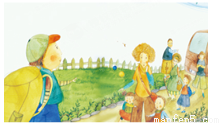
Max packs (打包) lots of things in his bag when he goes c 1. with his family.

“Your bag is too big and it w 2. a lot,” says Mom.

“I am hungry,” Max’s older brother Matt says.

“Have some s 3. and apples,” Max says.

“The sun is too strong. Max, do you have a hat or a cap?” asks Mom.

“Yes, I have a hat. And you can wear these sunglasses,” Max says.

“It’s hot. Can you give me something?” asks Grandma.

“Use my fan,” Max says.

“It’s dark. I can’t see well,” says Dad.

“I have a lamp (灯). I have a candle and m 4. too,” Max says.

“We l 5. our way,” says Dad.

“That’s okay. I have a map,” says Max.

Max’s family goes back home.

“Your big bag is great,” says everybody.


1.camping

2.weighs

3.sandwiches

4.match

5.Lose

【解析】

试题分析:当马克斯和他的家人去野营的时候,他在包里放了很多东西。包很大也很重。当他的哥哥饿了的时候,他就递过去食物;当他的妈妈提到天气太热的时候,他就拿出了帽子和太阳镜;当爸爸说天黑的时候,他就拿出的灯。

1.

2.

3.

4.

5.

考点:故事类短文阅读。

练习册系列答案
相关题目

Living in a foreign country can be exciting, but it can also be confusing (令人迷惑的).A group of Americans who taught English in other countries recently discussed their experiences. They decided that miscommunications were always possible, even over something as simple as “yes” and “no”.

On her first day in Micronesia, an island in the Pacific, Lisa thought people weren’t paying any attention to her. The day was hot. She went into a store and asked,“Do you have cold drinks?”The woman there didn’t say anything. Lisa repeated the question. Still the woman said nothing. She later learned that the woman had answered her: She had raised her eyebrows (眉毛), which in Micronesia means“yes”.

Jan remembered an experience she had in Bulgaria, a country in Europe. She went to a restaurant that was known for its cabbage. She asked the waiter, “Do you have cabbage today?” He nodded his head. Jan waited, but the cabbage never came. In that country, a nod means “no”.

Tom had a similar problem when he arrived in India. After explaining something in class, he asked his students if they understood. They answered with many different nods and shakes of the head. He thought some students had not understood, so he explained again. When he asked again, they did the same thing. He soon found out that his students did understand. In India, people nod and shake their heads in different ways depending on where they come from. You have to know where a person is from to understand whether they mean “yes” or “no”.

1. These Americans teaching English in other countries found that they ______.

A. should go abroad for vacations

B. needed to learn foreign languages

C. should often discuss their experiences

D. had problems with communications

2.People in Micronesia show “yes” by ______.

A. nodding heads B. raising eyebrows

C. shaking heads D. saying “no”

3.Tom misunderstood his class at first because______.

A. he did not know much about Indian culture

B. he didn’t explain everything clearly enough

C. some students didn’t understand his questions

D. he didn’t know where the students came from

4.The passage is mainly about______.

A. body language in foreign restaurants

B. class discussion in Indian schools

C. miscommunication in different cultures

D. English teaching in other countries


A Play: Four Butterflies

Characters: Red Butterfly (RB), Green Butterfly (GB), Green Tree (GT), Rose (R), Grandpa Sun (GS)

Look! There are four butterflies in the garden. One is red, one is yellow, one is green, and the other one is white. They play games and dance together every day, and they are very happy. One day, it’s fine. Four butterflies are playing a game in the garden. Suddenly it is full of dark clouds and it begins to rain hard.

1. GB: Oh, it’s raining hard. Green Tree is over there. She can

help us.

GB: Green Tree, our wings are wet. Please let us stay under your leaves.

GT: Green Butterfly, I like you. We have the same color. You can come in, but the other three butterflies must go away.

GB: No, thank you. We are good friends. We love each other and must stay together.

RB: Rose is over there. She can help us.

2. RB: Rose, our wings are wet. Please let us stay under your leaves.

R: Red Butterfly, I like you. We have the same color. You can come in, but the other three butterflies must go away.

RB: No, thank you. We are good friends. We love each other and must stay together.

3. GS: What good friends they are! This is a real friendship. I must help them.

The sun drives the clouds away and asks the rain to stop. Soon the sun gives off bright light and dries up their wings.

4. Four butterflies: Oh, the sun comes out. Our wings are dry. Let’s play and dance again.


1.How many butterflies are there in the garden?

A. One. B. Two. C. Three. D. Four.

2.What are the butterflies doing when it starts to rain?

A. They are flying. B.They are dancing.

C. They are playing a game. D. They are staying under the leaves.

3.Who helps the butterflies at last?

A. Rose.B. Rain.

C. Grandpa Sun.D. Dark clouds.

4.What is the main idea of the play?

A. Butterflies cannot fly if their wings are wet.

B. The four butterflies are sisters and brothers.

C. Grandpa often helps others.

D. A real friendship means that friends stay together when they are in trouble.


违法和不良信息举报电话:027-86699610 举报邮箱:58377363@163.com

精英家教网