题目内容

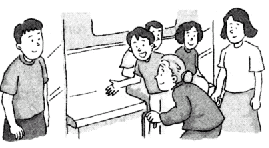
We see and hear instructions every day telling us what to do and what not to do. Complete the instructions.

be

be careful

change

drink

give

stand

(1) Do not __________ the water directly from the tap.

(2) A train is coming. Please _________ behind the yellow line.

(3) Please _________ quiet in the library.

(4) Please _________ to train T64.

(5) _________ when crossing the road.

(6) _________ your seat to old people.
答案:drink;stand;be;change;Be careful;Give
练习册系列答案
相关题目
Some people have very good memories and can easily learn quite long poem(诗歌)by heart. Some people have  51 memories and can only  52 things that they have said again and again.
The  53 English writer Charles Dickens said that he could walk down  54  street in London and then tell you the name of every shop on  55 sides of the street. Great men in the world have wonderful memories.
A good memory is a great help in learning a language. Everybody learns  56 language by remembering what he hears  57 he is a small child. Some children live with their parents in foreign countries and they seem  58 two languages as  59 as one. In school it is not so easy to learn foreign languages  60 students have little time  61  it and they are busy with other subjects as well.
A man's mind is quite like a camera but it 62 photos of what we see and it can also take photos of what we feel, hear, smell and taste. When we take a real photo  63 a camera there is much work  64  before the photo is finished and ready to show to our friends.  65  the same way there is much work to do before we can keep a picture forever in our mind.
【小题1】
A.wonderfulB.betterC.poorD.badly
【小题2】
A.speakB.studyC.knowD.remember
【小题3】
A.niceB.beautifulC.famousD.kind
【小题4】
A.anyB.someC.manyD.the
【小题5】
A.everyB.eachC.bothD.all
【小题6】
A.herB.hisC.one’sD.their
【小题7】
A.whenB.sinceC.ifD.as soon as
【小题8】
A.to keep B.to getC.to learnD.to take
【小题9】
A.badlyB.hardC.easilyD.happily
【小题10】
A.becauseB.whyC.whatD.when
【小题11】
A.likeB.forC.toD.in
【小题12】
A.leavesB.takesC.getsD.receives
【小题13】
A.in B.byC.withD.through
【小题14】
A.to doB.to haveC.to startD.to stay
【小题15】
A.InB.OnC.WithD.As

Some people have very good memories and can easily learn quite long poem(诗歌)by heart. Some people have  51 memories and can only  52 things that they have said again and again.
The  53 English writer Charles Dickens said that he could walk down  54  street in London and then tell you the name of every shop on  55 sides of the street. Great men in the world have wonderful memories.
A good memory is a great help in learning a language. Everybody learns  56 language by remembering what he hears  57 he is a small child. Some children live with their parents in foreign countries and they seem  58 two languages as  59 as one. In school it is not so easy to learn foreign languages  60 students have little time  61  it and they are busy with other subjects as well.
A man’s mind is quite like a camera but it 62 photos of what we see and it can also take photos of what we feel, hear, smell and taste. When we take a real photo  63 a camera there is much work  64  before the photo is finished and ready to show to our friends.  65  the same way there is much work to do before we can keep a picture forever in our mind.

【小题1】
A.wonderfulB.betterC.poorD.badly
【小题2】
A.speakB.studyC.knowD.remember
【小题3】
A.niceB.beautifulC.famousD.kind
【小题4】
A.anyB.someC.manyD.the
【小题5】
A.everyB.eachC.bothD.all
【小题6】
A.herB.hisC.one’sD.their
【小题7】
A.whenB.sinceC.ifD.as soon as
【小题8】
A.to keep B.to getC.to learnD.to take
【小题9】
A.badlyB.hardC.easilyD.happily
【小题10】
A.becauseB.whyC.whatD.when
【小题11】
A.likeB.forC.toD.in
【小题12】
A.leavesB.takesC.getsD.receives
【小题13】
A.inB.byC.withD.through
【小题14】
A.to doB.to haveC.to startD.to stay
【小题15】
A.InB.OnC.WithD.As

Fear may be felt in the heart as well as in the head, according to a study that has found a link between the cycles of a beating heart and the chance of someone feeling fear.

?? Tests on healthy volunteers found that they were more likely to feel a sense of fear at the moment when their hearts are contracting(收缩) and pumping(向---送出) blood around their bodies, compared with the point when the heartbeat is relaxed. Scientists say the results suggest that the heart is able to influence how the brain responds to a fearful event, depending on which point it is at in its regular cycle of contraction and relaxation.

??? Sarah Garfinkel at the Brighton and Sussex Medical School said: "Our study shows for the first time that the way in which we deal with fear is different depending on when we see fearful pictures in relation to our heart."

??? The study tested 20 healthy volunteers on their reactions to fear as they were shown pictures of fearful faces. Dr Garfinkel said, "The study showed that fearful faces are better noticed when the heart is pumping than when it is relaxed. So our hearts can also affect what we see and what we don't see - and guide whether we see fear."

?? To further understand this relationship, the scientists also used a brain scanner(扫描仪) to show how the brain influences the way the heart changes a person's feeling of fear. "We have found an important mechanism by which the heart and brain ‘speak’ to each other to change our feelings and reduce fear," Dr Garfinkel said.

?? "We hope that by increasing our understanding about how fear is dealt with and ways that it could be reduced, we may be able to develop more successful treatments for anxiety disorders, and also for those for those who may be suffering from serious stress disorder."

1.What is the finding of the study?

A. fear has something to do with one's health.

B. fear is a result of one's relaxed heartbeat.

C. One's heart affects how he feels fear.

D. One’s fast heartbeats are likely to cause fear.

2.When are people more likely to feel a sense of fear ?

A. When the heartbeat is relaxed.

B. When their hearts are contracting.

C. When people are tired.

D. When people are happy.

3.The study was carried out by analyzing (分析)_______.

A. the time volunteers saw fearful pictures and their health conditions

B. volunteers' heartbeats when they saw terrible pictures

C. volunteers' reactions to horrible pictures and data form their brain scans

D. different pictures shown to volunteers and their heart-brain communication

4.Which of the following is closest in meaning to "mechanism" in Paragraph 6?

A. Order.           B. Machine.          C. Treatment.          D. System.

5.This study may be useful to _______.

A. treating anxiety and stress better

B. explaining the cycle of fear and anxiety

C. finding the sky to the heart-brain communication

D. understanding different fears in our hearts and heads


Some people have very good memories(记忆力) and can easily learn quite long poem(诗歌) by heart. Some people have  1 memories and can only remember things that they have said again and again.

The  2 English writer Charles Dickens said that he could walk down  3  street in London and then tell you the name of every shop on  4 sides of the street. Great men in the world have wonderful memories.

A good memory is a great help in learning a language. Everybody learns  5   own language by remembering what he hears when he is a small child. Some children live with their parents in foreign(外国的) countries and they seem  6 two languages as easily as one. At school it is not so easy to learn foreign languages  7 students have little time for it and they are busy with other subjects as well.

A man's mind is quite like a camera but it 8  photos of what we see and it can also take photos of what we feel, hear, smell and taste. When we take a real photo with a camera, there is much work 9  before the photo is finished and ready to show to our friends.  10  the same way there is much work to do before we can keep a picture forever(永远)in our mind.

1.                A.wonderful      B.better          C.poor D.badly


2.                A.nice           B.beautiful        C.famous   D.kind


3.                A.much          B.some           C.many D.the


4.                A.every          B.each           C.both D.all


5.                A.her            B.his             C.one’s   D.its


6.                A.to keep         B.to get          C.to learn   D.to take


7.                A.because        B.why            C.what D.when


8.                A.leaves          B.takes           C.gets D.receives


9.                A.to do          B.to have         C.to start   D.to stay


10.               A.In             B.On            C.With  D.As


Some people have very good memories and can easily learn quite long poem(诗歌)by heart. Some people have  51  memories and can only  52  things that they have said again and again.

The  53  English writer Charles Dickens said that he could walk down  54   street in London and then tell you the name of every shop on  55  sides of the street. Great men in the world have wonderful memories.

A good memory is a great help in learning a language. Everybody learns  56 language by remembering what he hears  57  he is a small child. Some children live with their parents in foreign countries and they seem  58  two languages as  59  as one. In school it is not so easy to learn foreign languages  60  students have little time  61   it and they are busy with other subjects as well.

A man's mind is quite like a camera but it  62  photos of what we see and it can also take photos of what we feel, hear, smell and taste. When we take a real photo  63  a camera there is much work  64  before the photo is finished and ready to show to our friends.  65  the same way there is much work to do before we can keep a picture forever in our mind.

1. A. wonderful     B. better           C. poor         D. badly

2.A. speak          B. study            C. know         D. remember

3.A. nice           B. beautiful        C. famous       D. kind

4.A. any            B. some         C. many         D. the

5.A. every          B. each         C. both         D. all

6.A. her            B. his          C. one’s        D. their

7.A. when           B. since            C. if               D. as soon as

8.A. to keep        B. to get           C. to learn     D. to take

9. A. badly         B. hard         C. easily           D. happily

10.A. because       B. why          C. what         D. when

11.A. like          B. for          C. to           D. in

12.A. leaves            B. takes            C. gets         D. receives

13. A. in               B. by           C. with         D. through

14. A. to do            B. to have      C. to start         D. to stay

15.A. In                B. On           C. With         D. As


违法和不良信息举报电话:027-86699610 举报邮箱:58377363@163.com

精英家教网