题目内容

China began to open to the outside world in the late 1970s. _________, there have been great changes in the country.

A. By then B. As a result C. At last D. In all


B

【解析】

试题分析:句意:在20世纪70年代后期,中国开始对外开放。结果中国发生了很大的变化。by then 到那时为止;as a result 结果是……; at last 最后;in all 总而言之。根据句意可知,对外开放的结果是让中国发生了巨大的变化。故选B。

考点:考查介词短语


练习册系列答案
相关题目

BBC News on TV, radio and online often brings you stories from across the world. Today we can hear “Life in China”. Have you got a story about life in China today? If you do, please put your stories here.

Wu Peng, Anhui

I am a 14-year-old boy from a poor village in Anhui Province. Like many other left-behind children in China, I live with my grandparents now. My parents went to work in Shanghai several years ago. They call me twice a month to ask about my study. I really miss my parents and I hope I can go to school in Shanghai. I think every child needs parents’ love and care.

Cindy, Shenzhen

I like traveling and I have traveled a lot around China. During the trip, I often find that a number of Chinese often break the rules in public. For example, when I traveled in Hong Kong this year, I saw a kid eating noodles on the underground, which was against the rules. However, the kid’s mother didn’t think she did wrong. Can you believe it? Let’s improve our public manners.

Mike, Shanghai

These days, we’re asked to “clear our plates” when having our meals and say no to wasting. Some of us used to order more than what we could eat. That was a big waste of food. Now we need to finish the food we order. We should also stop wasting in some other ways. For example, we should turn off the lights when we leave the classroom.

1. How does Wu Peng contact his parents according to the passage?

A. By writing letters.B. On the telephone.

C. On the Internet. D. By sending text messages.

2. Who thought it was not right to eat on the underground?

A. Cindy. B. Mike.

C. Wu Peng. D. The kid’s mother

3. What does Mike want people to do?

A. Care about left-behind children

B. Obey the rules in public.

C. Improve their public manners

D. Stop wasting


THIS is a story about a boy called Sparky. For Sparky, school was all but impossible. He failed every subject in the eighth grade. He got a zero in physics. It made him the worst physics student in the school’s history. He didn’t do much better in sports. He made the school golf team, but lost the only important match of the season.
He didn’t have friends, either. Other kids didn’t care about him. If a classmate said “hello” to Sparky outside of school, he would feel very surprised. There’s no way to tell how he might have done at dating(约会). Sparky never once asked a girl to go out in high school. He was too afraid of being turned down.

He was a loser(失败者), and he and his classmates knew it. But, somehow, he decided to keep trying. The only thing important in his life was drawing. He was proud of his ability even though no one else appreciated it. He submitted(递交) some cartoons for his high school yearbook, but they were rejected.(拒绝)

After completing high school he wrote a letter to the Walt Disney Studios. He was told to submit some samples. He spent a great deal of time on the drawings. They were rejected. Another loss for the loser.

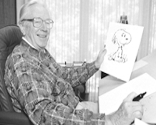
So Sparky decided to write his own auto biography(自传) in cartoons. He created his childhood self – a little-boy loser: Charlie. He never succeeded in kicking a football and never got a date with the little red-haired girl. Sparky, the boy who had such a lack of success in school and whose work was rejected again and again, was Charles Schulz. He created the Peanuts comic strip and the world-famous cartoon characters Charlie Brown and Snoopy.

1.From the first paragraph we can see that Sparky was in high school.

A. a loser B. a talented boy C. a good player D. a bad boy

2.Sparky never asked a girl for dating because he was afraid of .

A. making mistakes B. making friends

C. being refused D. talking to girls

3.What does the underlined word “He” in the last paragraph refer to?

A. His cartoon character Charlie B. Snoopy

C. Charles Schulz D. Walt Disney

4.His only success mentioned in this passage is .

A. his autobiography in cartoons

B. his artwork submitted to the Yearbook

C. his cartoons submitted to Walt Disney Studios

D. his golf match in high school


Children all around the world are familiar with fairy tales ,such as “The Little Mermaid”, “The Princess and the Pea” and “The Emperor’s new clothes”. The colourful characters from the stories made us laugh and throughout our childhood.

The stories are the of Danish writer Hans Christian Anderson. He was born into a poor family in Odense, Denmark, on April 2, 1805. His early life was not . His father was a shoemaker and his mother a washerwoman. He very little education. As a child he was very emotional(情绪化) and was at for being feminine(女性化) and tall.

In 1816 his father died and Anderson was forced to go out to work, first in a tailor’s shop and then at a tobacco factory. At the age of 14 Anderson moved to Copenhagen to start a as a singer and actor. He struggled for three years he had to leave the theater when his voice broke in 1822.

, Anderson went to a grammar school. Having done well, he was allowed to go to Copenhagen University in 1828. He began to publish his fairy tales in1835.They in small volumes(量)until his death.

Anderson lived a hard life, but he tried to make people laugh in all his stories. He wrote because he didn’t want children to have a sad childhood as he did. The works Anderson famous all over the world , but he was still a lonely man. He never married and his friends were the people who paid for his work. Anderson passed away on August 4, 1875 at the age of 70. His home in Odense is now a museum and thousands of people visit it every year.

1.A. tell B. speak C. smile D. cry

2.A. discoveries B. inventions C. creations D. feelings

3.A. hard B. easy C. excited D. bad

4.A. bought B. found C. received D. lost

5.A. spoken B. talked C. smiled D. laughed

6.A. career B. hobbyC. performance D. trip

7.A. since B. after C. until D. still

8.A. Even so B. AfterwardsC. Since then D. Otherwise

9.A. turned out B. sold out C. came out D. went out

10.A. found B. brought C. made D. let


违法和不良信息举报电话:027-86699610 举报邮箱:58377363@163.com

精英家教网