题目内容
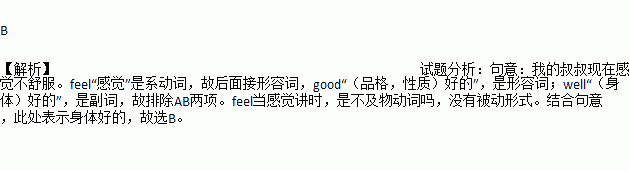
My uncle isn’t _____ at the moment.
A. feel well B. feeling well.
C. feeling good D. felt good.
I want to learn _______ Chinese history.
A. about B. a lot C. to D. from
It’s _______ that we will never forget.
A. such a nice city B. a such nice city
C. a so nice city D. so a nice city
三、翻译句子
1.我的朋友上周日发烧了.
My friend ______________________last Sunday.
2.你能捎我一程吗?
Could you give me ______________
3.我们不应该太依赖父母.
We shouldn’t _______________ our parents too much.
4.直到雨停了,我们才回家.
We _______ go home ________ the rain stopped.
5.王子和那个穷女孩结婚了.
The prince _________________the poor girl
6.你为什么不和你的家人和睦相处呢?
__________________________________________
7.当暴风雨来的时候我正走回家.
______________________________________
8.请你给他打个电话好吗?
_____________________________________
9.玩电脑游戏是浪费时间.
_______________________________________
10.从前有个老人尽力去移山.
___________________________________________________
The disabled man has trouble _______common things like carrying things.
A. do B. to do C. does D. doing
Susan used my ruler without . I was not happy about that.
A. ask B. asking C. asks D. asked
Reporter:Excuse me. I’m doing a survey. Can I ask you some questions?
You:Sure.
Reporter: How old are you?
You:1..
Reporter:2.?
You:Yes, I like my school.
Reporter:Uh-huh. How do you go to your school?
You: 3..
Reporter:Well,4.?
You:I want to be a doctor .
Reporter: Great. I hope you can do that.
You:5..
— Excuse me, whose French book is this?
—It be Tom’s. In our class, only he is studying French.
A. must B. can’t C. May
Manners(礼貌)are important to happy relations (关系)among people. No one____a person with bad manners. A____with good manners never laughs at people when they are in trouble. Instead, he____to help them. When he asks for something, he says “___ ”And when he receives something, he___says “Thank you”. He does not interrupt(打扰)___people when they are talking. He does not talk loudly or laugh loudly__public. When he sneezes or spits(吐痰), he uses a___. If you are late, you___make an apology (道歉)to the teacher either at the time____after class.
1.A. thinks B. likes C. hates D. loves
2.A. boy B. manner C. person D. give
3.A. tries B. wants C. has D. enjoys
4.A. Give me B. Please C. Yes D. Hello
5.A. never B. sometime C. usually D. still
6.A. every B. some C. his D. other
7.A. on B. at C. of D. in
8.A. book B. cup C. handkerchief D. hand
9.A. should B. will C. could D. may
10.A. or B. nor C. and D. but