题目内容

Many years ago, I was a shy boy and lived a very peaceful life. I liked school but I felt bored.

And then I started the fourth grade. My teacher, Mrs. Chen, was a young woman who was good at writing, art and music. Her class was very interesting. With her help, I started Fun Club with some boys in my class. I also wrote a book called Through the Forest. And lots of my classmates liked it.

However, I was surprised when fifty years later I got a letter about a reunion (聚会). A few days later, we had a reunion at Mrs. Chen's home. Reconnecting with Mrs. Chen was a journey back in time. Fifty years have passed, but my teacher still remembers every student. She even doesn't forget the class bully (欺负) — a boy used to hit me with snowballs on my way to school. Lots of teachers thought bullying was nothing serious at that time, but Mrs. Chen didn't agree. She put a stop to it at once when she found out about it.

Now, in my mid-fifties, I appreciate the gifts Mrs. Chen has given me even more. It's never too late to say thanks to this fantastic teacher. I hope you are lucky enough to have one teacher like Mrs. Chen.

1.Before the writer started the fourth grade, he thought his school life was _______.

A. unusual B. busy

C. boring D. tiring

2.How did the writer know there would be a reunion at Mrs. Chen's home?

A. He got a letter.

B. He got a phone call.

C. He saw a notice on the Internet.

D. He met his classmate on the street.

3.What does the underlined word “appreciate” in the last paragraph mean in Chinese?

A. 祝贺 B. 原谅

C. 感激 D. 同情

4.Which of the following is TRUE according to the passage?

A. The writer started Fun Club with some girls in his class.

B. Mrs. Chen stopped the writer from bullying others.

C. The writer often visits his teacher.

D. Mrs. Chen has a good memory.

5.Why does the writer write this passage?

A. To show his love for a teacher.

B. To describe what a teacher's job is.

C. To describe his primary school life.

D. To show his great changes in the past years.

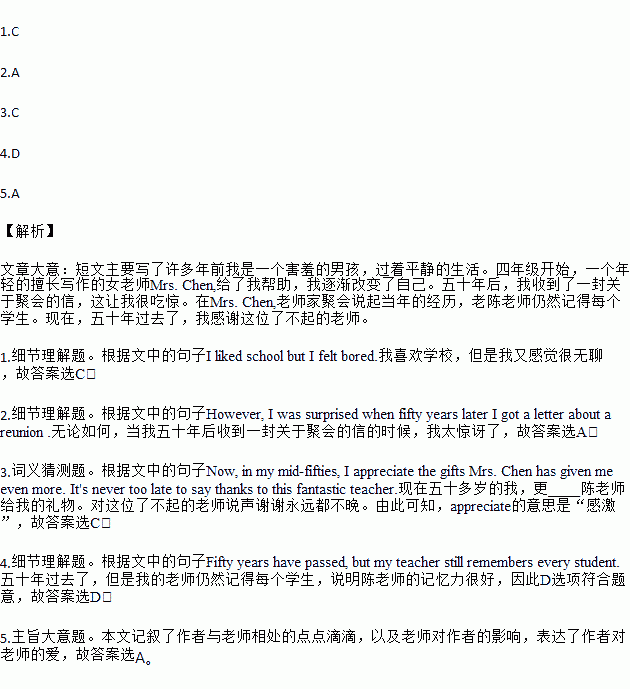
1.C 2.A 3.C 4.D 5.A 【解析】 文章大意:短文主要写了许多年前我是一个害羞的男孩,过着平静的生活。四年级开始,一个年轻的擅长写作的女老师Mrs. Chen,给了我帮助,我逐渐改变了自己。五十年后,我收到了一封关于聚会的信,这让我很吃惊。在Mrs. Chen,老师家聚会说起当年的经历,老陈老师仍然记得每个学生。现在,五十年过去了,我感谢这位了不起...
练习册系列答案
相关题目

阅读下列短文,从各题所给的A、B、C、D四个选项中,选出可以填入空白处的最佳选项。

Lucky, our beautiful dog, isn’t with us any more. But she brought such joy and love into our lives____we still miss her. There are so many wonderful stories about the love in this dog, but my favorite is this one:

It was an autumn day in Minnesota. Unexpectedly, a big snowstorm which no one was prepared for____our city.

We have two apple trees in our backyard. Lucky loved apples. When she went outside, she’d hold an apple in her____and take it into the house to save for eating later. The apples had been on the ground and were often dirty so I wasn’t always____that Lucky had brought them into the house.

On the day that it snowed too early in the season, Lucky went outside and I____her from the window. I noticed that she was____digging to bring the apples to the surface so they could be seen____the snow. I wondered why she was doing this. She seemed to be completely busy with some kind of important task to find as many____as possible during her yard time.

____, she had one apple in her mouth when I called her back into the house. About five minutes later I looked outside. The yard was completely covered with birds. Lucky had____all those apples for her bird and squirrel friends to eat. She knew that they wouldn’t have stored enough food to survive such an early winter!

1.A. why B. if C. when D. that

2.A. hit B. attacked C. beat D. caught

3.A. nose B. stomach C. mouth D. ear

4.A. happy B. angry C. worried D. excited

5.A. heard B. helped C. watched D. followed

6.A. gently B. madly C. easily D. sadly

7.A. under B. across C. beyond D. above

8.A. apples B. trees C. birds D. squirrels

9.A. As a result B. As usual C. In fact D. In a word

10.A. eaten up B. put up C. dug up D. cleaned up

1.D 2.A 3.C 4.A 5.C 6.B 7.D 8.A 9.B 10.C 【解析】 试题本文作者回忆一条宠物狗,讲述了狗狗的可爱、聪明、友好的故事。 1. 2. 3. 4. 5. 6. 7. 8. 9. 10.

In the 1950s, a female swimming athlete set a goal for herself. She decided to swim across the English Channel before she retired. If she could make it, she would be the first person in the world who did it.

On that day, she jumped into the sea without any hesitation and swam towards the opposite bank.

In the journey, she faced heavy fog, heavy rain and heavy waves. Though she was very tired, she carried on swimming.

But in the end, she gave up. And what she didn't know at the moment she gave up was that the opposite bank was only I mile away.

Later people asked her about the reason. And she said:"The reason why I gave up is that I could not see the destination which I was so close to."

Too many success stories have been lecturing us about courage and persistence(坚持). But they never told us where to find courage and persistence.

You can have courage only when you know where your goal is. You can manage to persist only when you know where your goal is, and prepare yourself well mentally(心理上).

Courage and persistence never fall from the sky. They come from weighing between input and output.

A life without goals is like a ship without a compass. It goes nowhere. There is no courage or persistence in a life without goals.

1.In paragraph 1, the underlined word "it" refers to _______.

A. being retired

B. swimming across the English Channel

C. swimming towards the bank

D. setting a goal

2.________ is not mentioned in the passage.

A. Fog

B. Waves

C. Rain

D. Wind

3.The underlined word "weighing" in paragraph 8 probably mean _______.

A. 权衡

B. 有……重

C. 称重量

D. 有分量

4.Why did the athlete give up? Because ________.

A. the bank was one mile away

B. she was too tired

C. she didn’t have courage at first

D. she thought her destination was far away

5.What can be inferred (推论) from the last sentence of the passage?

A. If you have courage and persistence, you have goals.

B. Even if you have no goals, you have courage to persist.

C. There is no courage or persistence unless you know your goals.

D. Between input and output, you must find courage and persistence.

1.B 2.D 3.A 4.D 5.C 【解析】本文讲了一位女性运动员游泳挑战穿越英吉利海峡的故事,因为她不知道自己离目的地还有多远,所以在离岸边很近的地方放弃了挑战,告诉了我们没有目标的生活就像没有指南针的船。没有目标的生活就会少了勇气或坚持。 1.句意:在第1段中,带下划线的“它”一词是指游过英吉利海峡。A.退休B.游过英吉利海峡C.游向岸边D.设定目标。原...

The best way of learning a language is by using it. The best way of learning English is using English as much as possible. Sometimes you will get your words mixed up(迷惑的)and people won't understand. Sometimes people will say things too quickly and you can't understand them.

But if you keep your sense of humor( 幽默感),you can always have a good laugh at the mistakes you make.

Don't be unhappy if the people seem to(好象) laugh at your mistakes. It's much better for people to laugh at your mistake than to be angry because they don't know what you are saying. The most important rule for learning English is "Don't be afraid of making mistakes. Everyone makes mistakes."

1.The most important thing of learning a language is ________.

A. laughing B. writing C. remembering D. practising

2.In learning English, you should ________.

A. speak as quickly as possible. B. laugh as much as you can.

C. use it as often as you can. D. write more than you read.

3.When you make a mistake, you'd better ________.

A. do the same thing again. B. ask others for help.

C. have a sense of humor. D. run away.

4.When people laugh at your mistake ,you should _______.

A. not to be serious B. be angry with them.

C. be more careful D. not speak English any more.

5.Which of the following is true?

A. Everyone is afraid of making mistakes when he writes in English.

B. Everyone makes mistakes when he speaks a foreign language.

C. Nobody makes any mistakes in learning a foreign language.

D. Clever people never make mistakes when they speak English.

1.D 2.C 3.C 4.A 5.B 【解析】 本文讲到学习英语的最佳方式是使用它并鼓励学习英语的人去大胆使用英语,不要害怕犯错误。 1.句意:学习语言最重要的是练习。A.笑B.写C.记住D.练习。原文“The best way of learning a language is by using it.”(学习语言的最佳方式是使用它。)说明学习语言最重...

违法和不良信息举报电话:027-86699610 举报邮箱:58377363@163.com

精英家教网