题目内容
【题目】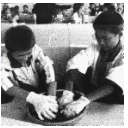
School students are not allowed to drink wine(酒), but there’s nothing wrong with
making it. Urumqi No. 37 Middle School students in Xinjiang have been doing it since
2005.
Grapes are grown everywhere in Xinjiang. It’s the reason the school decided to teach students how to make red wine a few years ago, according to Zhu Dacheng, vice-head of the school.
“We hope the students can find out about something in real life and learn practical(实用的) skills,” he said.
The students got to work in September, when the grapes in Xinjiang were good enough. They were divided into groups. They needed about 5kg of grapes each, some yeast (酵母), a large bowl and a big bottle.
Yang Lili, 13, told Teens how the four students in her group made their wine.
“We worked like a production line,” she said. One student washed the grapes, another pulled them from their stems(茎,梗); the others pressed the grapes in a large bowl. Then they put the grapes and the yeast into a big bottle and closed it up. The task takes about an hour.
Then what? A lot of waiting! After 45 days, the students cleaned the wine twice and then put it into small
bottles. At last, the wine was ready.
Yang said that of the 11 groups in her class, just three failed to make wine. In March, the whole class held a wine-tasting party.
Xu Hao, 13, said they were excited to taste the results. “The wine is so sweet,” he said. “We made better wine than you can buy in the supermarket!”
“It’s because our wine is made from 100% grapes,” he added.
At the party, the teacher also taught the students about wine culture. For example, how to hold a glass, and
how you can judge the quality of a wine by its color.
【1】Why did the school decide to teach the students how to make red wine?
A. Because drinking wine is not allowed in school.
B. Because the school has grown lots of grapes.
C. Because grapes are grown everywhere in Xinjiang.
D. Because the school has been doing it for many years.
【2】What is the purpose of the school in teaching the students to make red wine?
A. To make good red wine for students themselves.
B. To get close to real life by learning to grow grapes.
C. To let the students understand real life and learn some useful skills.
D. To help the students do better in their study.
【3】How does the group “production line” work according to the passage?
A. Weigh the grapes→get the bowl ready→pull the grapes→press the grapes→put the yeast in.
B. Divided into groups→get the bowl→wash the grapes→press the grapes→close the bottle up.
C. Wash the grapes→pull the grapes→press the grapes→put the yeast in→close the bottle up.
D. Get grapes ready→get bowls ready→put the yeast in→press the grapes→close the bottle up.
【4】Why were the students excited to taste their wine?
A. Because they learned about the wine culture.
B. Because they succeeded at last after waiting for 45 days.
C. Because they could sell the wine to the supermarket.
D. Because the wine in the supermarket wasn’t as sweet as the wine they made.
【5】Which of the following is NOT true according to the passage?
A. The students in the school began to make wine in autumn.
B. The students have to wait for one month and a half before the wine is ready.
C. Eight groups in Yang’s class were successful in making the wine.
D. The teacher taught the students how to drink wine before the wine-tasting party.
【答案】
【1】D
【2】C
【3】C
【4】B
【5】D
【解析】短文大意:在校生是不允许喝酒的,但做酒没有错。新疆乌鲁木齐37中学的学生一直在做这件事。目的是希望学生能了解现实生活,学习实用技能。
【1】根据第二段可知,“新疆到处种植葡萄” 是学校决定教学生如何制作红葡萄酒的原因。故选:C。
【2】根据第三段“We hope the students can find out about something in real life and learn practical(实用的) skills,” he said.可知,让学生学习制作葡萄酒的目的在于,希望学生能了解现实生活中的东西,学习实用技能。故选:C。
【3】根据第六段可知,他们的小组生产线是这样工作的:Wash the grapes→pull the grapes→press the grapes→put the yeast in→close the bottle up.。故选:C。
【4】根据倒数第三段第一句Xu Hao, 13, said they were excited to taste the results. 可知,学生尝到酒兴奋的原因是,因为他们在等了45天之后, 做的酒终于成功了。故选:B。
【5】根据短文大意可知,在品酒会之前,老师教学生如何做酒,而不是教学生饮酒,所以D项表述是错误的。故选:D。


【题目】
Are you interested in these Jobs? |
Would you like a job that lets you play games? Mitch Ellis works for a video game company. A lot of teenagers want his job because he plays video games four hours a day! He’s the one who tests the games to make sure they work. Mitch loves his job because it’s exciting! |
Would you like a job that lets you work with animals? Do you want one that lets you be outside a lot? Amy Carson walks three dogs, three times a day, five days a week! Dogs are playful and fun, so her job is never boring. |
Many people want work that lets them travel. Are you active and healthy? Are you someone who likes to hike and climb mountains? Join us! Paulo Costa is a climbing guide. He helps people climb mountains. He travels all over Brazil – and gets paid for it! |
Do you love books? Can you work on Sunday night? The library is looking for someone who can help sort (分类) books and put them back on the shelves. Before Thursday, send an e-mail to Janet Chen (Janet. chen@kidsheinle.com) if you are interested. |


【1】Who works as a dog walker?
A. Amy Carson. B. Mitch Ellis.
C. Paulo Costa . D. Janet Chen.
【2】If you are active and healthy, you’re wanted to be a ______.
A. video game tester B. dog walker
C. climbing guide D. book sorter
【3】The library needs someone to work ______.
A. on Thursday night
B. before Thursday
C. before Sunday
D. on Sunday night
