题目内容

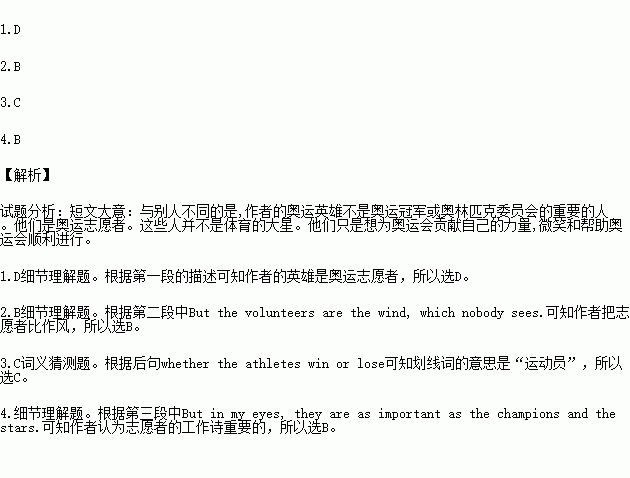
Unlike other people, my Olympic heroes are not Olympic champions or the important people on the Olympic Committee (委员会). They are just the ordinary ones who do the everyday things. They work without the recognition (公认) the famous people get. They are the Olympic volunteers.

These people aren't the great stars of sport. They just want to do their part for the Olympics by smiling and helping the Games go smoothly.The stars of the Games are like brightly colored sailboats on the sea, racing through the waves. How lovely to watch them! But the volunteers are the wind, which nobody sees. Without the wind the sailboats would not be able to move and no one would want to watch them. The volunteers breathe (发出) the wind of life into the athletes.

The volunteers may never win medals, but they always do their best to encourage the athletes, whether the athletes win or lose.Some might think what the volunteers do is boring, hardly worth mentioning (提及). But in my eyes, they are as important as the champions and the stars. They are just as much heroes, despite (尽管) not appearing in newspapers or on TV.

I truly admire them and I will always cheer for them. They are my Olympic heroes.

1.From the first paragraph we know that the writer’s heroes are .

A. Olympic champions

B. the important people on the Olympic Committee

C. the ordinary people who don’t do the everyday things

D. the Olympic volunteers

2.The writer compares the Olympic volunteers to.

A. brightly colored sailboats B. the wind

C. the sun D. the water

3.What does the underlined word “athletes” in Paragraph 3 mean in the passage?

A. 教练 B. 裁判

C. 运动员 D. 观众

4. What does the writer think of the volunteers’ work?

A. boring B. important

C. interesting D. excellent
练习册系列答案
相关题目

When the weather is hot, you go to a lake or an ocean. When you are near a lake or an ocean, you feel cool. Why? The sun makes the earth hot, but it can not make the water hot. Though the air over the earth becomes hot, the air over the water stays cool. The hot air over the earth goes up, then the cool air over the water moves in and takes the place of the hot air. When you are near a lake or an ocean, you feel the cool air when it moves in. You feel the wind and the wind makes you cool.

Of course, scientists cannot answer all of our questions. If we ask “Why is the ocean full of salt?” scientists will say that the salt comes from rocks. When a rock gets very hot or very cool, it cracks (崩裂) , and rain falls into the cracks. The rain then carries the salt into the earth and the rivers. The rivers carry the salt into the ocean. But then we ask “What happens to the salt in the ocean? The ocean does not get saltier every year. “ scientists are not sure about the answer to the question.

We know a lot about our world. But there are still many answers that we do not have, and we are curious(好奇的).

1.In the first paragraph, the underlined word “it” refers to .

A. The hot air over the water

B. The cool air over the earth

C. The hot air over the earth

D. The cool air over the water

2.Now scientists know .

A. What makes people feel cool near a lake or an ocean in summer.

B. Everything about the ocean.

C. What happens to the salt in the ocean.

D. Why the ocean does not get more saltier.

3.A rock crack when . .

A. rain falls B. it gets very hot

C. it gets very cold D. Both B and C

4.Which of the following is NOT mentioned in this passage?

A. The reason why people feel cool when they are near a lake or an ocean in hot weather.

B. The reason why the ocean doesn’t get saltier every year.

C. The reason why the water in the ocean is salty.

D. The reason why rocks crack.

5.The main idea of this passage is that .

A. people feel cool when they are near a lake or an ocean.

B. scientists can explain many things, but not everything.

C. scientists can explain everything about the ocean.

D. the salt in the ocean comes from rocks.

You may know about “junk food” like French fries. But do you know about “junk sleep”? Recently, a British survey found that electronic products(电子产品) in teenagers' bedrooms are affecting(影响)their sleep.

The survey was done among 1,0 00 British kids from 12 to 16. It found that 30 percent of them got just 4 to 7 hours of sleep every day. But doctors say they need 8 to 9 hours. Almost a quarter of the kids said they fell asleep more than once a week while watching TV, listening to music or using other electronic products.

“This is very worrying.” said Dr Chris , a British expert, “We call it ‘junk sleep’, It means you don't get enough sleep and the quality of the sleep is bad, too. If you don't get good rest, you don't perform well in school the next day.”

The survey found that 40 percent of the kids felt tired each day, with girls between 13 and 16 feeling the worst. Nearly all the teenagers have a phone, Mp5 or TV in their bedroom. And many of them have all three.

1.This passage is mainly about ________.

A.junk food B.junk sleep

C.electronic products D.the importance of sleep

2.________ of the children in the survey sleep only 4 to 7 hours a day.

A.200 B.300 C .500 D.1,000

3.“Junk food” and “junk sleep”are similar to each other in the way that ________.

A.they are both low in quality

B.they are both produced in factories

C.people enjoy both in their spare time

D.they are both good to people's health

4.Which of the following is TRUE according to the passage?

A.Teenagers need 4 to 7 hours of sleep each day.

B.Few of the teenagers have a phone in their bedrooms .

C.Teenagers spend too much time on electronic products.

D.Girls between 15 and 16 spend the least time on electronic products.

5.Which of the following is the best solution to the problem?

A.Parents watch TV together with their children.

B.Forbid teenagers to use any electronic product.

C.Teenagers should be limited (限制) to their use of the electronic products.

D.The use of mobile phone and Mp5 is not allowed at school.

违法和不良信息举报电话:027-86699610 举报邮箱:58377363@163.com

精英家教网