题目内容

(共10小题,每小题1分,满分10分)

阅读下面材料,在空白处填入适当的内容(1个单词)或括号内单词的正确形式。

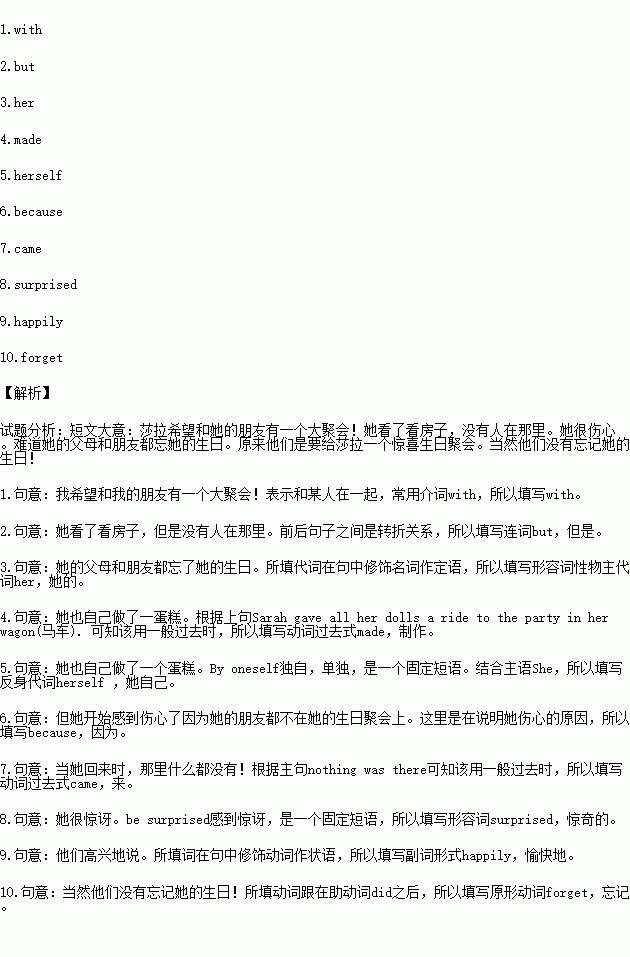
“Today is my birthday”, Sarah said. “I hope there will be a big party 1. all my friends!” She looked around the house, 2. nobody was there. She was sad that her parents and friends forgot 3. (she) birthday.

She decided to have a party on her own. “I’ll invite my dolls and my favorite Teddy Bear to my party.” Sarah gave all her dolls a ride to the party in her wagon(马车). She also 4. (make) a cake by 5. (she).

“Now I need a special gift for my birthday! It will be the most beautiful gift I have had!” Sarah said proudly, but she began to feel sad again 6. her friends were not at her party. Then she ran upstairs to prepare the gift. When she 7. (come) back, nothing was there! “Where is my cake? Where are my dolls?” She was 8. (surprise). Just then, her parents and friends came out. “Surprise, Sarah! Here is your birthday party,” they said 9. (happy). Of course they didn’t 10. (forget) her birthday!
练习册系列答案
相关题目

Spending two or three hours playing outdoors each day can reduce the chance of becoming short-sighted, a research shows. It challenges the belief(信念) that short-sightedness is caused by computer use, watching TV or reading in weak light.

The Australian government researchers believe that the sunlight is good for people’s eyes. They compared the vision(视力) and habits of 100 seven-year-old children in Singapore and Australia. In all, 30% of the Singaporean children were short-sighted—this rate(比率) was ten times higher than Australian children.

Both groups spend a similar amount(数量) of time reading, watching television and playing computer games. However the Singaporean children spent an average (平均) of only half an hour a day outdoors—90 minutes less than the Australian children.

Professor Ian Morgan, from the Australian Research Council’s vision Centre, said, “Humans are naturally long-sighted, but when people begin to go to school and spend little or no time outdoors, the number of short-sighted people gets larger. We’re also seeing more and more short-sighted children in cities all around the world and the main reason may be that city children spend less time outdoors.

Daylight can be hundreds of times brighter than indoor light. But why does playing outside prevent us from becoming short-sighted? Scientists believe that natural light has a special chemical(化学物质) which stops the eyeball from growing out of shape and prevents people from becoming short-sighted.

So be outdoors. It doesn’t matter if that time is spent having a picnic or having sports.

1. How much time did the Australian children spend outdoors on average accordingto the

research?

A. 30 minutes. B. 60 minutes.

C. 90 minutes. D. 120 minutes.

2.Which of the following is TRUE according to the passage?

A. If people spend less time outdoors they will certainly become short-sighted.

B. There are fewer short-sighted Singaporean Children than Australian children because they have more know ledge of protecting their eyesight.

C. There will be fewer risks of getting short-sighted if people spend two or three hours a day playing out side.

D. When people begin to go to school they will become long-sighted.

3.What is the fifth paragraph mainly about?

A. Why natural daylight has a special chemical.

B. Why daylight prevents people from becoming short-sighted.

C. Why daylight is much brighter than indoor light.

D. What the special chemical which can stop eyeballs from growing out of shape is.

违法和不良信息举报电话:027-86699610 举报邮箱:58377363@163.com

精英家教网